
Table of Contents
Customer experience is undergoing the most significant transformation since the introduction of digital self-service. For decades, organizations relied on a mix of contact center technology, conversational AI tools, and CRM systems to manage service interactions. But these systems weren’t built for agentic AI that can perceive, reason, and act autonomously on behalf of customers.
That’s changing with the introduction of the agentic customer experience platform (CXP), a new foundation for enterprises that want to deliver intelligent, personalized experiences throughout end-to-end customer journeys at scale. As AI agents become capable of handling complex tasks, guiding workflows, and personalizing interactions in real time, the CXP is emerging as the system of record, system of action, and system of intelligence for the modern customer experience.
What is a customer experience platform (CXP)?
Over the years, the term customer experience platform has been used to describe a wide range of platforms that enable customer service. In the agentic AI era, the term is more specific. Today, a customer experience platform (CXP) is a unified, AI-native system that orchestrates all customer interactions across voice, digital, self-service, and human-assisted channels while connecting deeply with back-end systems, data sources, and business processes.
Unlike traditional solutions that focus on communication or automation in isolation, a CXP provides:
- A single orchestration layer for all customer journeys
- A shared AI reasoning engine that understands context and intent
- A real-time knowledge model that unifies data across systems
- Native support for agentic AI agents that can complete tasks end-to-end
- Integrated tools for workflows, routing, and analytics
In essence, a customer experience platform is not just a system that supports interactions. It’s the intelligent operating system that powers the entire customer service lifecycle.
A true CXP provides consistency across channels, continuity across journeys, and intelligence across every decision point. It becomes the backbone that allows enterprises to scale high-quality customer experiences without ballooning costs, increasing headcount, or ratcheting up the complexity of the tech stack.
How CXPs differ from CCaaS and conversational AI solutions
Many CX leaders wonder whether a CXP is simply the next iteration of Contact Center as a Service (CCaaS) or a more advanced version of conversational AI solutions. While there is overlap, the differences are foundational.
CXP vs. CCaaS
CCaaS platforms were built to modernize communication infrastructure—voice, messaging, routing, and call handling. They excel at telephony, channel management, and agent desktops. However:
- CCaaS platforms are channel-first, not intelligence-first.
- They are not designed to support agentic AI completing tasks and workflows end-to-end.
- They manage interactions, not outcomes.
In contrast, a customer experience platform is AI-native and outcome-centric. It orchestrates not just communications, but the reasoning, workflows, and business logic that drive resolution.
CXP vs. conversational AI solutions
Conversational AI solutions automate routine customer interactions with a familiar conversational experience. They may rely on generative AI to improve the conversational flow, but they don’t take advantage of the full capabilities of generative and agentic AI. They also were not designed to support human-AI collaboration.
Conversational AI solutions often use deterministic flows and intent-based automation, and they do not retain context across conversations. Their focus is primarily on customer engagement.
These systems are effective for narrow automation but limited in scope:
- They cannot reason about multi-step, multi-intent tasks.
- They require heavy manual intent engineering.
- They operate separately from the agent desktop and back-end systems.
- They are not designed to support autonomous AI agents.
In contrast, a CXP:
- Provides a shared context model across all interactions
- Integrates deeply with enterprise systems
- Allows AI agents to act, not just respond
- Orchestrates humans, bots, and workflow engines seamlessly
In other words, conversational AI delivers automated moments. A customer experience platform delivers automated journeys. Long term, that continuity builds trust and customer loyalty.
How agentic AI is redefining CX platforms
Agentic AI can autonomously understand goals, plan actions, execute tasks, and adapt to changing conditions, so it has fundamentally changed what a CXP is capable of doing. In turn, that changes the expectations of CX leaders for customer experience platform capabilities.
The old model of customer experience assumed:
- Human agents were the primary problem-solvers
- Automation was narrow and rules-based
- Bots could only converse and assist, not act
- Most resolutions required intervention by human agents
- Customer journeys that spanned multiple channels were fragmented
But agentic AI raises the baseline expectations. AI agents can now:
- Interpret complex customer goals
- Retrieve and synthesize customer information and other data across systems
- Initiate and complete operational workflows
- Personalize responses using the customer’s full history
- Escalate with full context to the right human agent
- Learn from thousands of interactions to improve autonomously
- Identify trends across interactions to make data-driven decisions
To support this new reality, a customer experience platform must be built with agentic AI at its core, rather than bolted on as an afterthought.
Requirements for a modern CXP
- An AI-native architecture: The platform must be built from a foundation of AI to integrate reasoning, memory, and planning, not just natural language processing (NLP).
- A unified knowledge and data layer: AI agents must draw on consistent, real-time context to make informed decisions at every step
- Deep system integrations: A CXP should connect to CRMs, ERPs, billing systems, support tools, and internal applications so AI agents can take action.
- Journey-centric orchestration: The platform must manage multi-step tasks, not just conversational flows.
- Trust and governance controls: Enterprise-grade safety, security, audits, redaction, and compliance are essential when AI agents act autonomously.
- Seamless collaboration between AI and human agents: AI agents should operate autonomously to resolve customer issues, but should also be capable of actively collaborating with human agents in real time.
- Real-time analytics and optimization: A CXP must learn continually from outcomes, turning interaction data into actionable insights, rather than relying on manual tuning.
With agentic AI at its core, a CXP is much more than a communications hub to manage customer interactions. It’s the mission control center for the entire customer experience ecosystem.
What to look for in a customer experience platform
With the rapid rise of AI-native customer experience platforms, it’s essential to distinguish robust CXPs from legacy systems rebranded to appear ready for the agentic AI era.
Here are the critical attributes to look for:
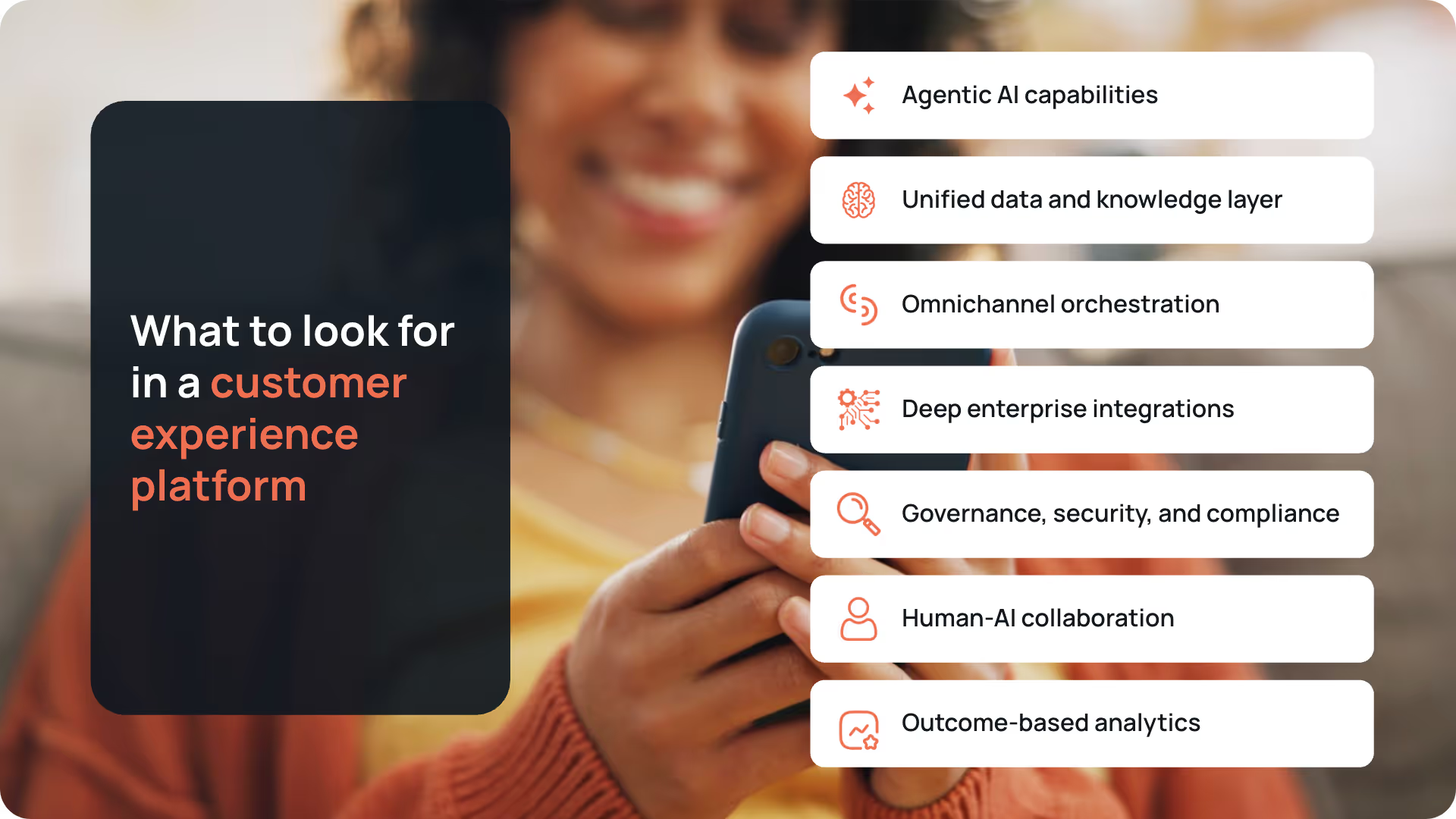
1. Agentic AI capabilities
A true CXP should support AI agents that can:
- Autonomously complete tasks end-to-end
- Reason over context and data
- Initiate workflows in back-end systems
- Learn continuously and improve over time
If the platform only supports scripted bots or FAQ-style automation, it is not a CXP.
2. Unified data and knowledge layer
The CXP must provide:
- A consolidated real-time customer profile that updates with each interaction
- A knowledge model that unifies documents, policies, and historical interactions
- Context awareness that spans every channel and every step of the journey
Without unified knowledge, AI agents cannot act reliably.
3. Experience orchestration
A CXP should orchestrate:
- Voice
- Chat
- Messaging
- IVR
- In-app experiences
- Human-assisted and AI-assisted interactions
The experience—not the channel—should be its organizing principle.
4. Deep enterprise integrations
Look for native, secure integrations with:
- CRM
- Billing systems
- Order management
- Ticketing tools
- Policy databases
- Custom internal applications
AI agents cannot deliver outcomes unless they can take action in relevant systems inside your business.
5. Governance, security, and compliance
A modern CXP must include:
- AI safety controls
- Real-time redaction
- Audit trails
- PII handling
- Access controls
- Model governance
Safety and security mechanisms are non-negotiable when automating high-value, high-risk customer interactions.
6. Human-AI collaboration
The platform should enable:
- Real-time human-in-the-loop consultations to bring human judgment into AI-driven conversations
- Full context and conversation history when handoff to a human is necessary
- Real-time guidance, recommendations, and copilots for human agents
- A unified agent desktop
The best CXPs empower both AI autonomy and human excellence.
7. Outcome-based analytics
Finally, a CXP should deliver analytics focused on:
- Resolution rates
- Containment rates
- Journey outcomes
- Agentic AI performance
- Workflow completion
- Feature adoption
- Cost-to-serve
- Customer satisfaction
A modern customer experience platform should measure what actually matters—outcomes, not call volumes or bot deflection.
Why the customer experience platform is becoming the new CX standard
As agentic AI becomes foundational to enterprise operations, organizations can no longer rely on a fragmented tech stack built around communication channels and siloed automation. The CXP has emerged as the model for the future because it:
- Unifies interactions
- Standardizes reasoning across touchpoints
- Coordinates AI-human collaboration
- Connects every system in the CX ecosystem
- Drives consistency, personalization, and efficiency
- Scales AI safely and responsibly
In a world where customer expectations are rising and complexity is multiplying, the customer experience platform is the only architecture capable of delivering on the full promise of agentic AI.
Final thoughts
The era of disparate contact center tools, disconnected chatbots, and manual agent workflows is ending. Enterprises now need a customer experience platform that can orchestrate intelligent journeys, power autonomous AI agents, and deliver seamless, personalized service across every touchpoint.
As you evaluate platforms, look for a CXP that is AI-native, outcome-oriented, deeply integrated, and built to scale agentic AI safely and effectively. This new category of CX platform is not just an upgrade. It’s the foundation of the next generation of customer experience.