Table of Contents



What most AI strategies miss—the human factor
Preparing for the workforce transformation AI agents will bring
AI is transforming customer service—but not always for the better. Gartner recently predicted that over 40% of AI agent initiatives will be scrapped by 2027, leaving contact centers frustrated and customers dissatisfied. Gartner cites that the primary causes include poor integration with existing workflows, lack of human oversight, and insufficient alignment with business goals.
Even when AI can handle complex tasks, human involvement remains critical for certain interactions. Yet many contact centers still deploy AI in isolation, creating bottlenecks and diluting the transformative potential of generative AI in customer service.
Enter the HILA™ workflow—a proven approach that blends AI efficiency with real-time human expertise, ensuring speed to resolution, accuracy, and exceptional customer experiences.
In the next section, we’ll explore why traditional human-in-the-loop approaches fall short and how the HILA approach is fundamentally different, backed by analyst validation and real-world results.
The Challenge: Why Current AI Approaches Fall Short
While generative AI agents can now automate even complex interactions, contact centers still struggle when AI agents operate in AI-only systems that were not designed for true human/AI collaboration. Common pitfalls include:
- Limitations of the status quo: Nearly every “expert” source describes effective human-in-the-loop as a seamless transfer of conversation and context from AI to human. Vendors support this approach as the only option.
- Loss of automation efficiencies: AI-only systems automatically escalate to a human agent, putting customers back in the queue to wait for an available agent. This results in disjointed and frustrating experiences that still incur the cost of a live agent for a majority of the interaction.
- Workflow misalignment: AI tools not integrated with human processes cause additional inefficiencies, as AI transfers to live agents across systems, losing context and any ability for the AI to learn from human inputs.
- Inconsistent experiences: Customers receive variable outcomes when human judgment isn’t applied, or applied within a high-friction experience.
- Data & integration problems: Integrating generative AI with legacy customer service platforms is often difficult, resulting in data silos and inconsistent experiences for both customers and agents.
Nearly 95% of generative AI pilot programs fail to produce measurable business outcomes, largely due to poor integration with existing workflows
— MIT, The GenAI Divide: State of AI in Business 2025
This gap isn’t just a technology problem—it’s an operational one. Without the ability to blend human expertise with AI, in the right circumstances and to the right extent, many initiatives stall or fail entirely.
The HILA™ workflow: A proven approach
ASAPP's HILA approach addresses these challenges by embedding humans directly into AI workflows to unblock the AI. Let that sink in—humans supporting AI, not the other way around, with a UI/UX designed specifically for this human/AI collaboration. Instead of taking a transferred interaction from the AI agent whenever it hits a roadblock, a human expert supports the AI agent in real time, behind the scenes, through the HILA workflow. In other words, the AI agent handles complex interactions on its own, calling on a human expert only when needed, for an exception, an approval, or an action in a system the AI can't access. Once the human responds, the AI continues to resolve the interaction. The AI, in this case GenerativeAgent, is smart enough to know when and how to involve the human expert but keeps ownership of the interaction.
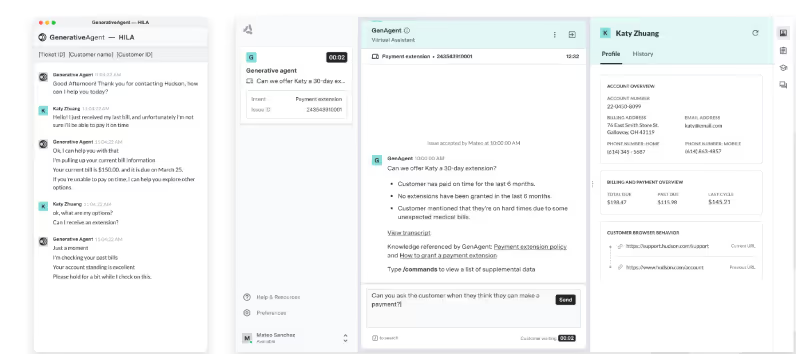
Key benefits of the HILA model
- Faster resolution: Combining AI efficiency with human assistance behind the scenes accelerates problem-solving.
- Scalable personalization: Agents supported by AI can deliver faster, more consistent, personalized experiences.
- Concurrency - since human agents are handling questions, approvals, and an occasional task, they can handle 2-3, or more, interactions at the same time easily.
- Frictionless experiences - customers no longer have to endure awkward forced transfers, repetitive conversations without context, or extra wait time for a human agent. Just fast resolution from a high-quality experience.
Analyst Validation: Why Industry Experts Endorse Human-AI Collaboration
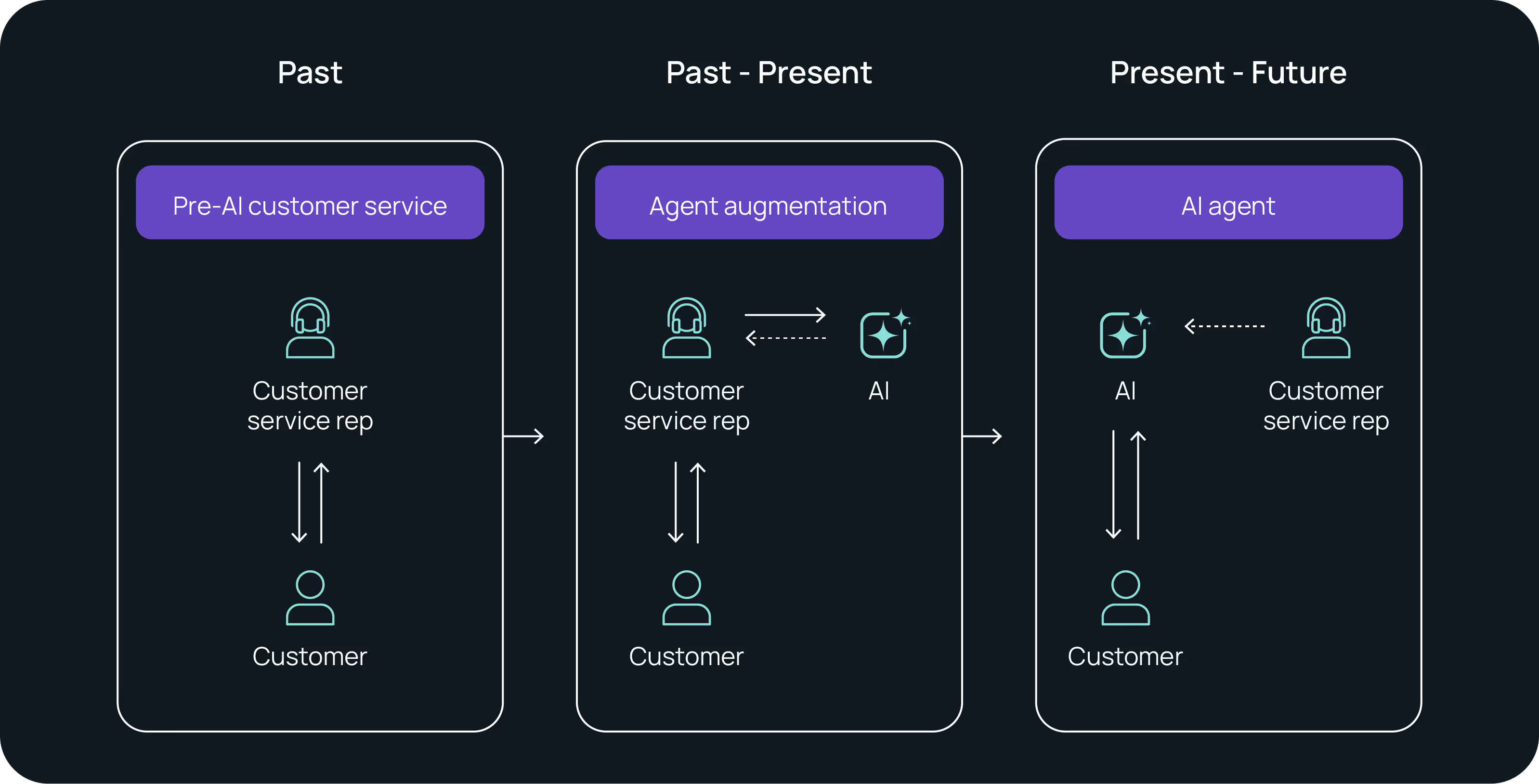
Analysts agree: the future of AI agents will impact the customer service workforce. But the real value is not in an AI-only approach, but AI-led, where AI and humans work seamlessly together. Recent reports underscore the critical role of human-AI collaboration:
First, brands must transition to allowing AI to lead customer interactions end-to-end. When an exception arises, the AI must consult with human subject matter experts (SMEs) in the background who will “unblock” the AI in real time.
This is a completely new interaction paradigm and will require a new workspace optimized for enabling (and capturing) human judgment calls, not handling conversations.
— Tacit Knowledge Will Power the AI-Led Contact Center, Forrester January, 2025
Evidence in Action: Real Results with the HILA workflow
The HILA model isn’t just theory—it’s delivering real-world impact today. Here’s what contact centers see when they adopt this approach.
Customer Success Snapshots:
- A travel & hospitality customer piloted the HILA workflow across 5,000 monthly interactions and saw their average agent handle time (AHT) reduced by 60% in week one alone and a 50% reduction in potential CS compliance issues over the first 60 days.
- A worldwide leader in online protection uses the HILA workflow in its customer installation use case to help address issues - like unique error codes - that require human expertise. Instead of having a customer wait in the queue for a live agent, GenerativeAgent asks a human expert through the HILA workflow for approval to send the customer a unique link to their email to resolve the issue. The human expert confirms, sends the email, and GenerativeAgent continues to resolve the issue with the customer.
Another added benefit is concurrency—real concurrency—as human experts can easily manage two or three (or, in some cases, four or five) interactions with the HILA workflow at the same time, depending on the experience of the human agent and the workflows involved.
The HILA model doesn’t just help contact centers move faster; it helps train AI to reduce risk and makes the human agent’s work more rewarding.
Actionable Takeaways for Contact Center Leaders
If you’re evaluating AI for your contact center, keep these principles in mind:
- Don’t rely on automation alone. AI is powerful, but human expertise and oversight ensure speed, accuracy, and customer trust.
- Measure beyond cost savings. Look at resolution speed, containment without repeat/FCR, and CSAT.
- Choose solutions with intentional design for human/AI collaboration. Platforms that enable human-AI workflows where a human expert can unblock AI outperform AI-only tools.
- Think of human/AI collaboration not only within the customer experience, but also across contact center operations - how to manage and optimize AI-led workflows.
Conclusion: The Future of AI in Contact Centers is Human + AI
AI is here to stay—but the organizations winning with AI aren’t the ones removing humans from the equation. They’re the ones integrating AI with human expertise in real time, reducing risk and accelerating performance.
Companies will transition interaction volumes to AI gradually; as the AI model learns, it will be supported by behind-the-scenes human ‘unblockers.’
— Forrester, “AI Agents Will Transform The Customer Service Workforce,” June, 2025
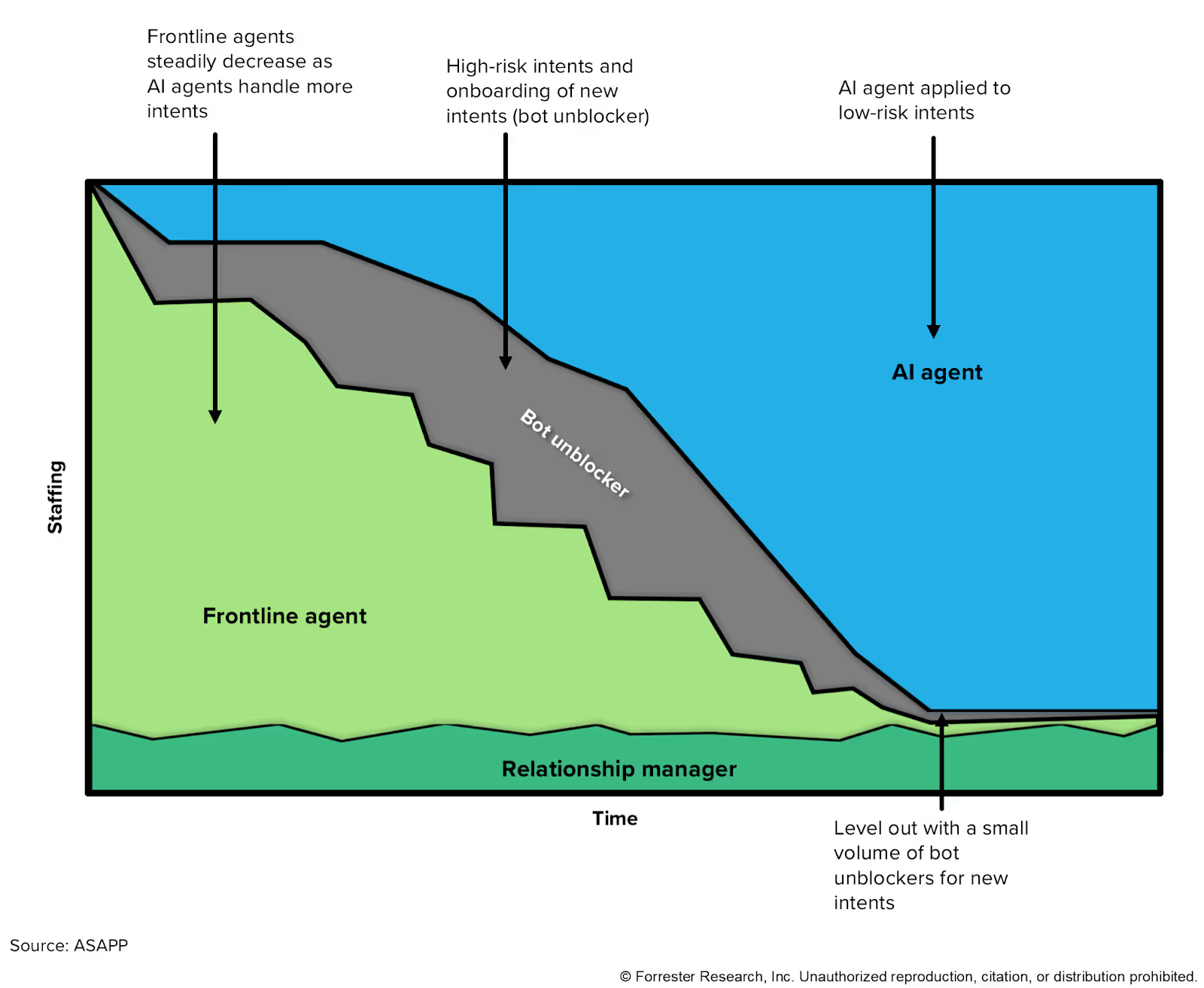
ASAPP is proud to have contributed to this research. Our approach to generative AI is grounded in real-world enterprise contact center performance. ASAPP’s GenerativeAgent is designed for agent-AI collaboration from the ground up—featuring the HILA workflow that keep seasoned agents engaged in unblocking AI, handling complex exceptions, and optimizing outcomes. We believe the future of CX lies in aligning automation with human judgment, trust, and control.
We invite you to read both reports to better understand how AI will reshape customer service roles—and how forward-thinking organizations can lead this transformation.
The HILA workflow isn’t just a trend—it’s a proven approach validated by industry analysts and real-world results.