Table of Contents



Key Takeaways
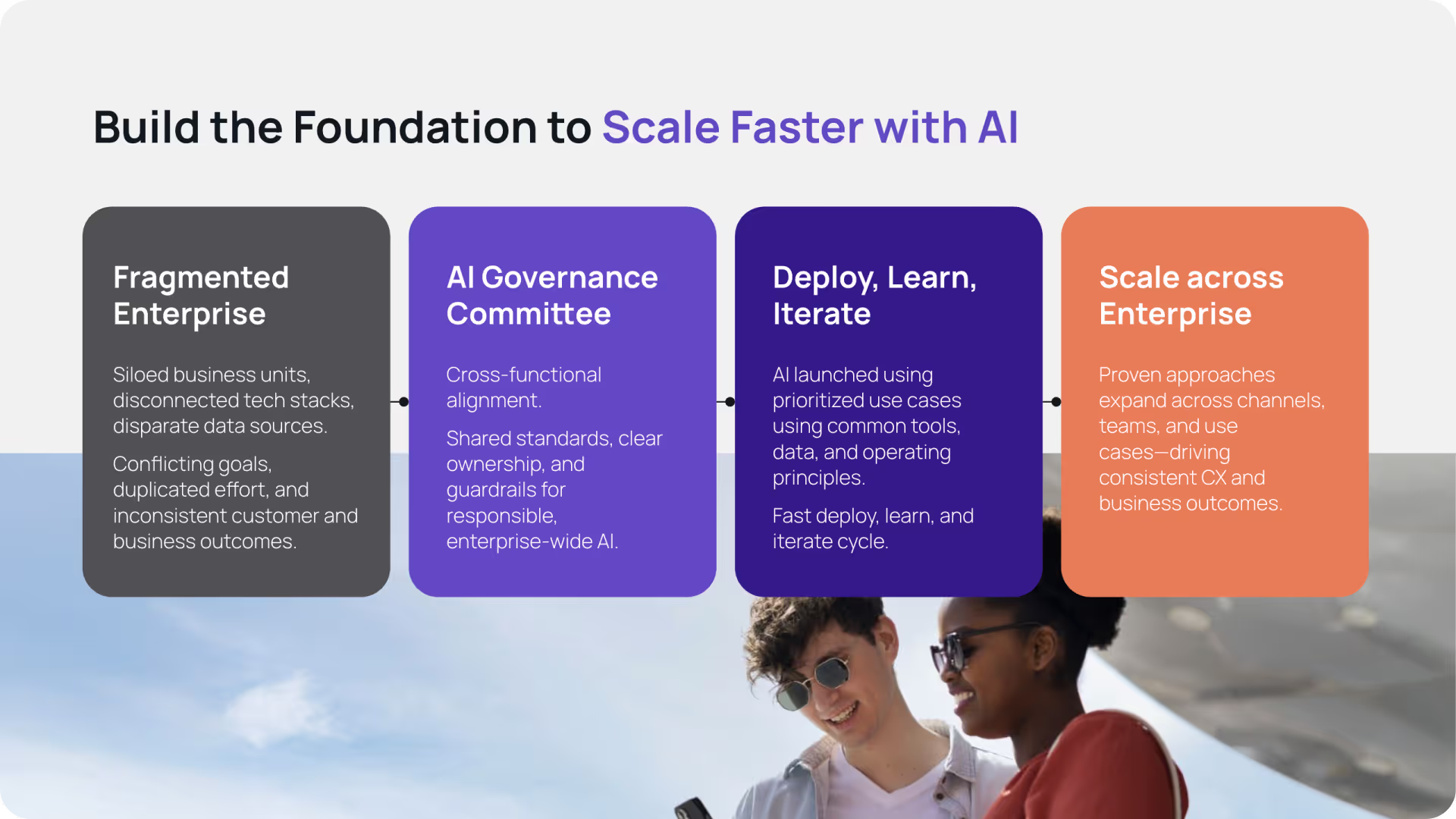
- AI does not scale when deployed in silos: without cross-functional governance, teams create fragmented systems and inconsistent customer experiences.
- Governance starts with alignment: bring customer-facing teams together under executive sponsorship, define shared AI principles, clarify decision ownership, and build from there.
- Governance is the foundation of an agentic enterprise: it provides shared standards, visibility, and accountability for deploying and improving AI across the customer journey.
- Customer expectations now exceed traditional automation: Agentic AI that creates a seamless customer journey across voice and digital, stitching together every key moment in the customer lifecycle. This is what's different in today's AI-native solution.
A smarter kind of speed
Every company wants to move faster with AI. To automate more, capture ROI sooner, and show progress this quarter. I get it. But here’s the truth: in an age obsessed with speed, the smartest enterprises are learning to slow down.
Because the future of AI isn’t about doing more, faster. It’s about building an agentic enterprise: one that can act, reason, and adapt responsibly across every customer interaction. It’s not about piling on more automation. It’s about creating a coordinated system of intelligence that learns, self-governs, and improves the customer experience over time.
And that starts with one thing most companies overlook: governance.
Breaking down silos
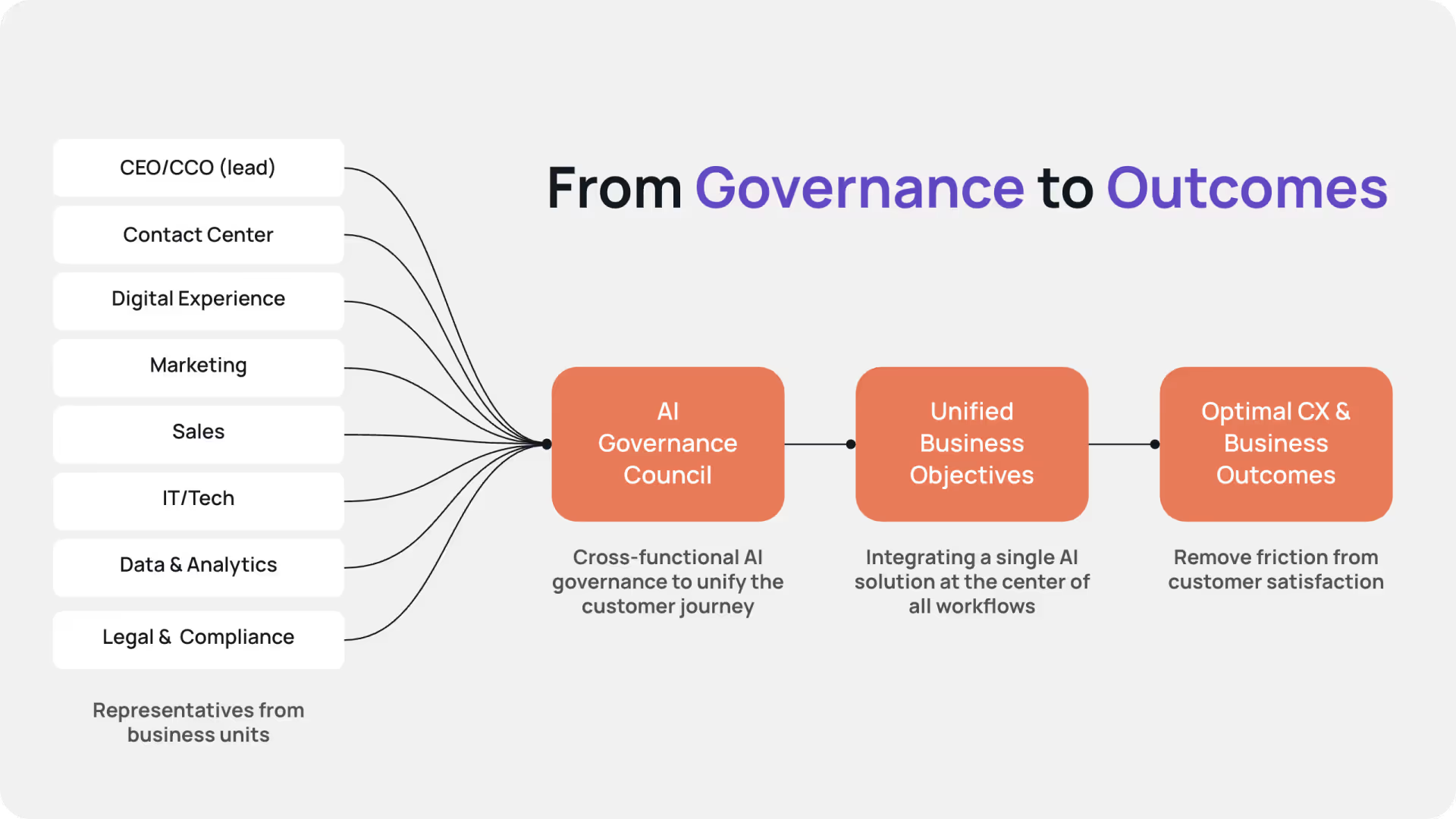
Virtually every company I have ever worked with operated in silos that inevitably resulted in friction and fragmentation in the customer journey. We have an opportunity to address this organizational fragmentation as we execute on our first important step in the AI journey: the creation of a cross-functional AI governance committee tasked with leveraging AI to enhance the customer journey across the entire lifecycle.
This should be initiated from the C-suite, typically the Chief Executive Officer or Chief Customer Officer. To maximize the benefits of these AI solutions, we need to eliminate unnecessary impediments to customer satisfaction by ensuring all critical business units are represented and execute in a way that supports optimal customer and business outcomes.
Building the framework for agentic enterprise
Building this framework in advance will take time and effort and will require compromise as each team learns to work together for the benefit of the customer. The oversight committee will govern all decisions related to AI deployment, ensuring there is consistency and reliability in the customer experience across every touchpoint, from retail, web, and mobile app to marketing and the contact center, to name only a few.
Governance isn’t theory. It’s about putting real oversight into practice. That means having clear visibility into what AI systems are doing, how they’re making decisions, and where they might need human intervention. You can’t govern what you can’t see. Having a structure that allows testing, monitoring, and refinement before anything reaches the customer is how you maintain both control and confidence while scaling to achieve maximum value.
What happens without governance
Imagine, for a second, if we did not proactively govern how AI is deployed.
The sales team deploys AI to their team for the purpose of closing more business. The digital team in charge of the website and mobile app is focused on driving more clicks, so they deploy a separate AI system to put more personalized offers in front of those visitors.
Marketing is focused on conversion rates, so they’ve deployed an AI solution to lure potential new customers from competitors, but have no idea what’s going to happen if they’re successful.
And then there’s the contact center. Oh, the contact center that sits downstream from all of these standalone—and sometimes conflicting—agendas. Yet another AI solution to help agents resolve more interactions the first time, most likely focused squarely on handle times and survey scores.
I hope this paints a picture of the fragmentation that will be born from an AI strategy that doesn’t include cross-functional governance. We will be left with a modernized version of the mess we’ve been trying to clean up for two decades.
Go slow to go fast
We don’t like to put this much time and energy into an effort because the pressures of the business require us to produce results this month and then show improvement every month thereafter. This strategy is going to require a different kind of thinking.
I call it “go slow to go fast.”
Yes, it’s labor-intensive on the front end, but that’s the very reason you will be able to move very quickly as your program matures. The AI program that’s built on this strong foundation will deliver substantial ROI and enhanced customer loyalty that will prove to be a competitive advantage over the years to come.
When governance is done right, it becomes your advantage. It’s what allows your organization to adapt to new AI capabilities, new regulations, and new customer expectations without starting over each time.
The most successful companies will be those that start small, learn, and iterate, but do so with quickness and agility.
We’ve entered the expectation age
Customers no longer compare one brand’s service to another. They compare every interaction to the best digital experience they’ve had anywhere. From personal assistants to large-language-model interfaces, they now interact daily with systems that can reason, respond, and resolve in real time. They expect the same when engaging with enterprises.
The problem is, most CX environments weren’t designed for cognition. They were designed for compliance. They can route, tag, and escalate, but they can’t independently act.
Governance is how we begin to change that. It’s how we ensure AI is used responsibly, consistently, and in ways that earn trust. It creates accountability across teams and gives leaders the confidence to evolve their operations without losing control.
Meeting those expectations isn’t about chasing the latest AI tool. It’s about designing your business to think and act with the same level of intelligence your customers now expect from technology itself. The result will be loyal customers who feel supported rather than processed, trusting in your brand rather than quietly shopping your competitor.
Becoming an agentic enterprise
The goal of this work isn’t to deploy more AI. It’s to build the kind of enterprise that can act, reason, and adapt responsibly. That’s what it means to be agentic.
When governance is in place, every customer interaction becomes a learning opportunity. Every team, human or AI, works from the same playbook. Every decision feeds enterprise memory and sharpens the next.
This is a leapfrog moment to move from brittle, flow-based solutions that can’t handle the complexity of customer interactions to generative and agentic platforms that will listen, reason, remember, and act. In practice, this means a shift from reactive issue handling to proactive customer service. What used to be spread out across fragmented conversations and siloed tech stacks will now be consolidated by generative and agentic AI into intelligence that fuels automation. This will—and in fact already has—shifted how enterprises operate.
And that’s why governance is such an important piece of operationalizing an agentic enterprise.
Governance may not be the flashiest part of the AI journey, but it’s the most critical. It’s the part that ensures your investment turns into lasting impact, where speed, scale, and trust can finally coexist.
Where to start
Every company is at a different point in the journey. The good news is that governance doesn’t require a massive transformation to begin. Start by aligning the teams that touch the customer. Define a single set of AI principles, clarify who owns decisions, and build from there.
The sooner you bring everyone to the same table, the faster you’ll move later.