Table of Contents



When it comes to AI for CX, having a human-in-the-loop (HITL) is non-negotiable. It signals responsibility, oversight, and a recognition that fully autonomous systems aren’t always enough. But beneath the surface, the term blanket HITL often masks very different approaches.
In practice, most HITL implementations fall into a few familiar patterns. Some rely on failover or escalation models, where the AI handles interactions until it reaches a breaking point and transfers the conversation to a human. Others position the human as a passive safety net, stepping in only when something goes wrong. Still others reduce HITL to ticket creation or handoffs, where AI gathers information but ultimately defers resolution.
All of these approaches share a common flaw: they treat humans as a backup plan rather than an integral part of the system. The result is a fragmented experience that introduces delays, loses context, and limits the potential of both AI and human agents.
It’s time for a more effective model, one that’s intentionally designed around how humans and AI should work together.
The HILA workflow: A more intentional model for human-AI collaboration
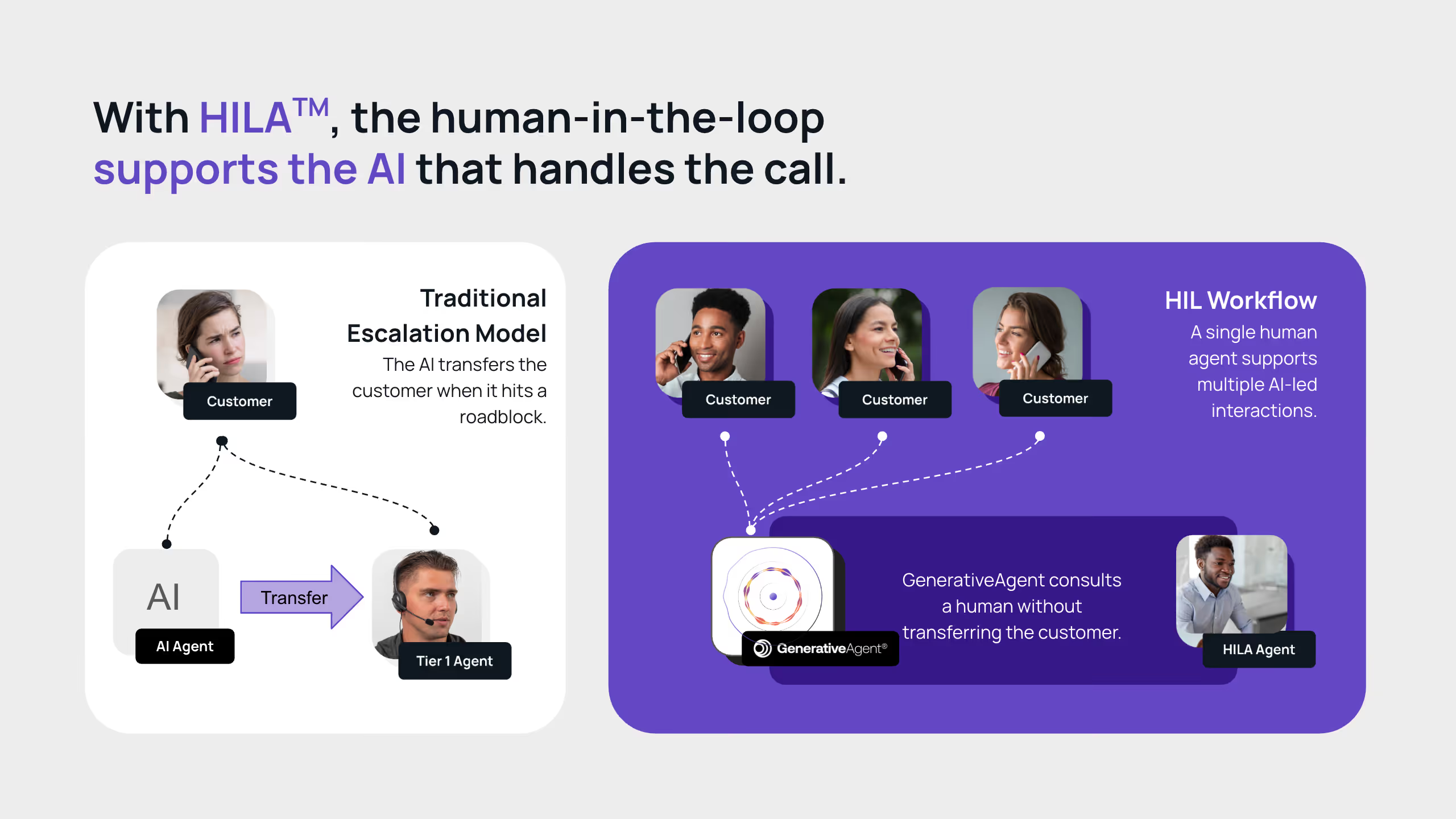
The HILA™ workflow in ASAPP's CXP is a fundamentally different way to bring humans and AI together: GenerativeAgent consults a human expert behind the scenes while it stays in the conversation with the customer.
Rather than treating human involvement as a fallback or escalation point, it is a designed, intentional component of the platform. It enables a purpose-built interaction model where AI and humans each play specific, complementary roles within the same process.
This distinction is critical. The HILA workflow is not a handoff. It’s not escalation. And it’s not a failure recovery mode.
Instead, it embeds human collaboration directly into the AI workflow. The AI determines when human input is valuable, not because the AI has failed, but because it needs human judgment or input to improve the outcome. Just as importantly, the enterprise has control over when and how that involvement occurs, using the platform’s workflow tooling to define those moments intentionally.
The result is a system where human participation is intentional and proactive, rather than failure-driven and reactive.
From recovery point to targeted guidance
In most traditional models, human involvement is triggered by failure. The AI attempts to resolve an issue independently, and when it can’t, it escalates to a human. The human who takes over often has to start from scratch or piece together context from fragments of information.
The HILA approach flips this model and replaces it with a more streamlined process.
Instead of stepping in to recover from failure, humans provide guidance at specific, pre-configured points in the workflow. That guidance can take several forms: approval, clarification, or instruction, but the key is that it is targeted and intentional.
Once the human provides input, the AI continues working toward resolution.
This reframes the entire interaction model. It’s no longer “AI failed, so a human takes over.” The HILA collaboration becomes a real-time collaboration where AI and human agents work together to resolve the issue efficiently and effectively.
Eliminating the automation tradeoff
For years, CX leaders have faced a persistent tradeoff. Automation delivers speed and efficiency, while humans provide quality and personalization. Choosing one often meant sacrificing the other.
The HILA model removes that constraint.
By strategically embedding human judgment into automated workflows, enterprise contact centers can maintain the benefits of automation: speed, scalability, and consistency, while introducing human judgment exactly where it matters most. Rather than blending two imperfect systems, we designed a unified system that leverages the strengths of both humans and AI. That means operational efficiency and a genuinely satisfying customer experience aren’t mutually exclusive. You can achieve both at the same time.
Faster than escalation, more scalable than humans alone
Traditional escalation models introduce friction at every step. When a conversation is handed off, context can be lost, queues introduce delays, and resolution times increase.
The HILA design avoids these pitfalls entirely.
Because there is no full conversation transfer, the AI retains context throughout the interaction. Humans engage only when needed and only for specific inputs, eliminating the need for lengthy back-and-forth or re-explanation. There are no queue delays in the traditional sense, just targeted moments of collaboration.
The impact on performance is substantial. Resolution times can improve dramatically, often three times faster than escalation-based approaches. Average handling time drops by 4x because humans are no longer responsible for entire conversations.
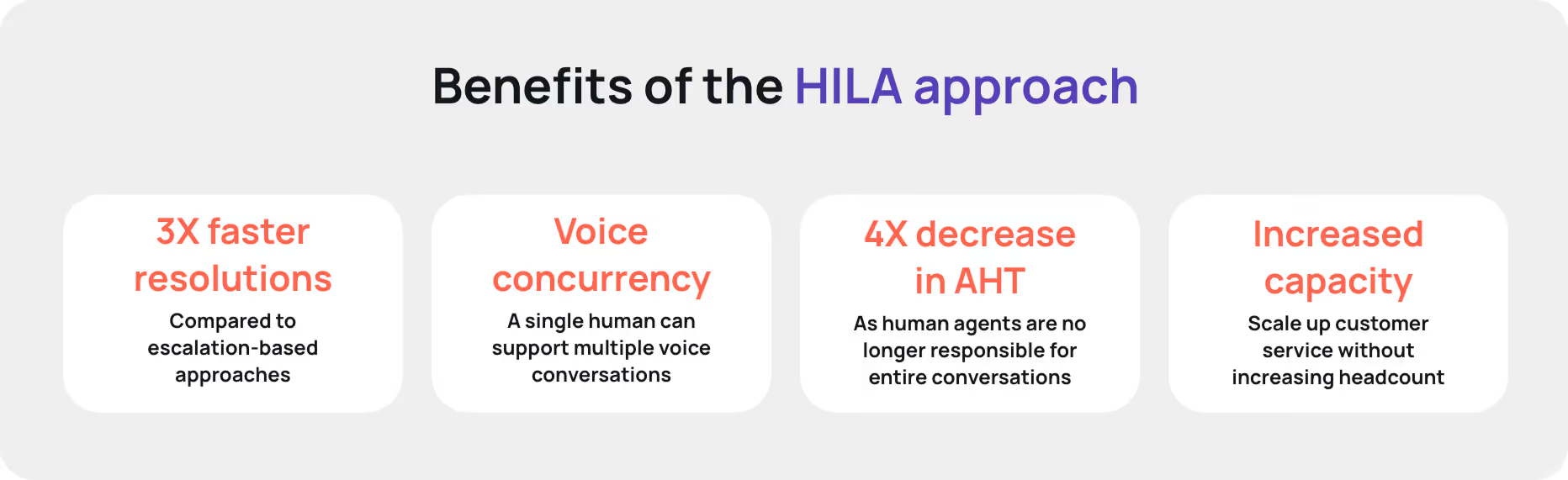
Even more importantly, the HILA approach unlocks a new level of scalability. In a traditional model, one agent handles one conversation at a time, with limited concurrency. With the workflow, a single human can support multiple AI-driven interactions simultaneously. Instead of a one-to-one model, it becomes one-to-many, allowing organizations to significantly increase capacity without increasing headcount.
Humans as an integral component, not an afterthought
Many organizations today operate in a state of partial automation, with human involvement treated as an afterthought. AI handles the initial stages of an interaction, collecting information or answering simple questions until it hits a roadblock and transfers the customer to a human for resolution.
This approach limits the value of AI and places a disproportionate burden on human agents, who are simply inserted into the process without rethinking the workflow or the tools required to improve efficiency and customer satisfaction.
The HILA design takes the opposite approach with a more collaborative model. It’s an intentionally designed component of the CXP platform, with purpose-built interfaces and interaction models designed specifically for human-AI collaboration.
Humans are given the context they need upfront (summaries, key questions, and relevant information), so they can quickly understand the situation without reviewing an entire conversation. From there, they can take precise, targeted actions while the AI retains control of the customer interaction.
The AI remains responsible for executing the workflow end-to-end, consulting humans only when necessary, which reduces the scope of human involvement while increasing its impact.
The difference is subtle but powerful. Instead of large, time-consuming interventions, humans provide small, high-leverage inputs that guide the system forward. The human-in-the-loop isn’t an afterthought here. Instead, the loop itself has been redesigned to maximize human effectiveness.
Amplifying human performance with built-in tools
As a component of ASAPP’s CXP, the HILA process sits within a broader system that enhances the productivity of human agents.
AI-assisted responses, structured workflows, and context-rich inputs reduce the cognitive load required to provide guidance to AI. Instead of composing responses from scratch or navigating complex systems, agents can interact in a more streamlined, almost “click-to-complete” manner.
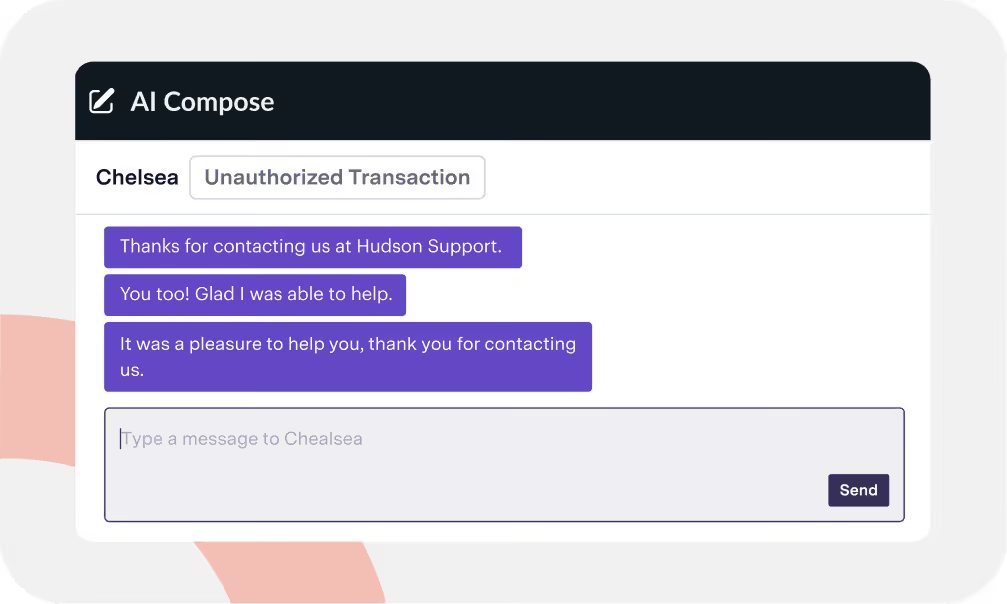
This leads to faster decisions, more consistent outputs, and a higher level of overall performance. Human input becomes more precise and impactful, which in turn improves the AI’s ability to execute.
The relationship becomes symbiotic. The AI enhances human productivity, and human input continuously improves AI outcomes.
Ratcheting up value from incremental to exponential
The benefits of this approach are not theoretical. They translate directly into measurable outcomes.
Contact centers can reduce average handle time while simultaneously increasing agent productivity. Concurrency improves as human agents support multiple AI-led interactions at once. Customers get faster resolutions and a more consistent experience with less friction.
Perhaps most importantly, the HILA capability enables contact centers to automate more complex workflows without sacrificing quality. Combining AI automation with targeted human insight leads to better outcomes in situations where traditional approaches to automation would struggle.
This is not just incremental improvement. It’s a shift in how customer service operations are designed and executed.
A new model for AI in the contact center
Human-in-the-loop shouldn’t be just a safety net or a temporary bridge to full automation. When implemented as a purpose-built feature of your AI platform, it becomes something much more powerful.
With an intentionally designed system for human-AI collaboration, the customer experience becomes both high-quality and infinitely scalable. This approach to agentic AI for CX is not about replacing humans or limiting AI. It’s about orchestrating both in a way that maximizes their strengths.
That’s what the HILA approach is designed to do – redefine how humans and AI work together in the contact center, so automation and human expertise are not in tension, but in sync. And that lays the groundwork for AI-first customer service.