Table of Contents



Gartner predicts that by 2029, agentic AI will autonomously resolve 80% of common customer service issues without human intervention. That number isn't a forecast about some distant category of software. It describes where the most advanced platforms are already headed, and what enterprise buyers are choosing between today.
Conversational AI is no longer a novel addition to the contact center. It is becoming the primary service layer for customer conversations. But not every platform delivers the same level of automation. Some generate responses. Others route conversations. A growing number of AI agents can now understand customer intent, connect to backend systems, execute workflows, and resolve issues from start to finish. But few have meaningful integration of human judgment within the AI agent workflow without having to transfer the call to a human agent.
This list is for enterprise buyers who are past the chatbot evaluation stage. You are choosing between platforms that differ in how much of the customer service workload they can genuinely own, across voice and digital channels, at production scale.
Key takeaways
- The best conversational AI agents go beyond chatbots to automate entire customer interactions—in voice or chat—from start to resolution.
- Enterprise platforms differentiate through orchestration, integrations, and the ability to execute workflows, not just generate responses.
- Other platforms vary in strengths, from branded consumer engagement tools to specialized voice automation.
- The right choice depends on whether your goal is augmentation, partial automation, or full CX transformation.
What makes a conversational AI platform best for customer service
What actually separates a best-in-class conversational AI platform from a capable one is whether the AI can resolve customer issues, not just engage in conversation.
Most evaluations focus on the wrong things: human-like natural language fluency, integration count, or how polished the demo looked. These matter at the margins.
Resolution requires the AI to do three things well. First, it has to understand what the customer actually wants and their customer needs, including ambiguous, multi-turn requests that don't follow a script. Second, it has to take action: connecting to CRM systems, querying billing platforms, and executing critical (and usually compliance-related) decisions—where the ability to involve human judgment is necessary—in real time. Third, it has to know when and how to involve a human without handing the interaction off entirely and restarting from zero.
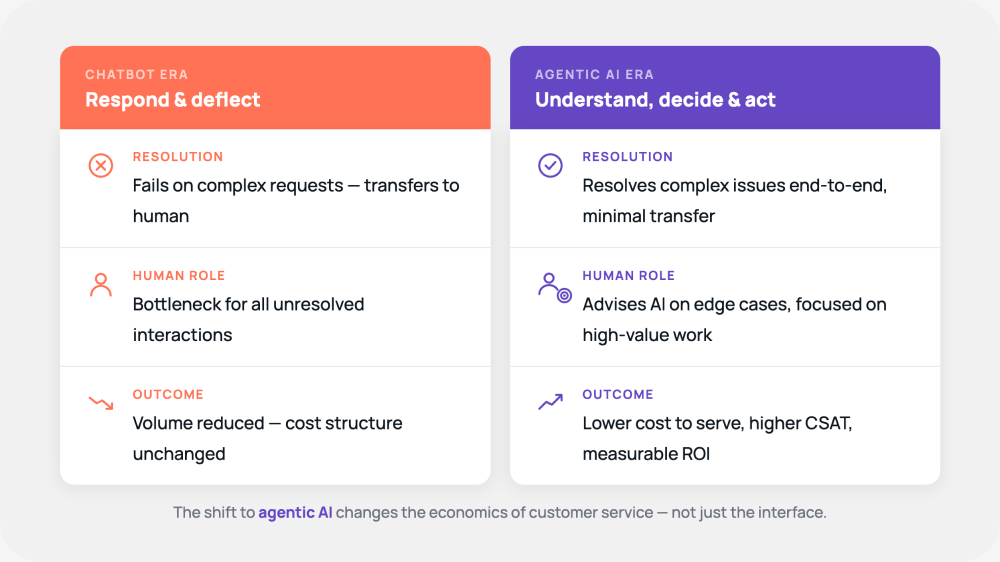
Platforms that fall short on any of these capabilities hit a ceiling. They reduce ticket volume, which has value. But they do not fundamentally change the economics or the customer experience of your contact center.
The evaluation criteria that matter for enterprise buyers: automation depth, integration and execution capability, human-AI collaboration model, governance and observability, and scalability across voice and digital channels.
How to choose the right conversational AI platform
Platform selection is not just a technology decision. It is a statement about your automation ambitions and how far you are willing to redesign your operating model around AI-led service delivery. Here are some important considerations when choosing the right conversational AI platform.
Define your automation goals
There is a meaningful difference between augmentation and automation. Augmentation improves what human agents do: faster responses, better suggestions, and easier access to information. Automation takes over what human agents were doing: handling the interaction from greeting to resolution without escalation.
According to the IBM Institute for Business Value, 67% of customer service organizations have already deployed generative AI in at least one use case. Organizations that have paired generative AI with existing conversational AI systems report a 37% increase in ROI for veteran teams, and 117% for those earlier in their AI journey. The trajectory is clear. Whether you are targeting cost reduction, first contact resolution improvement, capacity expansion without adding headcount, or trying to optimize your entire service operation, the platform you choose needs to be calibrated to your automation goal.
Evaluate integration requirements
AI customer service agents cannot resolve customer issues without backend system access. Your evaluation needs to go beyond API availability. You need to understand how the platform handles legacy systems, whether it can use existing APIs without requiring re-engineering, and how it translates business logic and policy decisions into executable AI workflows.
To fully resolve customer issues, the AI must be able to take action and complete tasks within backend systems. Look for platforms that offer deep integrations with enterprise infrastructure—CRMs, billing systems, order management, and knowledge bases—without requiring rip-and-replace. That kind of integration depth is what separates a platform that automates high-volume, complex interactions from one that handles only simple self-service tasks.
Consider long-term scalability
Contact center volumes are not stable. They spike during product launches, billing cycles, and peak seasons. A conversational AI platform that cannot scale instantly and maintain consistent performance under load is a liability. IDC estimated that AI-enabled customer service and self-service already represented $16.7 billion in global spending in 2024. Enterprise investment at that level reflects an expectation of production-grade reliability, not pilot-scale performance.
Scalability also means cross-channel consistency. Customers do not distinguish between voice and digital. Your AI platform should handle both, with shared context and consistent resolution quality regardless of channel.
Account for human judgment in the workflow
Governance is not optional. PwC's 2026 AI Predictions note that agentic AI deployments require deliberate human oversight frameworks, with clearly defined moments for human review, approval, and intervention. This isn't a compliance checkbox. It's a design requirement.
The most sophisticated platforms build human judgment into the AI agent workflow intentionally, rather than treating escalation as a fallback when the AI agents fail. Ask any vendor: when the AI gets stuck, what happens? The answer reveals whether their human-in-the-loop model is built for resolution or built for deflection.
ASAPP's approach to human-AI collaboration is one of the clearest examples in the market of what intentional oversight looks like at scale.
The 5 best conversational AI agents and platforms for customer service
Each platform and system below approaches conversational AI differently. They are compared on what they are built to do, not just what they claim.
1. ASAPP: best for agentic customer service with embedded human judgment
ASAPP’s Customer Experience Platform (CXP), powered by GenerativeAgent®, is built for enterprises looking to automate customer service across voice and digital channels at scale. The customer service platform combines conversational AI, agentic orchestration, and enterprise integrations to resolve customer interactions end-to-end rather than simply answering questions.
Unlike scripted virtual agents, GenerativeAgent can manage complex multi-turn conversations, connect to backend systems, and collaborate with human agents through ASAPP’s Human-in-the-Loop Agent (HILATM) model when needed. Its production outcomes include 91% first contact resolution, 330% ROI, a 72% reduction in resolution time, and a 12-point lift in CSAT. It has been named Fortune’s America’s Most Innovative Companies 2026 and Technology Innovator’s Top AI-Powered Customer Experience Companies in 2026.
Key features:
- End-to-end conversational AI automation across voice and digital channels
- Coordination of a team of AI agents to complete complex tasks end-to-end, with humans stepping in where judgment matters.
- Deep enterprise integrations via existing APIs, with no rip-and-replace
- Human-in-the-Loop Agent (HILA) for resolution, not escalation
- Full observability: real-time dashboards, QA at scale, continuous AI improvement
- Built-in simulation and testing tools for safe, governed deployment
Best for:
- Enterprises aiming to automate large portions of customer service.
- Organizations in regulated industries that require governance and observability.
- Teams moving past agent assist toward AI-led CX at scale.
Learn more about why ASAPP is built differently from other conversational AI platforms.
2. Sierra AI: best for branded AI customer experiences
Sierra focuses on customer-facing AI agents designed around brand voice and personalized consumer engagement. Its strength is in creating AI experiences that feel natural and consistent with a company's identity, which matters for consumer brands where the quality of the front-end interaction is central to the service model.
Key features:
- Personalized AI agents designed for branded customer experiences
- Omnichannel conversational support across digital channels
- Autonomous task handling and customer interaction management
- Workflow and backend system integrations
- Enterprise-scale AI deployment and management
Best for:
- Consumer brands prioritizing customer engagement and conversational quality.
- Organizations looking to deliver premium AI-powered brand experiences.
- Teams focused on personalized customer interactions and digital self-service.
Enterprises that require deep backend workflow orchestration, voice automation, or regulated-industry governance may need to evaluate whether Sierra's platform meets those requirements without additional tooling.
3. Decagon: best for rapid workflow automation
Decagon is built for support teams looking to standardize and automate high-volume, repetitive workflows across digital channels within a unified environment. It is well-suited for organizations that want a contained, managed environment for their conversational AI workflows.
Key features:
- Omnichannel customer support automation across voice and digital channels
- AI-driven workflow orchestration and task automation
- CRM and customer support platform integrations
- Operational analytics and support performance monitoring
Best for:
- Organizations looking to automate repetitive customer support workflows.
- Teams standardizing support workflows within a single platform.
Organizations with highly customized, multi-step, or regulated workflows may require additional implementation planning as their deployment matures.
4. PolyAI: best for enterprise voice AI automation
PolyAI is a voice-first platform built for contact centers with high call volumes and IVR modernization needs. It handles natural-language phone interactions and is well-suited for enterprises looking to reduce call handling costs and replace legacy phone automation infrastructure.
Key features:
- Natural-language voice AI for enterprise customer service
- Automated phone support and conversational IVR modernization
- Multilingual voice interactions across customer service environments
- Contact center and telephony platform integrations
- High-volume voice automation for customer service operations
Best for:
- Enterprises modernizing phone-based customer service.
- Voice-heavy contact centers handling high interaction volumes.
- Organizations focused on AI-powered voice automation and IVR replacement.
Organizations seeking unified orchestration across both voice and digital channels, or requiring real-time human-AI collaboration within voice interactions, may need to evaluate additional platform components alongside PolyAI.
5. Parloa: best for voice self-service automation
Parloa focuses on AI-powered voice automation and customer self-service, with strong tooling for enterprise telephony workflows. It is designed for contact centers that want to build and iterate on AI-driven voice interactions without requiring heavy engineering involvement.
Key features:
- AI-powered voice automation for customer service operations
- Conversational workflows for customer self-service
- Enterprise telephony and contact center integrations
- Voice AI orchestration for customer support interactions
- Automation tools for customer service call flows
Best for:
- Organizations prioritizing AI-powered voice customer service.
- Enterprises modernizing telephony and customer self-service workflows.
- Contact centers focused on automating phone-based customer support interactions.
Parloa is optimized for voice-centric service. Enterprises requiring deeply unified, cross-channel orchestration that spans voice, digital, and backend systems should evaluate whether additional tooling is needed alongside the platform.
The future of conversational AI customer support
Conversational AI is becoming the default interface for customer interactions, and the gap between platforms that assist humans and enterprise-grade platforms that redesign the entire interaction workflows is widening.
IBM Institute for Business Value research found that 65% of customer service leaders expect combining generative AI with conversational AI to increase customer satisfaction. Customer service has become the C-suite's top priority for AI adoption, precisely because it is the function where AI's ability to deliver measurable operational and business outcomes is most visible and most testable.
The shift toward agentic AI accelerates that dynamic. Customer experience as we know it is being redefined, not by better chatbots, but by AI systems that own outcomes. The contact center is no longer primarily a headcount-driven cost function. For enterprises deploying AI at scale, it is becoming a performance engine.
That shift also changes what leadership decisions matter. Rethinking the CX workforce for AI-led customer service means redefining roles, redesigning operating models, and building governance frameworks that can sustain AI autonomy over time. As PwC's 2026 AI Predictions note, the organizations building real-world proof points and governance models now are the ones that will pull ahead. Conversational AI is not a category where delayed evaluation produces better outcomes; the value of moving early is structural and compounding.
Start building a smarter customer experience with AI
The best conversational AI agents are not the ones with the most features. They are the ones that resolve the most interactions, integrate the deepest, and give your team the governance controls to scale AI safely and deliberately.
Evaluate on outcomes, not demos. Ask for production metrics, including resolution rate, response time, and reduction in cost to serve. Be specific about whether your goal is augmentation or end-to-end automation, and choose a platform built for where you want to go, not just where you are today.
Talk to ASAPP about building an AI-led contact center.
FAQs
What should I look for in a conversational AI platform?
Enterprise buyers should evaluate conversational AI solutions based on automation depth, backend integrations, scalability, governance capabilities, and support for both voice and digital channels. The strongest platforms can resolve customer interactions end-to-end while maintaining visibility, control, and human oversight where needed.
Which conversational AI platform is best for enterprises?
The best conversational AI platform for enterprises depends on automation goals, integration requirements, governance needs, and channel complexity. Enterprise teams should prioritize platforms that can resolve customer interactions end-to-end across voice and digital channels while supporting scalability, observability, and human oversight.
Can conversational AI agents handle complex customer service workflows?
Some conversational AI agents can manage complex workflows by integrating with backend systems, accessing customer data, executing actions, and involving human agents when necessary. Capabilities vary significantly between platforms.
What is the difference between conversational AI and AI-powered agent assistants?
Agent assist AI tools help human agents respond faster during customer interactions, while conversational AI agents can handle customer interactions directly and automate parts of the service workflow independently.
Do conversational AI agents replace human agents?
Most enterprise conversational AI deployments use a combination of automation and human oversight. AI agents increasingly handle repetitive and high-volume interactions, while human agents manage exceptions, approvals, and complex edge cases.