Table of Contents



Most enterprise buyers searching for conversational AI in customer service already suspect that chatbots aren't enough. What they're less sure about is what “enough” actually looks like.
That picture has changed. Conversational AI has evolved from scripted bots that deflect simple customer queries into systems that understand intent, reason through context, and execute workflows inside backend systems. That shift matters because customers don't want a conversation. They want their problem solved.
In this article, we will define conversational AI technology in operational terms, explain how modern systems actually work, and lay out what separates platforms that just talk from platforms that resolve.
Key takeaways
- Conversational AI has evolved from scripted chatbots into systems that resolve customer issues end-to-end across voice and digital channels
- The core shift is from generating responses to making decisions and executing workflows inside backend systems
- Enterprise teams use conversational AI to reduce costs, improve resolution rates, and scale customer support without adding headcount or sacrificing customer satisfaction.
- Evaluating platforms on resolution capability, integration depth, and governance architecture is more reliable than evaluating on demo quality
What is conversational AI in customer service
Conversational AI refers to artificial intelligence systems that can understand, process, and respond to human language in a natural, contextual way. In customer service, that means handling customer interactions across voice and digital channels. Not just fielding customer questions, but acting on them.
The core technologies include natural language processing (NLP), which interprets what a customer is saying and extracts intent; machine learning, which improves performance over time based on historical interaction data; and generative AI, which enables systems to produce natural-language responses rather than only retrieving scripted replies from a rigid knowledge base.
What has changed is the enterprise expectation. Organizations used to ask whether conversational AI could respond correctly. The question now is whether it can resolve completely. That distinction drives every meaningful difference between conversational AI tools and platforms in the market today.
How conversational AI works across a customer interaction
A modern conversational AI system operates across a full interaction lifecycle: the customer inputs a request, the system identifies intent, determines the appropriate action, executes that action within connected systems, and returns a response.
That execution step is where most basic AI tools fall short. Generating a reply is not the same as completing a task. Telling a customer their refund is being processed requires accessing an order management system, verifying eligibility, and triggering the transaction. Conversational AI that cannot reach into those systems cannot resolve anything.
Platforms like ASAPP's Customer Experience Platform (CXP) connect conversational AI directly to backend workflows, enabling AI agents to handle multi-step tasks, such as account updates, billing adjustments, and service changes, end-to-end. That requires deep integrations with CRM, billing, and support infrastructure, not surface-level API connections.
Context also shapes the full lifecycle. Modern systems draw on customer history, account data, and real-time sentiment to interpret ambiguous requests and adapt the conversation dynamically. That is what separates a natural, productive interaction from one that breaks the moment a customer deviates from a scripted path.
Why conversational AI is more than AI-powered chatbots
Much of the market is still anchored in chatbot-era thinking. Vendors market automation as "conversational AI" while delivering rule-based flows that stall on any request outside a predefined intent library. That framing creates real confusion for buyers evaluating actual capabilities.
The operational difference is significant. AI chatbots handle interactions. Conversational AI, at its best, resolves them.
Scripted bots vs. adaptive AI systems
Traditional bots rely on scripted decision trees. When a customer's request does not match an anticipated pattern, the bot fails and the interaction gets transferred to a human agent who often has to start from scratch. This frustrates customers, adds cost, and structurally caps automation rates.
Adaptive AI systems, built on large language models and agentic architectures, reason through the conversation dynamically. They handle variation in how customers phrase requests, manage multi-intent interactions, and orchestrate multiple systems to reach resolution. The real differentiator is not conversational fluency. It is orchestration: the ability to coordinate generative AI, deterministic rules, other AI agents, and human judgment within a single workflow to fully resolve the customer's issue.
The shift to agentic conversational AI solutions
Agentic AI systems do not just respond. They decide and act. That is the shift redefining what conversational AI can deliver at scale.
Where a traditional conversational AI system generates a reply, an agentic platform reasons through the customer's goal, determines the appropriate workflow, and executes it across connected systems. Resolution is the output, not just a response. That also means agentic AI compounds in value as deployment scales: every interaction it handles fully is a reduction in cost per contact, handle time, and agent load.
This evolution is well underway. According to the Stanford HAI 2025 AI Index Report, U.S. private AI investment reached $109.1 billion in 2024, with AI rapidly transitioning from enterprise experimentation into production deployment. Customer service is among the most active areas of that deployment.
ASAPP's GenerativeAgent is built on this model: AI that thinks, reasons, and acts. For CX leaders working through the implications, the shift toward agentic CX is already reshaping the competitive landscape for customer service operations.
What are enterprises using conversational AI for?
The most effective enterprise deployments reflect specific, high-volume workflows where the benefits of conversational AI and the economics of automation are clearest.
Automating high-volume customer inquiries
Billing questions, account updates, service status checks, password resets. High-volume inquiries like these make up a large share of total contact center volume and are natural starting points for automation. But modern conversational AI goes well beyond routine tasks. Systems like ASAPP's Customer Experience Platform powered by GenerativeAgent are built to handle complex, multi-turn interactions that require reasoning across context, orchestrating multiple backend systems, and adapting dynamically as the conversation evolves.
That means the same platform that automates a password reset can also guide a customer through a multi-step plan change, resolve a disputed charge that requires cross-referencing billing history, or manage a service escalation that involves several decision points, all without support team involvement.
(ut what if there are situations where human judgment is required? We will get to that in a second.)
The business case compounds quickly. Contact centers that deploy conversational AI across both high-volume and complex interactions see measurable improvement in response times, customer satisfaction (CSAT), and first-contact resolution (FCR) rates. In live deployments, ASAPP's GenerativeAgent achieves 91% FCR, increasing CSAT by 12 points on average, with customers receiving resolutions that are 26 times more accurate than with human agents alone and 3.5 times faster.
Conversational AI technology in voice-based support
Voice remains the highest-cost, highest-volume channel in most enterprise call centers. It is also where automation has historically underperformed, with IVR systems that frustrate customers and rarely resolve anything.
AI-powered voice systems with natural language understanding handle real conversations, not menu navigation. They eliminate wait times, scale to meet demand without adding headcount to customer service teams, and resolve a broad range of issues that previously required live agents to assist customers. For enterprises where inbound call volume is a primary cost driver, voice automation is no longer experimental. It is a proven path to operational transformation.
AI-human collaboration for complex interactions
Not every customer interaction should be fully automated. Some require human judgment, policy review, or sensitive handling requiring human touch—that AI alone should not manage unilaterally. The challenge is involving humans without surrendering the efficiency gains of automation.
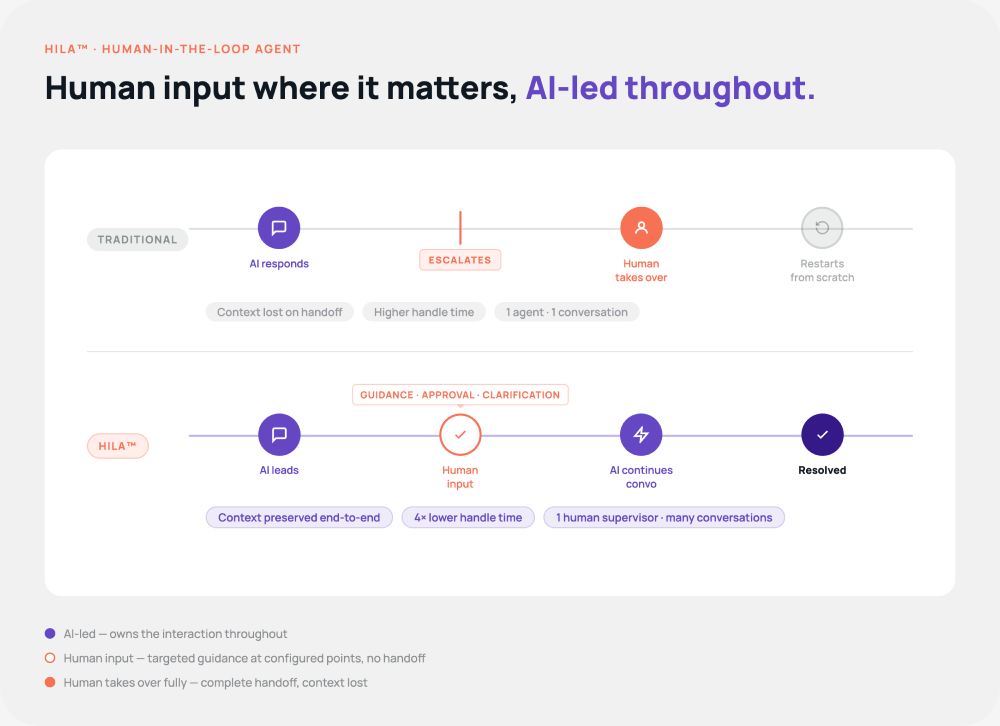
ASAPP's Human-in-the-Loop Agent model (HILA) addresses this directly. Rather than escalating when the AI hits a limitation, HILA embeds targeted human collaboration into the AI workflow at pre-configured points. A human agent provides guidance, approvals, or clarification where needed, while the AI retains control of the customer interaction end-to-end.
This approach eliminates the context loss of a full handoff, streamlines the workflow, reduces average handling time significantly, and allows a single human agent to support multiple AI-driven conversations simultaneously. The result is higher automation rates without lower service quality.
How to evaluate conversational AI customer service platforms
Many platforms still rely on architectures closer to legacy chatbot systems than to modern agentic AI. So, evaluate platforms on operational capability, integration depth, and measured outcomes, not on demos, which can be unreliable.
Can it resolve interactions end-to-end?
The primary measure of a conversational AI platform is resolution rate, not containment rate. Containment means the customer stayed in the automated channel. Resolution means their issue was actually solved. These are different metrics, and conflating them is how vendors inflate performance numbers. Ask for resolution data from real production deployments, not pilot environments.
Does it integrate deeply with your systems?
Conversational AI that cannot connect to CRM, billing, and order management systems cannot resolve anything that requires customer data or action from those systems. That is most real customer service workflows. Evaluate integration depth, not just the number of listed connectors. The key question is whether the AI can read context from and write new information to your core systems in real time. ASAPP's integration architecture is built for this at enterprise scale.
Can it scale across channels and volume?
Customer service volume is unpredictable. Enterprise platforms need to handle peak demand across voice and digital channels without performance degradation. Evaluate whether the platform maintains consistent, scalable behavior under load and supports omnichannel deployment from a single orchestration layer.
Does it support governance and human oversight?
AI agents are making decisions that affect customers. Enterprises are accountable for those decisions. Governance is not optional. Look for platforms that provide full audit trails for every AI action, monitoring and reporting against compliance requirements, and configurable policies that define which intents get automated versus escalated.
The NIST AI Risk Management Framework (AI RMF) offers a useful benchmark. The framework identifies governability as a characteristic of trustworthy AI, emphasizing clear accountability, human oversight, monitoring, and the ability to intervene when risks emerge. Organizations should be able to oversee, evaluate, and adjust AI systems throughout the lifecycle, rather than treating governance as a one-time deployment exercise.
"The most effective model combines clear ownership and accountability, embedded domain expertise, and centralized standards applied to every customer interaction," said Chris Arnold, VP of Contact Center Strategy at ASAPP. Learn more about AI governance in his blog post, The 10 tenets of AI governance in CX: An outcome-driven enterprise operating system.
Does it protect against AI-specific security risks
Conversational AI introduces security threats that traditional software does not. Prompt injection, where a malicious input manipulates the AI into taking unintended actions, is among the most significant. Sensitive information disclosure and insecure output handling are also featured in the OWASP Top 10 for Large Language Model Applications, the widely-referenced security resource for enterprise AI deployment.
When evaluating platforms, look for AI-specific protections such as prompt injection defenses, input and output safety controls, tool-use restrictions, and continuous monitoring, alongside foundational security capabilities like encryption, access controls, audit logging, and data retention policies. As AI systems gain greater autonomy, security controls must extend beyond traditional application security to address AI-specific attack vectors.
For a detailed comparison of leading enterprise conversational AI platforms, see our guide to the best conversational AI agents for customer service.
Why conversational AI is becoming the foundation of customer service
The customer service function has historically been treated as a cost center. The combination of proven resolution capability, voice automation viability, and agentic orchestration is changing that framing. Conversational AI is not simply a way to deflect volume. It is becoming the primary interface through which customers interact with enterprises.
That shift has compounding implications. Every interaction an AI agent fully resolves becomes a data point that improves future performance. Every customer who receives a fast, accurate resolution without waiting for a live agent represents a potential CSAT gain. Every human agent freed from repetitive, low-complexity requests is available for the work that actually requires judgment and relationship-building.
The contact center as an AI-first operating model is not a future state for leading enterprises. It is already in production. As CX leaders confront what this transition requires, the competitive risk is not moving too fast. It is continuing to invest in platforms that cap what AI can do.
Build a smarter customer experience with conversational AI
Conversational AI is not about having better conversations. It is about optimizing operations and resolving customer needs faster, at lower cost, with less dependence on manual intervention. The platforms worth evaluating are built to deliver on that outcome, not just demonstrate it
That means assessing integration depth, resolution performance in production, governance architecture, and security design, not just conversational fluency in a controlled demo. The question to bring into every evaluation is simple: can this platform actually resolve customer issues, or can it only respond to them?
See how ASAPP can help your team get started.
FAQs
What is a conversational AI agent?
A conversational AI agent is an AI-powered system that uses Natural Language Processing (NLP) to understand customer intent, communicate using natural language, and complete customer service tasks autonomously across voice and digital channels. Unlike traditional customer service chatbot software, conversational AI agents can execute workflows, connect to backend systems, and resolve customer issues end-to-end.
What is the difference between conversational AI and chatbots?
Traditional chatbots typically follow predefined scripts and decision trees, while conversational AI agents use natural language understanding and LLMs to manage dynamic conversations, execute workflows, and resolve customer issues more autonomously.
What is agentic conversational AI?
Agentic conversational AI goes beyond generating responses. It can reason through customer goals, make decisions, and execute workflows across connected systems to resolve customer issues end-to-end.
Can conversational AI fully automate customer service?
The latest conversational AI platforms can automate a wide range of customer interactions, including complex queries and multi-step requests, while human agents focus on nuanced cases, oversight, and high-value work. In ASAPP's model, AI and humans work together through HILA, where human agents provide targeted input at specific points in an AI-led workflow, rather than taking over interactions entirely. The goal is not replacement. It is a more effective division of labor that makes both AI and human agents more capable.
How does conversational AI improve customer service?
Conversational AI helps enterprises reduce support costs, improve first-contact resolution, shorten response times, and scale customer service operations without increasing headcount.
What should I look for in a conversational AI platform?
Evaluate conversational AI platforms against your business needs. Look for platforms that can resolve interactions end-to-end, integrate with backend systems, scale across channels, and provide governance and oversight.