Table of Contents



This article is part of the Agentic CX Playbook, a collection of frameworks, roadmaps, and operating models for CX and CX Operations leaders building AI-first service operations.
CX leaders already know the traditional contact center drill: optimize your headcount, strictly monitor schedule adherence, and constantly try to shave seconds off your average handle time (AHT) and queue performance. Meanwhile, monitor absenteeism and stay prepared to backfill when agents leave. For decades, this model defined operational excellence.
But as AI capabilities evolve from simple chatbots to autonomous agents, and now to fully agentic CX platforms, that model is breaking down.
What used to be a labor optimization problem is rapidly becoming a systems design challenge.
We are in the midst of a fundamental shift from workforce management to service system management. And this isn’t just a conceptual change. It has real implications for how you structure teams, measure performance, and lead significant change inside your organization.
Let’s dive into what that shift actually means and how to navigate it.
The fundamental mindset shift
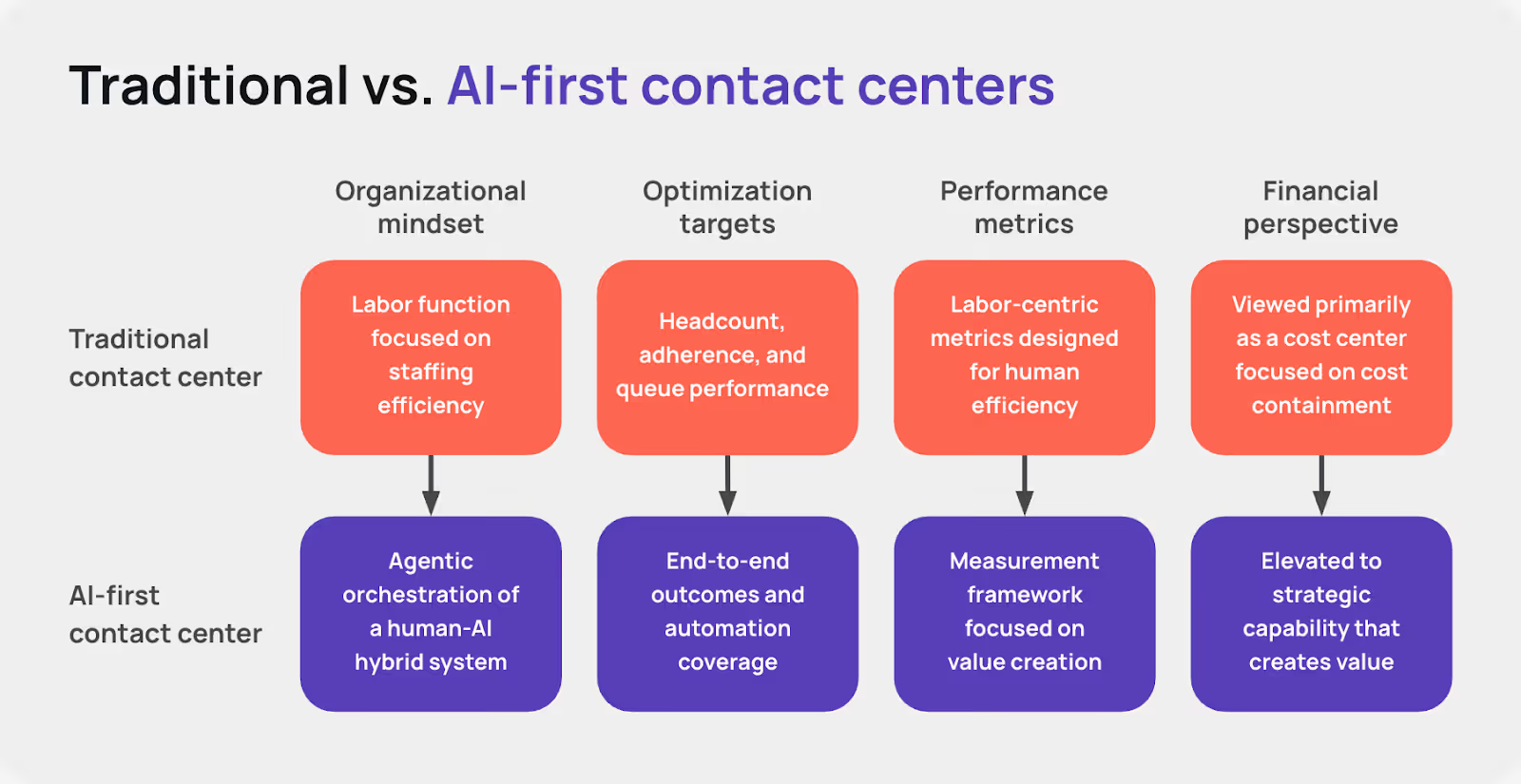
The first hurdle isn’t technology. It’s leadership mindset. Historically, contact centers have been treated as labor functions. The core question was: How many people do we need to handle this volume at the lowest cost?
In an agentic environment, that question becomes: How do we design a system that consistently delivers the best possible customer outcomes for both customers and the business?
That’s a profound change. The contact center must now be treated as an agentic operations function. As a CX leader, you are no longer just managing people and the technology tools they use. You are orchestrating a hybrid system of AI agents, human experts, workflows, and decision logic.
Staffing efficiency is no longer the central issue in contact center performance. The very idea of optimization expands to weigh other metrics more heavily:
- End-to-end resolution
- Customer experience quality
- Automation coverage and effectiveness
- Decision accuracy and consistency
- Customer effort and experience
- Long-term customer value
This reframing changes everything. It elevates CX from a cost center to a strategic capability. And it forces leaders to think more like product owners and systems architects than workforce managers.
Redesigning your operating model
Once the mindset shifts, the operating model must follow.
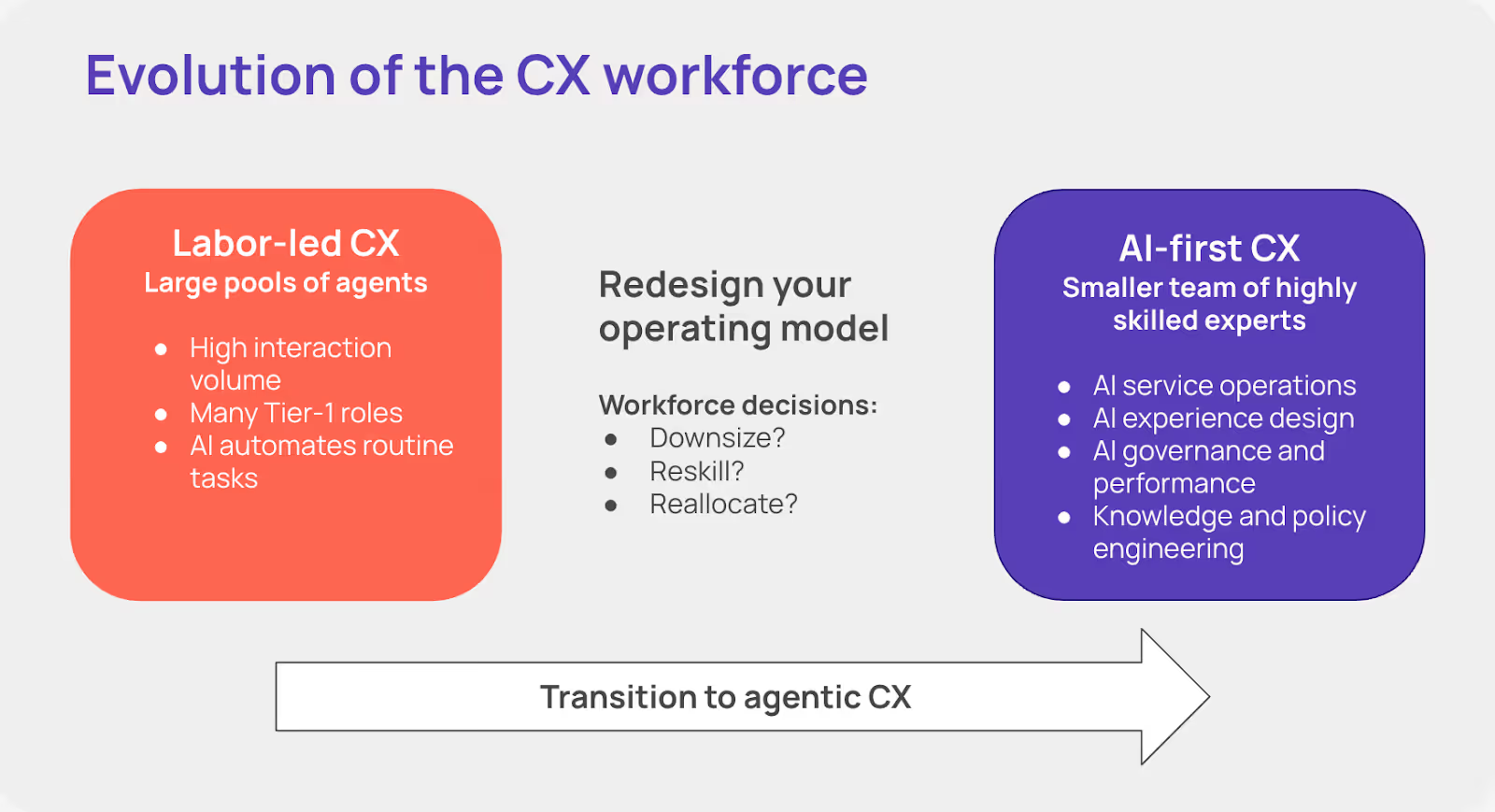
Traditional contact center structures organized around queues, channels, and agent tiers are not designed for AI-first environments. To make the transition, you need to reorganize around four core functions.
1. AI service operations (the execution layer)
In this new model, AI agents handle the majority of baseline customer interactions. But humans don’t disappear. Their roles evolve. Instead of handling one interaction at a time, your best people oversee entire interaction systems. They monitor AI performance, intervene in edge cases, and ensure quality at scale.
These roles often emerge as AI Agent Supervisors. Their responsibilities include:
- Reviewing high-risk or high-impact conversations
- Providing real-time guidance to AI agents
- Managing escalations that require judgment or empathy
- Identifying failure patterns in AI behavior
- Continuously improving system performance
This is a shift from execution to oversight—from doing the work to ensuring the work is done correctly.
2. AI experience design
Designing AI behavior is not a one-time setup. It’s an ongoing discipline that blends product management, CX design, and analytics. You’ll need specialists, sometimes called interaction designers, who are responsible for:
- Mapping end-to-end customer journeys
- Designing conversational flows and decision logic
- Simulating interactions before deployment
- Iterating on prompts, tone, and resolution strategies
Their goal is to strike the right balance between automation efficiency and customer experience quality. Done well, this function becomes a competitive advantage. It determines not just whether automation works, but how it feels to customers.
3. AI governance and performance
AI introduces new categories of risk that traditional QA models weren’t built to handle. Hallucinations, bias, inconsistent decision-making, and misaligned incentives can all erode trust quickly if left unmanaged. That’s why governance becomes a critical component of your service operation.
Traditional QA roles evolve into AI Observers and Tuners, responsible for:
- Monitoring AI outputs for accuracy and consistency
- Tracking hallucination and error rates
- Evaluating fairness and bias
- Ensuring alignment with business rules and compliance requirements
- Continuously tuning models and workflows
This function is not optional. As automation scales, governance is what keeps your system safe, reliable, and aligned with your brand.
4. Knowledge and policy engineering
A traditional knowledge base is no longer enough. AI systems don’t just retrieve information. They reason over it. That means your knowledge must be structured in a way that supports decision-making, not just lookup. This creates the need for knowledge and policy engineering as a dedicated function.
These specialists are responsible for:
- Structuring institutional knowledge for machine reasoning
- Maintaining decision trees and business logic
- Version-controlling policies and workflows
- Ensuring alignment with regulatory and compliance requirements
- Continuously updating guidance as products, policies, and conditions change
In an agentic system, knowledge is not static content. It is a living, operational asset that directly drives outcomes.
Leading through the transition
As you introduce these new functions, a new challenge emerges: fragmentation. Without clear coordination, it’s easy for teams to optimize locally—improving flows, tweaking models, adjusting policies—while unintentionally degrading overall system performance.
To avoid this, you need new cross-functional leadership roles that sit above individual teams and orchestrate the system as a whole.
AI Service Product Owner
Owns the roadmap for your AI agents. Prioritizes improvements, manages trade-offs, and is accountable for automation coverage and customer outcomes.
AI Operations Architect
Designs the system at scale. Oversees channel orchestration, integration points, and vendor ecosystems to ensure everything works together seamlessly.
AI Workforce Transition Lead
Focuses on the human side of transformation. Defines new roles, drives reskilling programs, and manages productivity and morale during the transition.
These roles are critical. Without them, even the best-designed components can fail to operate as a cohesive system.
Rethinking your metrics
You cannot measure an agentic service system using labor-centric metrics. Traditional KPIs like AHT, occupancy, and adherence were designed for human efficiency, not system effectiveness. In an AI-driven environment, they quickly become misleading.
Instead, you need a new measurement framework that reflects value creation.
Key metrics include:
- Automation containment rate: How effectively AI resolves interactions end-to-end
- Resolution quality score: Whether outcomes are correct, complete, and aligned with customer needs
- Escalation intelligence rate: How well the system identifies when human intervention is necessary
- Customer effort reduction: How easy it is for customers to get what they need
- Agentic system cost per resolved outcome: The true unit economics of your service model
These metrics shift the focus from efficiency alone to effectiveness and impact. They also create a more accurate picture of how AI contributes to both cost savings and experience improvements.
The reality of role compression
One of the most sensitive aspects of this transition is workforce impact.
As AI takes over high-volume, transactional interactions, large pools of Tier-1 agents will no longer be necessary. That will leave CX leaders with a choice – downsize the workforce, shift their focus to white-glove service, or reskill them for new roles that are emerging with agentic CX. This is the reality of automation at scale.
At the same time that execution roles decline, demand for higher-skill roles increases dramatically:
- AI supervision and oversight
- Workflow and interaction design
- Data analysis and performance tuning
- Risk management and governance
Your organization likely shifts from many low-skill roles to fewer, more specialized ones. This is what role compression looks like: a narrower but more capable workforce. For leaders, the challenge is managing this transition responsibly—investing in reskilling, creating clear career pathways, and maintaining trust throughout the process.
Organizations that treat this purely as a cost-cutting exercise will struggle. Those that treat it as a fundamental redesign of the customer service operation will win.
From labor-led to AI-first
The future of CX won’t center on human agents. The focus will be on designing, building, and orchestrating an intelligent service system that blends AI and human capabilities, continuously learns from interactions, and optimizes for both customer resolutions and a range of business outcomes.
Leaders who embrace this shift early will gain a significant advantage. They’ll move faster, operate more efficiently, and deliver better customer experiences at scale.
Those who cling to legacy models will find themselves trying to optimize a system that no longer defines how service works. The playbook is changing. The question is whether your organization is ready to change with it.