Table of Contents



This is the first article in the Agentic CX Playbook, a collection of frameworks, roadmaps, and operating models for CX and CX Operations leaders building AI-first service operations.
Let’s be candid.
For years, enterprise leaders have talked about “transforming customer experience.”
In reality, most organizations have been optimizing a model that is fundamentally broken.
We added channels. And tools. And dashboards. And layers of management.
But we never removed the core constraint. Service performance has remained dependent on how many people we can hire, train, and retain. That model does not scale in a world where customer expectations are rising faster than enterprise capacity.
Agentic AI changes this—permanently.
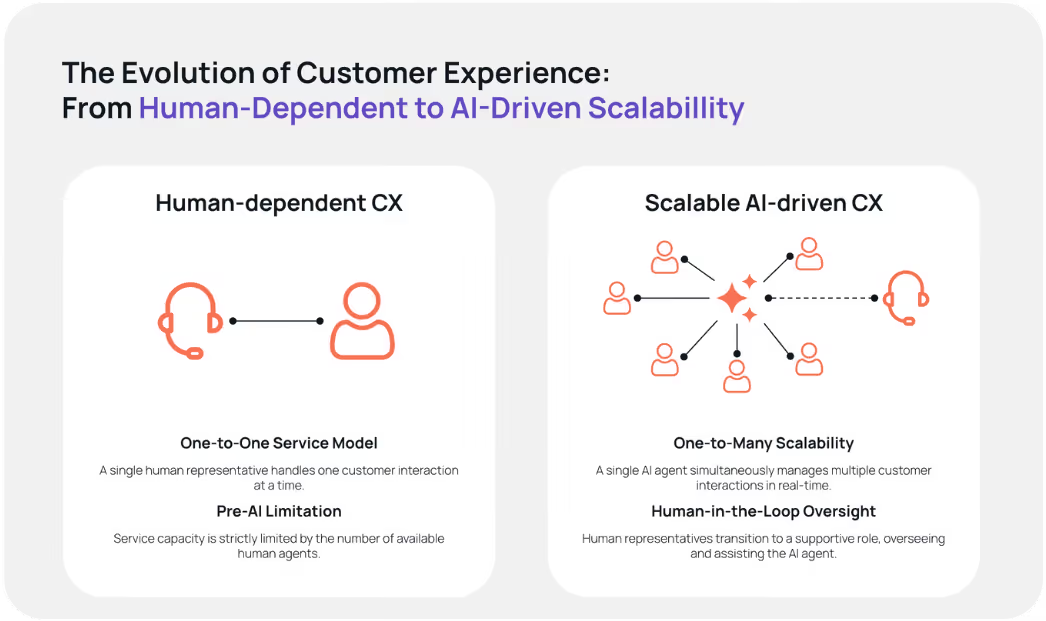
This is not another wave of chatbot hype. It is not simply about generative AI summarizing calls or suggesting responses. It is about intelligent systems that can own outcomes.
Autonomous AI agents can now understand intent, navigate enterprise systems, execute workflows, and continuously improve performance across millions of interactions. Companies like ASAPP are proving that service can be delivered through an AI workforce that operates in tandem with human teams—not just as a tool, but as an active participant in customer service delivery.
This shift is already starting to redefine the economics of customer experience. The contact center will no longer be a headcount-driven cost center. It will become a performance engine. One that protects revenue, accelerates growth, and provides real-time intelligence to the rest of the enterprise.
Some organizations will move decisively and redesign their operating models around autonomous service delivery.
Others will hesitate.
They will pilot endlessly. Debate governance frameworks without making real change. And attempt to retrofit agentic AI into legacy processes that were never built for intelligence at scale.
And they will fall behind. Because this transition is not optional. It is the new playing field. And it makes structural change an imperative.
This is a structural shift, not an incremental change
Just as cloud computing reshaped enterprise IT and digital commerce reshaped retail, autonomous AI will reshape how companies engage with customers.
The workforce will evolve. Service organizations will become smaller in some areas and more strategic in others. Leaders will need new skills, new metrics, and new levels of operational courage.
But the prize is enormous:
- Predictable service outcomes
- Scalable customer loyalty
- Operating leverage that was previously impossible
The real risk today is not moving too fast on AI. It is moving too slowly while competitors redesign their service models from the ground up.
Customer experience is entering its autonomous era. The only question is who will lead and who will be forced to follow.
What does this mean for CX leaders?
For those responsible for designing and managing customer experience, this creates both urgency and complexity. CX ecosystems are already fragmented. Technology promises have historically outpaced outcomes. So why is this moment different? And what should enterprises realistically expect over the next 24 months?
1. The narrative shifts from experimentation to proven outcomes.
Headlines will move away from AI missteps and toward documented, measurable success. Organizations of all sizes will deploy AI to eliminate large portions of repetitive front- and back-office work—the manual tasks that create friction, slow resolution, and drain employee productivity. Case studies will focus less on innovation and more on operational impact: reduced handle times, higher first-contact resolution, and meaningful cost-to-serve improvements.
Early deployments are already showing what this shift looks like in practice, with enterprises using AI customer service agents to automate workflows, resolve customer issues, and improve service performance at scale.
2. Consumer trust in AI agents will grow as experiences improve.
Adoption will not be driven by novelty, but by performance. As AI agents consistently resolve issues faster and more accurately, customer resistance will decline. Positive outcomes—fewer transfers, less repetition, and faster resolution—will replace the frustration historically associated with automated service. Over time, interacting with an AI agent will feel less like a workaround and more like the preferred path.
3. Long-promised CX concepts finally become operational realities.
Terms like omnichannel, digital transformation, and containment have lived on strategy slides for years. AI will make them tangible. Persistent context across channels, intelligent routing, and autonomous resolution will turn fragmented journeys into continuous ones. What was once aspirational will become standard operating capability.
4. Workforce AI adoption becomes the primary scaling strategy.
Rather than replacing employees, organizations will rapidly upskill them by embedding AI into daily workflows. Every role—from frontline agents to back-office specialists—will be supported by copilots that guide decisions, automate tasks, and surface insights in real time. As the mapping between employee personas and AI tools becomes more defined, enterprises will take greater ownership of managing and tuning their own AI systems, accelerating internal capability development.
5. The CX technology stack is reshaped by commoditized AI infrastructure.
Core AI infrastructure will become more accessible and standardized, shifting competitive differentiation up the stack. Legacy platforms, including traditional CCaaS providers, will face margin pressure from AI-native entrants and outcome-based pricing models that challenge per-seat and per-interaction economics. At the same time, highly effective point solutions will begin consolidating into fewer, more comprehensive agentic platforms capable of orchestrating end-to-end customer journeys.
It’s time to rewrite the CX leader’s playbook
For years, AI in service was framed as a tool to help agents work faster or reduce support costs. Today, agentic AI is fundamentally changing how customer experience operations are designed, executed, and governed.
It’s time to rewrite the CX playbook for the agentic era.
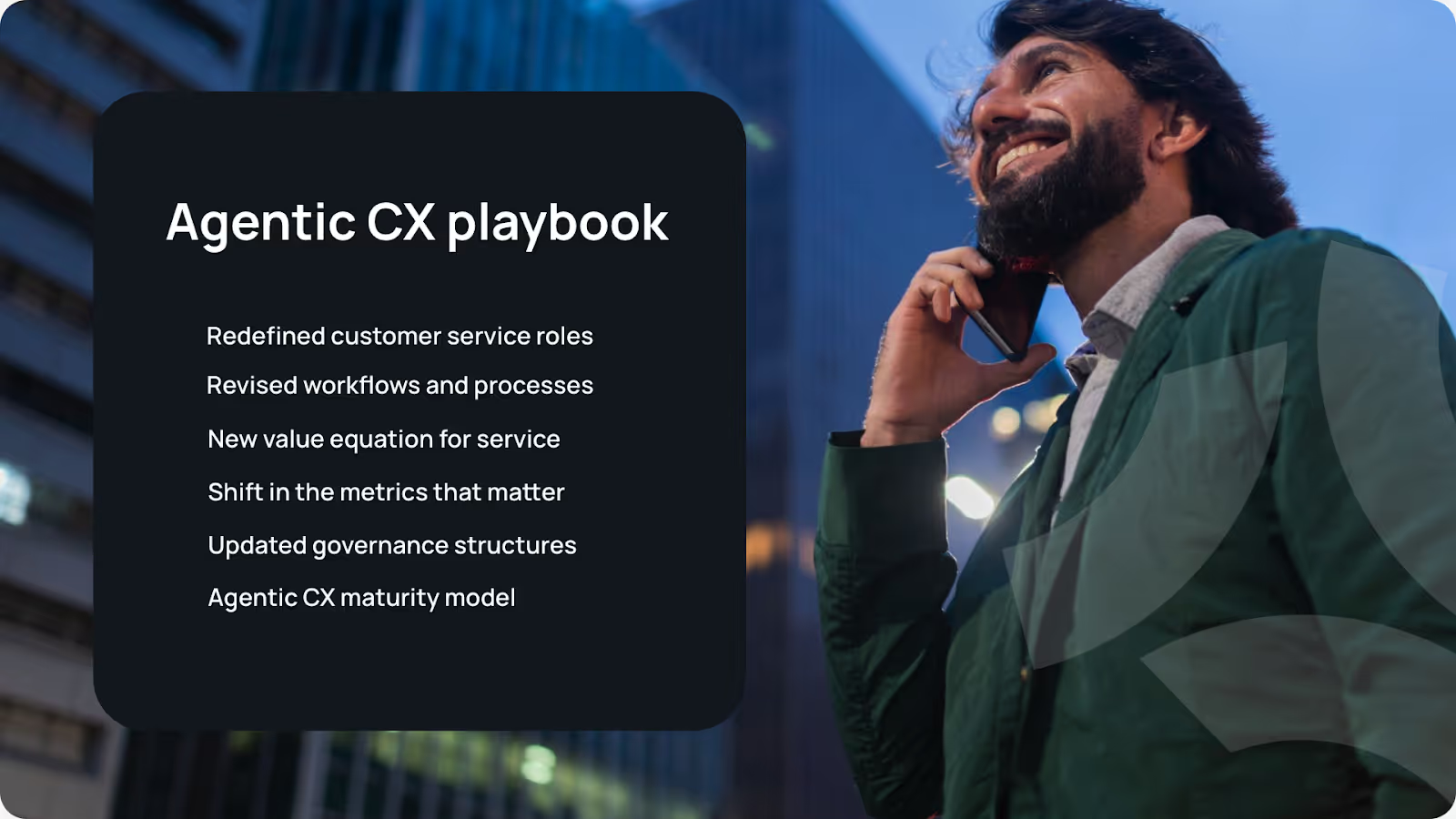
That’s why I’m starting this blog series—to explore what it means for AI to evolve from a productivity tool into a new CX operating system, built on a coordinated network of intelligent agents capable of handling interactions, executing workflows, and continuously optimizing outcomes across the customer lifecycle.
For CX leaders, the opportunity is enormous. Agentic AI has the potential to transform service from a reactive cost center into a proactive driver of retention, growth, and customer lifetime value.
But realizing that potential requires more than deploying new technology. It demands a systematic reimagining of operating models, workforce roles, data foundations, performance metrics, and governance structures. It also requires choosing technology that is built for enterprise complexity. As organizations evaluate AI platforms, the focus should move beyond features and demos toward resolution capability, system integration, governance, and the ability to operate reliably at scale.
Across this series, we will examine how organizations can move beyond isolated automation experiments toward AI-native service operations. Topics will include:
- How customer service roles evolve as humans shift from handling interactions to supervising AI systems
- Why orchestration, governance, and observability become core leadership capabilities
- How to avoid common pitfalls such as dual-stack workflows, hidden complexity, and local optimization
- What maturity looks like on the path from assisted service to autonomous experience management
- How to measure success when AI becomes embedded in end-to-end customer journeys
The goal is not simply to deploy AI agents, but to design a resilient CX operating system that aligns automation with enterprise strategy and customer outcomes.
The organizations that succeed will not be those that adopt AI fastest, but those that adopt it most deliberately by treating agentic AI as critical infrastructure for the future of customer experience.
Let’s get started rewriting the CX leader’s playbook.