Table of Contents



This article is part of the Agentic CX Playbook, a collection of frameworks, roadmaps, and operating models for CX and CX Operations leaders building AI-first service operations.
High-value AI governance in CX is not a compliance function bolted on after deployment. It is a cross-functional operating system that ensures AI agents optimize for enterprise outcomes: customer experience, revenue, and risk, rather than local, departmental metrics.
The most effective model combines clear ownership and accountability, embedded domain expertise, and centralized standards applied to every customer interaction. Below are ten critical actions to help ensure your AI implementation is built on a sustainable and scalable foundation that creates trust, reliability, and breakthrough outcomes for your business and customers.
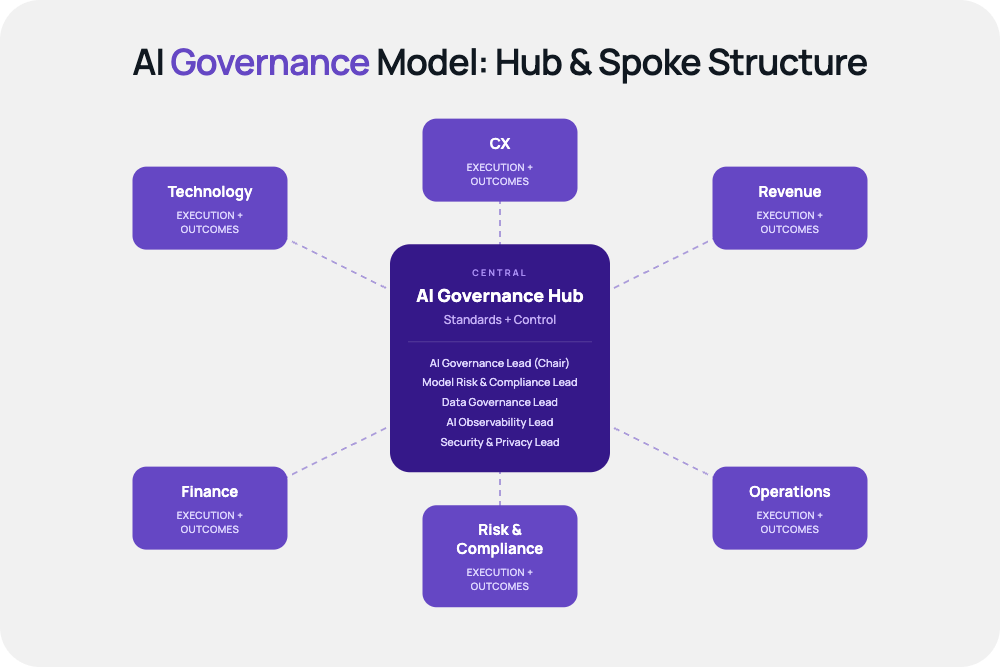
1. Organize governance as a “hub-and-spoke” model
Central AI Governance Hub (Standards + Control)
Led by a Chief AI / CX / Data executive.
Core responsibilities
- Define enterprise objectives (e.g., CLV, margin, CX targets)
- Set policy frameworks and guardrails
- Own model risk, compliance, and auditability
- Establish observability standards (events, logs, traceability)
- Review of high-risk use cases and changes
Core roles
- AI Governance Lead (chair)
- Model Risk & Compliance Lead
- Data Governance Lead
- AI Observability / Reliability Lead
- Security & Privacy Lead
Embedded Domain Spokes (Execution + Outcomes)
Placed inside CX, Revenue, Ops, etc.
Core responsibilities
- Own agent outcomes within their domain
- Configure objectives, prompts, and policies
- Monitor performance and propose changes
- Resolve cross-agent conflicts within the hub
Core CX roles
- AI Product Owner
- AI Operations Manager
- Interaction Intelligence Lead
- Knowledge / Policy Curator
2. Define clear accountability (RACI at the AI agent level)
Every AI agent/workflow must have:
- Single accountable owner (business leader)
- Named technical owner (platform/data)
- Defined approval authority for changes, including version control
- Predefined escalation paths for human assistance or seamless handoff
If an agent has no owner, it will optimize the wrong thing, and the ability to identify and resolve inaccurate or sub-optimal responses will be greatly diminished.
3. Govern through policies, not case-by-case decisions
High-performing teams don’t review every decision; they define constraints the system must operate within.
For example:
- Pricing: discount caps, approval thresholds
- Customer experience: intelligent human assistance to deliver first contact resolution
- Risk: financial or compliance boundaries
This enables scale while maintaining control of optimal outcomes.
4. Build full-stack observability
Governance without visibility is ineffective and an unnecessary risk.
Teams must track:
- What the agent did (actions taken)
- Why it did it (inputs, reasoning path)
- What data it used (sources, accuracy)
- Outcome impact (CX + business KPIs)
This enables:
- Root cause analysis
- Continuous tuning
- Audit readiness
5. Align all agents to shared enterprise objectives
Prevent local optimization by enforcing top-level KPIs across all agents, such as:
- Customer lifetime value
- Resolution quality
- Cost-to-serve (balanced with experience)
- Risk/compliance adherence
Avoid siloed metrics like containment (single-channel), cost per ticket (alone), and conversion rate (alone).
6) Establish continuous governance loops
Governance is not static; it is iterative and operational.
Cadence
- Daily: performance monitoring + anomaly detection
- Weekly: tuning and workflow adjustments
- Monthly: cross-functional optimization reviews
- Quarterly: policy and objective recalibration
7. Design for cross-agent conflict resolution
Create mechanisms to handle conflicts such as:
- Pricing vs. retention
- Cost vs. experience
- Automation vs. risk
Here are the approaches to designing the mechanisms:
- Orchestration layer decision arbitration
- Prioritize rules based on customer segment/value
- Real-time human assistance for ambiguous trade-offs
8. Evolve governance roles (not just add them)
9. Treat governance as a value driver, not a constraint
Poor governance slows AI down. Strong governance accelerates safe scale.
It enables:
- Faster deployment cycles
- Higher trust in automation
- Better alignment to business outcomes
10. Trust is critical to scalable and sustainable success. Measure it. Prioritize it.
The organizations that unlock the most value from AI in CX will not be those with the best models. They will be those with the most mature governance systems.
Because Autonomy without governance creates risk. Governance without autonomy creates stagnation. Blind faith is dangerous. That which has been tested can be trusted. The advantage lies in balancing both.
What AI governance teams must ensure
To maximize CX outcomes, AI governance teams must ensure:
- Every agent is owned
- Every decision is observable
- Every action is constrained by policy
- Every system is aligned to enterprise value
The highest-performing organizations operate with centralized standards, decentralized execution, and continuous observability. A purpose-built service operating model will deliver the greatest return when trust is at its highest.