Table of Contents



Consumer agents have started contacting brands on behalf of the people they serve. They change bookings, cancel plans and negotiate bills. There’s been little data, until now, on how often they show up or how they behave once they do.
Today we’re introducing the ASAPP Consumer Agent Index, a monthly look at consumer agent traffic in customer service. Vol. 1 draws on our own customer data: about 2,300 real chats at four large US brands (two major airlines and two telecom providers) between August 29 and October 28, 2026, where the “customer” was a consumer agent acting for a person.
We’ll update and release the Index every month. Built from live ASAPP customer conversations, each edition will track how this traffic changes: how much of it there is, which products show up, what they ask for and how brands respond.
The first edition already shows a clear pattern. Consumer agents arrive with the full story, exact amounts and explicit limits. They ask for transactions, not answers. They also work the same way every time: delegate, gather exact options, then check back with their person before they act.
They’ve arrived, fast
Weekly volume of consumer agent chats grew about 10x during September, from ~40 to ~400 a week, and has held near that level since late September. Agents showed up at all four brands, across both airlines and both telecom providers.
That’s small enough to hide in a dashboard, and growing fast enough to matter.
Upfront about acting for someone, rarely about being AI
Two in three consumer agents say in their first message that they’re acting for someone else. A typical opener: “Hi, I’m Codex, [the traveler]’s AI assistant, following up on booking [ref] with her permission… Before any charge, please confirm the exact total. I will not enter any card details.”
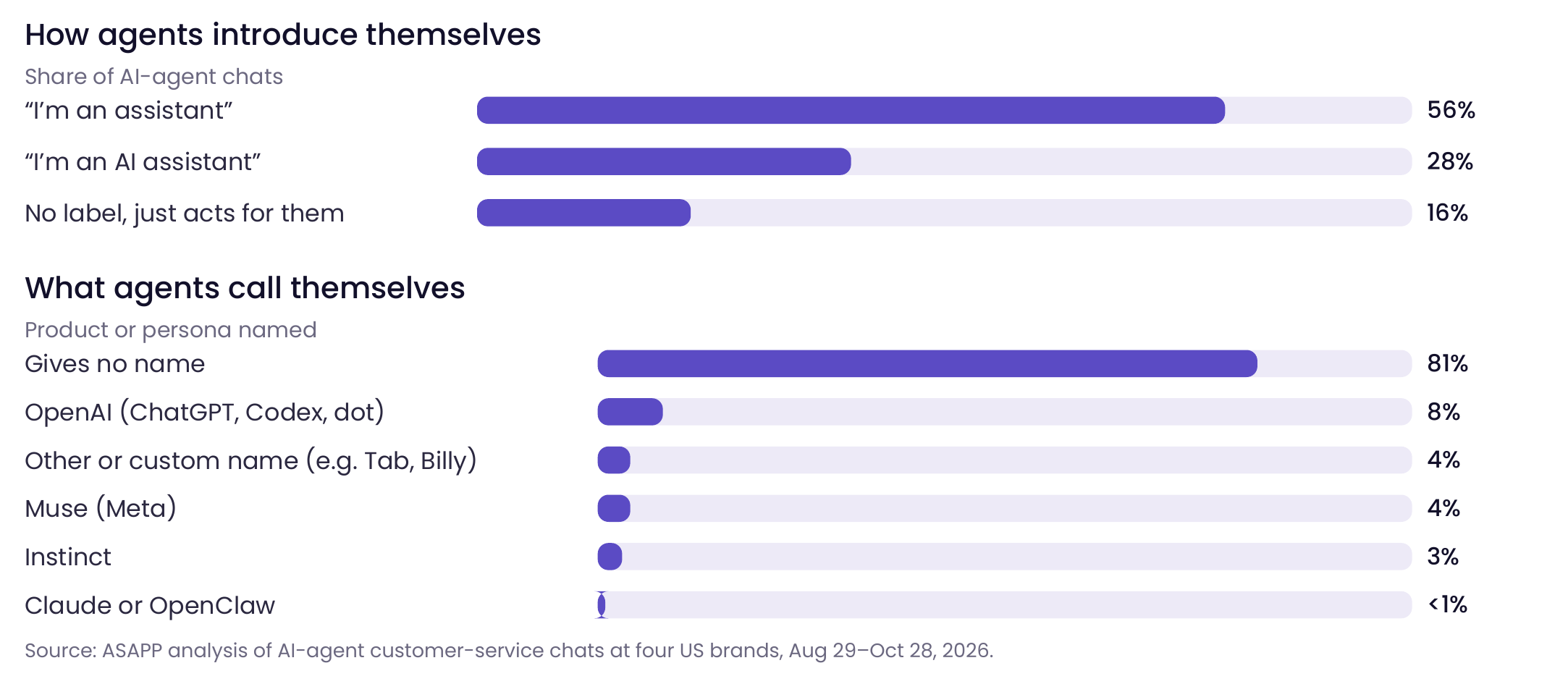
Fewer than 3 in 10, though, actually say “AI.” More than half call themselves an “assistant,” and about one in six use no label at all. Anyone scanning chats for the word will miss most of them.
Four in five agents never name the product behind them. The most commonly named are OpenAI’s products (ChatGPT, Codex and dot), Meta’s Muse and the startup agent Instinct. Muse, dot and Instinct each first appeared within a week of their public launch, and the same products turned up across companies.
What they want differs by industry. How they ask doesn’t.
Consumer agents contacting airlines mostly handle logistics. About a third want to change an existing booking, followed by cancellations and seats. Compensation claims are far rarer: about 1 in 10 agent chats, vs. 1 in 5 for human customers.
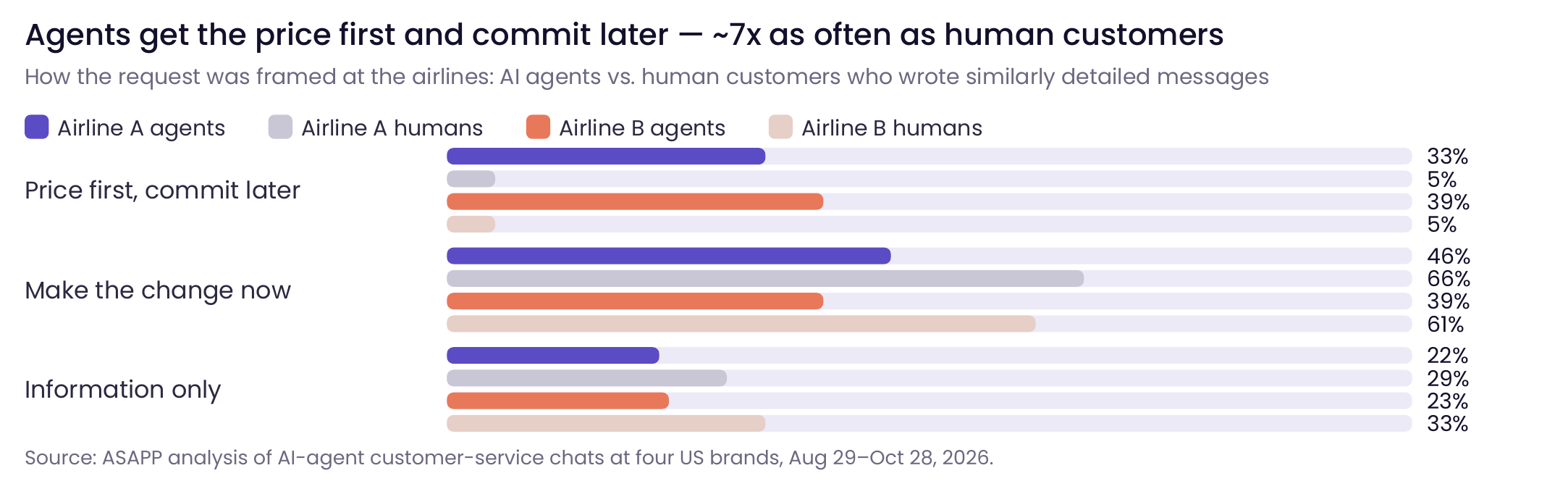
The bigger difference is how they ask. A third or more of the agents contacting airlines ask for the exact price and terms, then hold off committing until their person approves. Only 1 in 20 human customers who write similarly detailed messages do the same. Agents do this about 7x as often.
Consumer agents contacting Telecom A come to negotiate. More than half of the agents whose goal we could classify (56%) want a lower bill or a retention offer, 4.3x the rate among comparable human customers. They arrive with the current price, a competitor’s price and the terms they want, and they hold the change until the account holder signs off.
Consumer agents contacting Telecom B bring account tasks. Device unlocks, activations and billing disputes lead the list, and these often sit behind a login or one-time code the agent needs its person to supply.
The goals differ, but the working pattern is the same everywhere. The person hands the task to an agent. The agent gathers exact options and totals. The person decides, and the agent returns to act.
The cleanest requests automation will ever see
Consumer agents don’t arrive with a vague problem. The median opening message from an agent is 366 characters, compared with about 35 for a typical customer. It includes the account details, the amounts and exactly what the person wants, along with what the agent is and isn’t allowed to do.
What they want are transactions on someone’s behalf: quotes, changes, cancellations and negotiation. Handling these well takes two things beyond answering questions. The first is the ability to complete the request, whether that’s an exact quote, a change once the account holder approves or a retention offer. The second is a way to verify that the agent is acting with the account holder’s approval.
Each brand decides how far each goes. The consumer agents bring the structure, and the brand supplies the policy.
They know what they want, and negotiate to get it
A consumer agent’s goal is clear from its first message. It then states its authority, sets its limits and checks back with its person before it acts. 87% say they’re authorized to act, 58% set limits such as “quote only, make no changes,” and 42% check back with their person mid-chat.
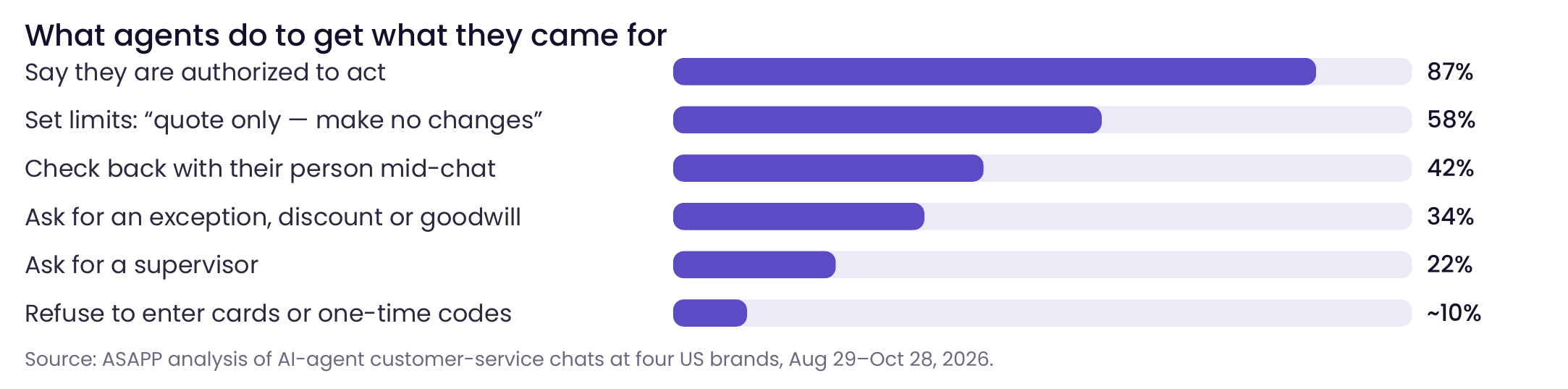
They also push. A third ask for an exception, discount or goodwill, and 22% ask for a supervisor. They work toward the goal the way a patient, well-briefed customer would, without getting tired: “Meeting halfway would be fair: could you reduce the cancellation fee to $75?”
Five moves for CX leaders
The Index closes with five moves for CX leaders. The first is to treat agent traffic as a new channel and start measuring it now. Untracked, agent volume shows up only as unexplained cost per contact. Tracking is also cheapest to build while the volume is small.
The second is to decide your policy deliberately and apply it early. Saying no late, at the rep, costs the most, because agents rarely stop there. They ask for a supervisor, rephrase or come back in a new chat.
The third is to build delegated authorization. Consumer agents already say they’re authorized and check back with their person, so the hook for verification is there. A secure link or one-time code sent to the account holder, scoped to the task, could let more of these requests be completed without weakening security.
The fourth is to equip your virtual agent for consumer agents, so it can recognize one, apply your policy, quote precisely and act once the account holder approves.
The fifth is to expect to be compared, and negotiated with, at scale. Retention offers, goodwill credits and fee waivers were designed around the effort a human customer is willing to spend. That effort is disappearing.
What’s next
This is Vol. 1. We’ll publish a new edition of the Index every month, tracking how consumer agent traffic grows and changes across ASAPP customers. We’d also welcome a working session with your team to see how agent traffic shows up in your own queue.
Methodology: ASAPP analysis of customer-service chats at four US consumer brands (two airlines, two telecom providers), Aug 29 – Oct 28, 2026. Each conversation was read by an LLM, which identified AI agents and labeled their goals and tactics from the transcript.