Table of Contents



ASAPP has integrated AI-powered features into our customer experience platform since the halcyon days of the early 2020’s. LLMs were new and exciting; our customers were excited to see real impact from their usage. We had a small number of workloads talking directly to a frontier model provider. Everything was humming along.
Oh, what’s that? They’re down for an hour and a half?
We learned quickly two important lessons:
- Every provider can fail. - There’s more options than ever to consume frontier and open-weights providers. Most offer 99.9% SLAs and offer reliability features like multi-region inference profiles.
We use four major cloud and neocloud providers following their documented best practices. We have seen all of them suffer reliability problems. Sometimes they are model issues. Sometimes they’re more “boring” like API gateway errors. Often they’re not restricted to a single region or provider; we’ve watched 5+ regions return errors and models across two providers fail. - A 5xx error isn’t your worst case. - A fast 5xx allows our systems to retry with another provider quickly. The worst case is average or outlier latency. High average legacy can degrade end user experience generally. High outlier latency is arguably worse - imagine a conversation with a voice agent where it takes five seconds to respond!
We support large companies like airlines, banks, and insurance companies. A provider outage - even if they remain above their 99.9% SLA - can have a serious impact on their workflows and end users.
Maintaining Enthusiasm
Cultivating Providers
We established a standard at ASAPP: For a model to be used at ASAPP, we need a minimum of two providers with available quota/capacity for at least 100% of peak-hour capacity for each provider.
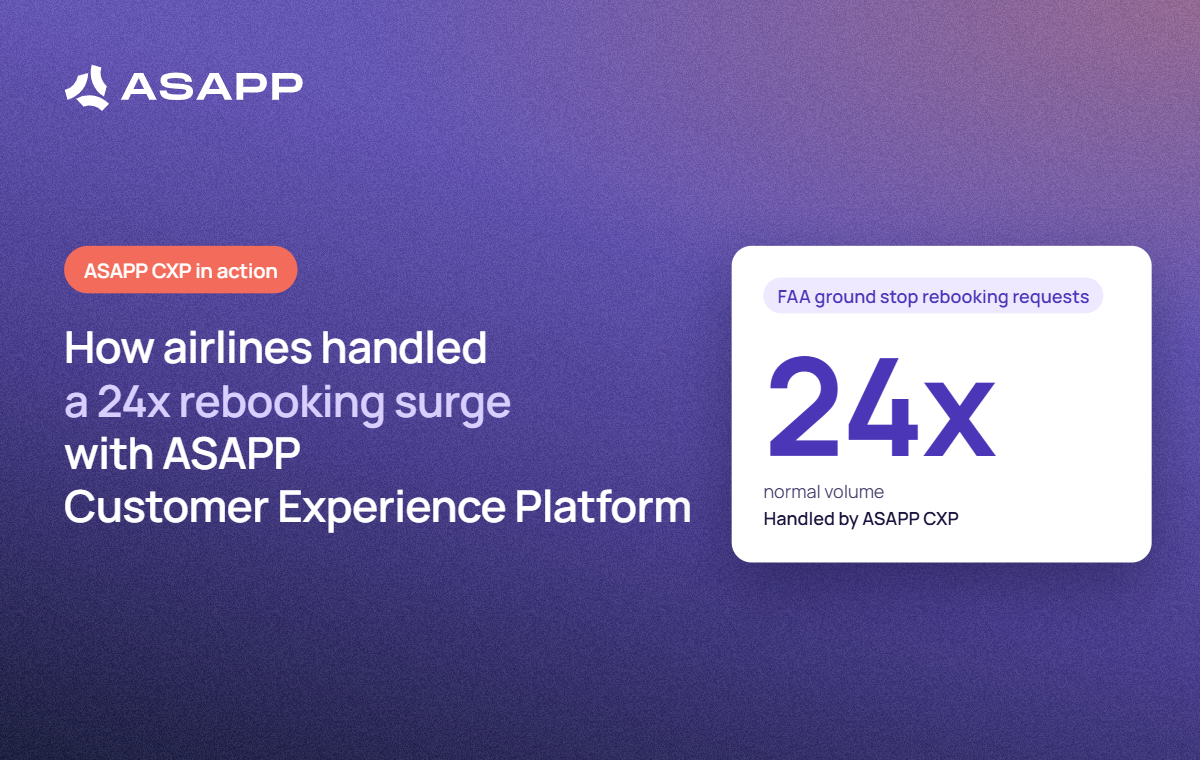
This means working closely with our selected partners (foundational labs, cloud providers) to ensure we can meet these standards. We’ve established strong relationships that in many cases have allowed us to exceed the standard, particularly, in capacity. This is clutch when out-of-the-blue events like the recent FAA groundings occur and traffic spikes. As an added bonus, this allows us to establish communications and operating cadence that allows us to report and resolve issues quickly.
ASAPP uses a LLM proxy architecture pattern with an internally developed client to connect workloads to LLM providers. This gives us a lot of benefits: better observability, FinOps controls, and better security. It also allows us to create sane “golden pathway” abstractions that allow our development teams to follow best-practices. Teams have a single, easy to understand model id (e.g. gpt-6-luna) and the LLM proxy handles routing requests to multiple providers. If a provider has issues (errors, high latency), the router will direct traffic to stable alternatives.
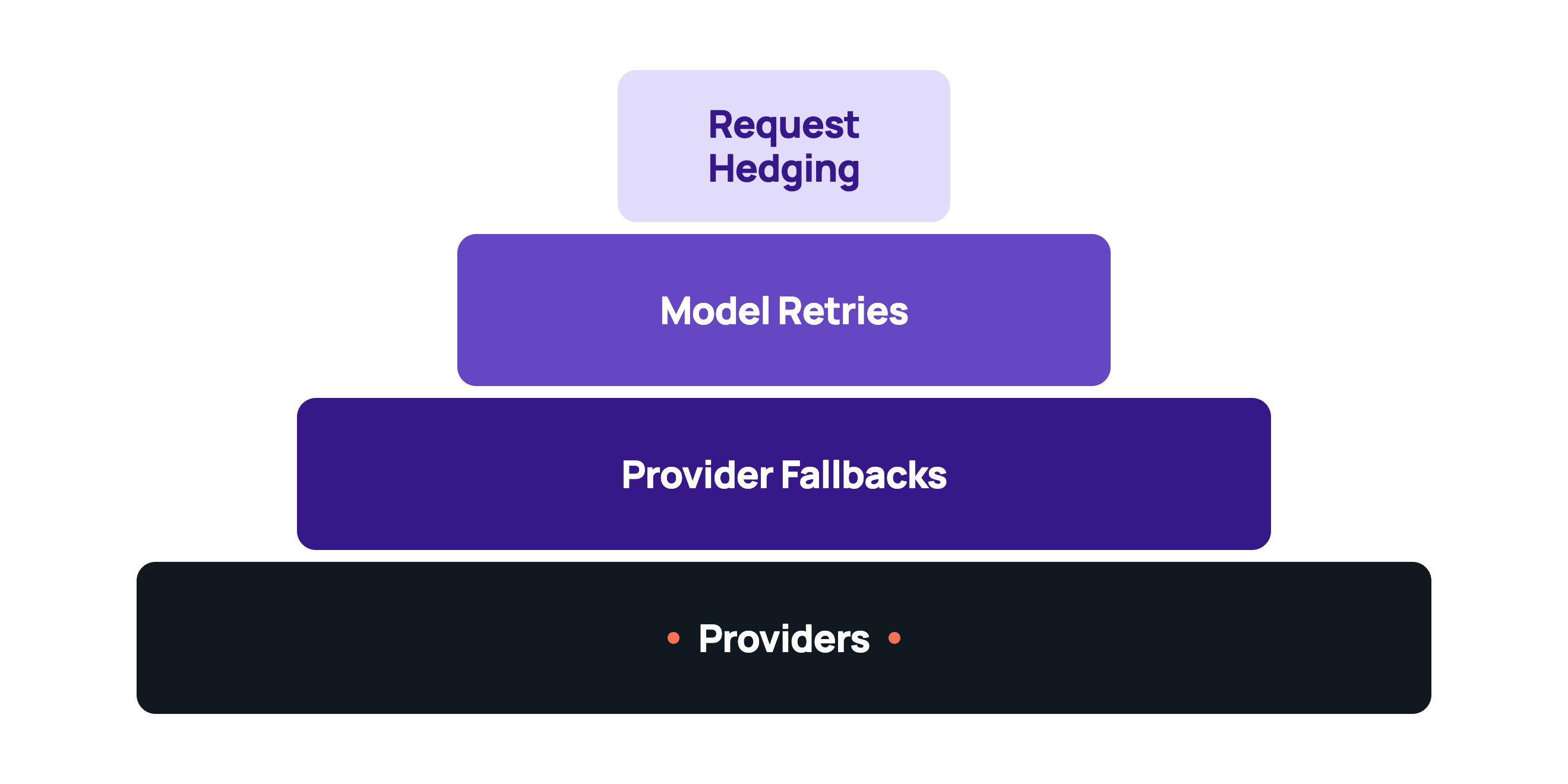
We view providers as only one chain in the model reliability pyramid.
Latency Be Gone
We’ve talked about the bottom of the reliability pyramid; now let’s talk about the top! We maintain a standard LLM client that integrates closely with our LLM proxy to give developers standard reliability features (timeouts, retries and fallbacks) by default. So far and so normal (for Platform engineering).
Retries after timeouts have a problem though: they only kick in after something fails. Even if the retry is fast, sequential retries result in a much slower response to the customers. LLMs are also slow (by computation standards) with high outliers (p95+). We’ve observed that hitting an outlier has an outsized impact on end-user experience even if latency is otherwise normal (or even good). This is also based on operational experience where models on certain providers are fast overnight then degrade as traffic picks up in the morning with the slowest latencies during the afternoon peak.
Latency is a real problem for our customers as well! When LLM providers get slow, it results in more escalations and more loads on customer support employees.
So we stopped waiting for slow requests to fail! We added request hedging to the client: if a response hasn’t arrived after a set delay, the client fires a one or more, identical request. Whichever comes back first wins and the other is cancelled. Because it lives in the standard client, hedging is a retry strategy any team can pick with a small config change: a delay and a cap on concurrent requests (we start at two)
Tuning the delay is where the work is: set it too low and you pay for hedges you didn’t need; too high and it never helps. We’ve built in adaptive metric analysis that track our latency outliers and help teams configure hedging delays as architecture, models and prompts change.
As a result of request hedging, we can effectively choose to “cut off” long-tail latency at a predetermined level. We have seen
- On some summarization workloads, we have reduced p99 latency from roughly 20-40 seconds to 6-10 seconds.
- In Generative Agent, we’ve made latency outliers disappear and median response time dropped from about 1.4 seconds to 1.1. This means better end-user experience and fewer escalations to humans.
Wrapping Things Up
Reliable, consistent LLM-backed services are not a one-time engineering project. It requires diligence, consistency, and operational focus over years. The payoff is worth it: reliable AI agents that will be there for you and your customers no matter what’s going on in the world.