Table of Contents



The platform that connects the interaction? Or the platform that understands how to resolve it?
A customer calls in, picks the closest-sounding option on a menu that was never going to have their actual problem on it, and gets routed to a queue based on which button they pressed. If a bot answers first, it asks them to repeat what they just told the IVR. If a human answers, they ask again. By the time anyone understands the issue, the customer has explained it three times, and the company has paid for all three.
That's not a training problem. It's an architecture problem.
The architecture reflects a simple assumption that's been true for decades: the first platform's job is to connect and route interactions. At ASAPP, we think its first job should be to understand them. Because the goal of customer experience isn't transport, it's resolution.
In almost every contact center running today, the telephony platform is the front door, and automation gets bolted on behind it: an IVR tree here, a chatbot there, a routing engine that sends customers wherever the call path was built to send them. The platform that touches the interaction first was built to connect customers reliably, not to understand what they need.
Understanding gets patched in downstream, one point solution at a time, and the seams show up exactly where customers complain: repeated context, unnecessary transfers, long handle times, and automation that stops just short of resolution.
The issue isn't that telephony is doing a bad job. Enterprise contact center platforms excel at what they were designed to do: carrier connectivity, workforce management, compliance, recording, resiliency, and routing people efficiently. Those capabilities remain essential.
For decades, contact center architecture has been designed around transporting customer interactions. The next generation will be designed around resolving them.
Why the first platform matters
The first platform that understands the customer's problem is uniquely positioned to decide everything that follows.
That makes it the only platform in a position to understand intent, determine the next best action, and decide whether the interaction should be resolved through automation, handled by a person, or completed through a combination of both. Every downstream system is reacting to whatever understanding exists by then.
Today, the first platform a customer encounters is typically the platform that connects the interaction.
We believe it should be the platform that understands it.
Put customer understanding first
The fix isn't a smarter bot bolted onto the same flow. It's reordering the stack.
Orchestration: the layer that understands intent, knows who the customer is, decides what happens next, and resolves what it can, belongs at the front of every interaction, not somewhere behind telephony and ticketing.
Call it CXP at the top: the customer meets one intelligent front door instead of a patchwork of menus and bots handing off to one another. Every interaction enters the same place, is understood the same way, decided the same way, orchestrated, accumulates context consistently, and leaves behind intelligence that improves future interactions.
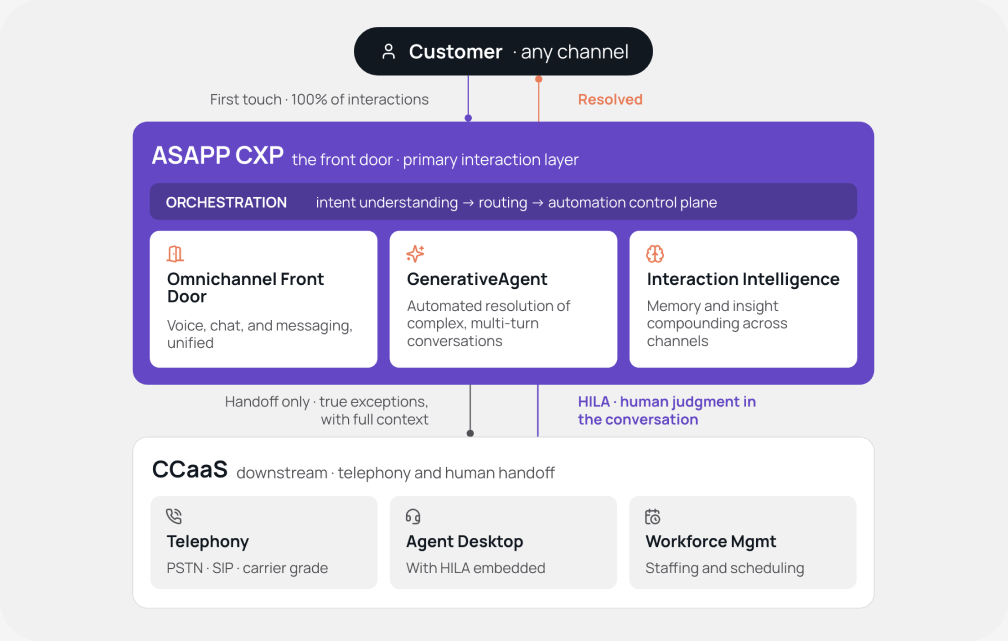
This is really about separating responsibilities. Telephony platforms are engineered to move interactions reliably across networks. Orchestration platforms are engineered to understand customers and determine outcomes. Those are different engineering problems, and expecting one platform to excel at both is what has created much of today's contact center complexity. Just as application servers didn't replace databases, and databases didn't replace networks. Orchestration isn't replacing telephony; it's taking responsibility for a different part of the architecture.
That only works if the orchestration layer can do the job a front door actually requires.
First, it has to understand intent in the customer's own words, at human-level accuracy, from day one, without menu trees or lengthy training cycles.
Second, it has to preserve identity and context wherever the customer goes, so neither customers nor employees have to start over as conversations move between channels or reach a person.
Third, it has to determine the right next step based on what the customer needs, not on which number they dialed or which queue the interaction happened to enter. The next action should be driven by intent, not infrastructure.
Finally, it has to execute reliably. Some interactions should be fully automated. Others genuinely require human ownership. Increasingly, many require something in between: a person contributing judgment at a specific moment while AI continues driving the interaction.
That's the model behind (HILA™) Human-in-the-Loop Agent: human expertise exactly where it's needed, without turning every exception into a full handoff. A person, behind the scenes, supplies a decision, approval, or correction; GenerativeAgent continues the interaction.
Understanding intent is only half the challenge. Enterprise automation also requires governed execution, reliable workflows, and predictable outcomes.
Those capabilities don't naturally belong in a platform built to connect and route interactions. They belong in the platform responsible for understanding them.
Across Fortune 100 production deployments of CXP at the top, where callers begin with zero menu prompts, orchestration-first architectures have:
- cut inter-agent transfers by 90%
- improved first-contact resolution by 18 percentage points
- reduced average handle time by 20%
- reduced customers restarting after an automation dead end by 60%
- reduced interactions without a classified intent by 51%
The common thread isn't simply better automation. It's that every participant, AI or human, is working from the same understanding of the customer.
Why this changes the economics
This isn't just a better customer experience. It's one of the rare architectural shifts where customer experience and operational efficiency improve together instead of trading off.
Contact center costs scale with interaction volume and interaction duration, regardless of whether you're licensing agent seats or paying on a consumption model. More interactions reaching the contact center—and spending more time there—means higher operating costs.
When ASAPP CXP sits at the front, GenerativeAgent resolves what it can before interactions ever reach downstream systems. The interactions that do require people arrive with complete context and a clear understanding of what human expertise is actually needed.
The more successful your AI strategy becomes, the less traffic reaches CCaaS.
Telephony and human agents continue doing what they're genuinely good at—connectivity, compliance, workforce management, and handling the moments that require human judgment—while the volume driving their cost structurally declines.
You can only automate what you understand first.
Anything downstream is optimizing work that's already entered the contact center.
None of this requires replacing existing infrastructure. Telephony remains essential. What's changing is which platform makes the first decision and which platforms execute those decisions afterward.
The bottom line
For the last two decades, the most important architectural decision in the contact center was choosing the platform that connected customers.
Increasingly, the more strategic decision is choosing the platform that understands them first.
That's why we believe ASAPP CXP belongs at the front of every interaction. GenerativeAgent identifies the customer, understands intent in their own words, and determines the next best action before routing starts—so the experience follows the customer's need, not the limitations of the underlying infrastructure.
That's also why the industry is increasingly talking about a customer experience control plane. The platform that understands the customer first is uniquely positioned to coordinate every decision that follows. Orchestration isn't the goal—it's the result of putting understanding first.
If you'd like to explore what that architecture would look like in your own environment, a working session mapping your current interaction flows is one of the fastest ways to identify where understanding first—and orchestrating from there—can create the greatest impact.