Table of Contents



Enterprises evaluating artificial intelligence for customer service now face a harder question than whether to adopt it: what, exactly, will they gain. Advances in machine learning, generative AI, and reasoning models have enabled AI agents to move beyond answering questions and begin executing customer service work.
The category has grown crowded with claims, and most vendor pitches blur at the level of buzzwords. But, implementing AI technologies, especially agentic AI in customer service, takes more precision than that.
The clearest answer is operational: what AI agents actually deliver, the mechanisms behind those benefits, and the metrics that prove them real. That matters because implementing AI that improves containment routinely fails to improve customer outcomes. The gap is governed almost entirely by whether the AI does work or just talks about it.
AI agents differ from traditional chatbots because they reason, take action, and execute workflows. Rather than simply answering questions or routing requests, they enable enterprises to move from interaction handling to task execution and resolution. The difference matters because it changes what enterprises should measure, what benefits they should expect, and how they should evaluate success.
Key takeaways
- AI agents lower cost-to-serve by autonomously resolving routine work, shortening live interactions, and reducing repeat contacts.
- 24/7 customer support only improves customer experience when AI moves customers toward resolution, not when it answers and deflects.
- Human-in-the-loop works best as part of the operating model, preserving expert judgment for approvals, exceptions, and risk-sensitive workflows instead of being the fallback for AI failure.
- For regulated enterprises, AI observability and governance are benefits in their own right. You cannot improve, audit, or trust what you cannot see.
The benefits of AI in customer service
AI in customer service has evolved through several distinct phases. Early customer service chatbots and virtual assistants followed predefined decision trees and were primarily used to answer common customer queries or route customers to the right queue. Automation expanded those capabilities, but most systems still relied on rigid workflows and struggled when conversations moved outside expected paths.
Generative AI improved the customer experience by making interactions more natural and flexible. Customers could describe problems in their own words to AI-powered chatbots, instead of navigating menus or keyword-based flows. But many conversational AI tool deployments remained limited to answering customer inquiries, summarizing information, or assisting human agents.
Agentic AI in customer service represents the next stage of that evolution. Rather than simply providing information, AI agents can understand intent, access enterprise systems, execute workflows, and complete customer tasks. The result is a fundamentally different business case. Instead of measuring how many interactions were automated, organizations can begin measuring how many customer problems were actually resolved.
The benefits of agentic AI customer service solutions should be evaluated through a simple lens: do they help resolve customer issues, or do they simply move work somewhere else? Be skeptical of metrics that measure automation without measuring outcomes. Containment rates can rise while customer satisfaction and first-contact resolution fall if the design deflects customers rather than helping them reach resolution. The most effective AI agents function as an execution layer that completes work, not just a conversational interface that routes requests.
Benefit 1: Lower cost to serve without cutting corners
AI agents lower cost to serve through three mechanisms: resolving work, shortening work, and preventing avoidable follow-up. The strongest gains come from reducing avoidable labor while maintaining or improving FCR and CSAT. Apparent savings disappear when AI pushes customers to another queue or generates repeat contacts, and merely displace the cost instead of reducing it. Disciplined use-case selection is the difference.
How autonomous resolution reduces cost per contact
Autonomous resolution removes marginal labor cost on routine intents by handling them end-to-end. When AI completes the task, confirms the outcome, and closes the interaction, it eliminates the per-contact labor cost for that interaction type. ROI varies significantly with intent complexity, containment design, and whether escalations count as resolution failures.
In a real-world workflow for a top US airline using ASAPP, AI agents significantly reduced the labor required to resolve customer interactions by shifting work from fully human-handled workflows to AI-led execution. In this case, labor requirements fell from approximately 60 minutes in traditional handling to 23 minutes with AI agents. Scaled across 5,000 interactions, that translates to more than 616 hours of labor saved.
AHT reduction through AI pre-processing and context handoff
AI pre-processing trims live handle time by capturing intent, authenticating identity, surfacing account history from the CRM, and pre-populating case context before a human agent joins. The agent picks up mid-resolution rather than starting from scratch. The customer never repeats themselves, which protects AHT and customer satisfaction at once.
Benefit 2: Faster, always-on customer service
Customers expect immediate access regardless of channel, time, or volume. AI lets organizations meet that customer expectation in real-time without being constrained by customer service agent availability or queue capacity.
How AI reduces wait times and improves responsiveness
AI engages customers immediately and consistently across voice and digital channels, eliminating the delays created by staffing constraints and queue capacity. Faster access reduces customer effort and helps move customers toward resolution sooner, particularly during periods when demand outpaces available labor. The value is largest when customer service teams cannot scale on their own: after-hours support, demand spikes such as flight disruptions or outage reporting, regulatory deadlines, and seasonal peaks.
Why accessibility matters to customer experience
Customers often judge service quality by how quickly they can begin getting help, not just how quickly the issue is ultimately resolved. Faster access lowers customer effort and improves service quality before resolution even happens. Availability should be measured through response times, SLA adherence, and accessibility, not channel coverage alone.
Benefit 3: Higher first-contact resolution and better customer outcomes
First-contact resolution is one of the clearest indicators of service effectiveness because it measures whether the customer's issue got resolved the first time. AI improves outcomes when it helps customers reach resolution faster, with minimal transfers and less effort.
How AI customer service agents improve first-contact resolution
The operational mechanisms are concrete: collecting context earlier, understanding intent accurately, accessing customer data, retrieving information from the knowledge base, and executing actions across enterprise systems. The greatest gains occur when AI agents can complete customer tasks directly, reducing transfers, callbacks, and manual intervention.
Why AI agents improve resolution rates
Resolution and containment are often treated as interchangeable metrics, but they measure fundamentally different outcomes:
Containment can increase while FCR decreases when AI deflects customers or pushes them into dead ends. Enterprise customer service teams should also evaluate goal completion: whether customers achieved their intended outcome, not just whether the interaction stayed on automated rails.
Benefit 4: Scale customer service interactions without proportional headcount growth
Contact volume rarely grows in a straight line, but labor plans and budgets do. AI agents shift scaling from labor capacity to system capacity. The benefit is capacity elasticity: more resolved customer interactions without matching increases in seats, overtime, or outsourced overflow.
Maintaining Service Levels During Demand Spikes
When an airline experiences a major weather disruption or a utility manages a regional outage, demand can increase faster than human staffing can adjust. Organizations often rely on overtime, queue rebalancing, or expensive BPO support to absorb the surge. AI agents introduce elastic capacity that scales with demand, helping organizations maintain service levels without proportional increases in labor costs.
How Continuous Optimization Expands AI Coverage
Many customer service AI deployments improve rapidly after launch and then plateau. The workflows are built, the automation is live, and performance stabilizes. New opportunities, failure patterns, and customer needs continue to emerge, but improving the system requires manual effort.
Organizations can create a different operating model with AI agents: A flywheel of an autonomous agentic life-cycle. Rather than treating deployment as the finish line, they continuously identify new automation opportunities, test improvements, validate performance, and optimize workflows based on production outcomes. Each cycle produces better workflows, higher resolution rates, and more opportunities for automation.
The result is not simply greater scale. It is a system that becomes more effective as it learns from real customer interactions and continuously improves how customer service work gets done.
Benefit 5: Agent augmentation for complex interactions
Even as customer service AI agents handle more interactions autonomously, human support agents remain essential for complex issues that require judgment, discretion, or specialized expertise. AI can improve the employee experience by automating repetitive tasks, reducing administrative work, and lowering cognitive load. But augmentation alone has structural limits, because every interaction still requires human labor.
Reducing cognitive load during complex interactions
Cognitive load in a contact center is specific. Agents juggle fragmented systems, recall evolving policy, handle emotionally demanding customers, and document every interaction. That load drives burnout and attrition. AI-powered assist tools streamline that work, letting the agent focus on the customer rather than the tools. Real-time conversation intelligence also gives supervisors and support teams objective interaction data for coaching, replacing random call sampling.
Why augmentation alone has limits
The primary constraint in service operations is not agent productivity; it is reliance on agent labor for routine work altogether. A human agent can still handle only one interaction at a time. Augmentation is only one component of a broader AI operating model.
Benefit 6: Human-in-the-loop AI as a deliberate design choice
Traditional chatbots and escalation models treat human involvement as a fallback after the AI fails. In enterprise workflows, approvals, exceptions, and compliance reviews are routine, and present as opportunities for targeted human expertise. The most effective architectures incorporate human judgment into AI workflows intentionally.
Human judgment without breaking the workflow
A purpose-built human-in-the-loop workflow keeps the conversation intact, brings human expertise into the workflow invisibly without disrupting the customer experience, and lets the AI drive to resolution. The customer never experiences a failure state. This matters particularly in regulated industries like financial services, healthcare, and insurance, where compliance-sensitive decisions cannot be fully automated but volume still demands AI involvement.
Moving beyond escalation-based automation
Traditional escalation breaks context. Collaborative AI-human workflows preserve it. The result is a higher automation ceiling, because the AI is no longer limited by the rate at which it fails. Human input becomes targeted and high-leverage rather than reactive. This also unlocks true concurrency, allowing a single human agent to oversee multiple AI-led interactions simultaneously.
Benefit 7: AI agent observability and governance as a competitive advantage
If you cannot see what the AI agent did, you cannot safely scale it. Observability is the precondition for trust, and trust is the precondition for higher resolution rates.
Governance deserves to be a named benefit. Enterprise buyers, particularly in regulated industries, need auditability before they will approve broader AI deployment internally. A platform that cannot produce an audit trail is a compliance liability. The NIST AI Risk Management Framework formalizes this around four functions: Govern, Map, Measure, and Manage. Each depends on visibility.
Strong observability and control let teams understand how AI-driven decisions were made, what data was used, and how outcomes affected business and customer KPIs. Real-time monitoring surfaces drift early, so teams can optimize the system before small problems become big ones.
How AI agents create value across industries
Generic benefit lists fail enterprise buyers because the same AI capability creates different value, and different risks, in each vertical.
The metrics that matter for AI agents
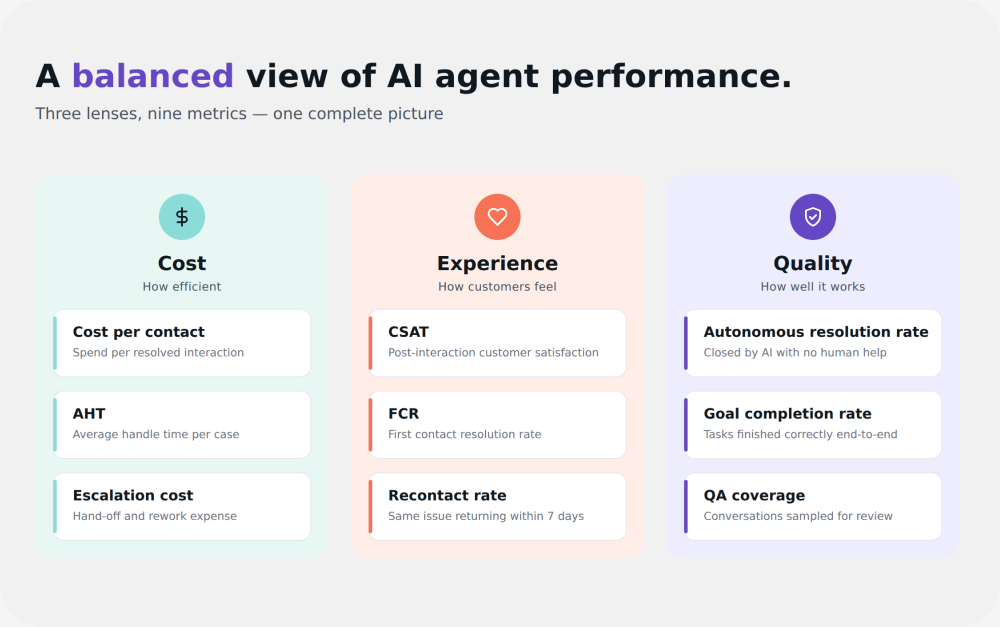
AI benefits are easy to overstate when teams track containment alone and ignore downstream rework, repeat contacts, and CSAT decay. A single metric like containment is insufficient to evaluate AI agent performance.
- Containment without FCR misses resolution quality.
- AHT without CSAT misses experience degradation.
- Cost-per-contact without recontact rate misses cost displacement.
The metrics that matter, in combination, are: autonomous resolution rate, cost-per-contact, average handle time, first-contact resolution, customer satisfaction, recontact rate after containment, escalation cost, QA coverage of AI-handled interactions, and goal completion rate. Containment continues to be an important metric to consider, just not in isolation.
For deeper guidance on evaluating platforms across these metrics, the 2026 AI agent platforms buyer's guide provides a structured comparison framework.
Use AI agents that resolve, govern, and improve your customer service
Enterprises need AI agents that execute work, collaborate safely with humans, and improve continuously. Those three requirements rule out generic chatbots and point toward purpose-built enterprise platforms. Value comes from combining reasoning, action, human collaboration, and governance within a single operating model. Trust becomes a scaling requirement because enterprises cannot safely scale AI without visibility and control.
ASAPP's Customer Experience Platform is an agentic AI platform designed for that operating model: AI agents that resolve customer issues, human-in-the-loop workflows that preserve judgment, and observability that enables continuous improvement. Learn more.
FAQs
What is the main benefit of using agentic AI in customer service operations? The primary benefit is scalable resolution at a lower cost. AI agents can resolve routine customer issues, complete tasks, and support human agents across a larger volume of interactions than traditional service models. When implemented effectively, organizations can improve customer outcomes while reducing cost to serve.
How does agentic AI reduce customer service operational costs? Agentic AI reduces customer service costs through three primary mechanisms: autonomously resolving customer requests, shortening live agent handle times, and reducing repeat contacts. This reduces total labor required per resolved interaction, improving cost-per-contact at scale.
Can AI agents improve customer satisfaction and first contact resolution? Yes. AI agents can improve customer satisfaction and first contact resolution by collecting context early, accessing customer information instantly, executing actions directly, and helping customers reach resolution faster. By reducing customer friction, AI agents can improve CSAT and first-contact resolution by lowering the need for transfers, repetition, and follow-up contacts.
How does human in the loop AI improve customer service? Rather than treating human involvement as a failure state, enterprise systems should intentionally bring humans into workflows for approvals, exceptions, compliance reviews, or complex decisions while preserving conversation context. The AI remains responsible for the interaction, consulting humans when needed and then continuing the resolution process. This allows organizations to automate more interactions safely without sacrificing service quality.
Why do governance and observability matter in AI customer service solutions? Governance and observability provide visibility into how AI systems operate, what actions they take, and where failures occur. Beyond compliance and auditability, observability enables continuous improvement by helping organizations identify performance gaps, optimize workflows, and increase automation safely over time.