Table of Contents



This article is part of the Agentic CX Playbook, a collection of frameworks, roadmaps, and operating models for CX and CX Operations leaders building AI-first service operations.
Customer service is shifting from a labor-driven function to an AI-driven operating system. Agentic AI can automate 70–90% of interactions, execute workflows, and influence revenue outcomes—but only if it’s supported by new operating models, governance, and data foundations.
The shift to agentic CX is not a mere tooling upgrade. It’s an enterprise transformation. Yes, transformation is a much overused word. But I can’t think of a better one to describe the seismic change that’s just starting. As agentic AI increasingly takes the lead in customer service, enterprises will face an unfamiliar landscape, one that requires coordinated change across CX, IT, data, and workforce strategy.
The big question facing CX leaders today is how to harness this transition with deliberate, forward-thinking strategy shifts and operational changes.
Here are my thoughts on how to do that.
The strategic opportunities
Let’s start with understanding the opportunities the shift to agentic CX will open up.
The stakes here couldn’t be higher. Enterprises that successfully transition to AI-first service operations will unlock some major advantages. Those who don’t chart a smart path forward will be dragged into a future they’re ill-prepared to navigate.
These are the big opportunities you can seize with a strong plan for an AI-first customer service operation.
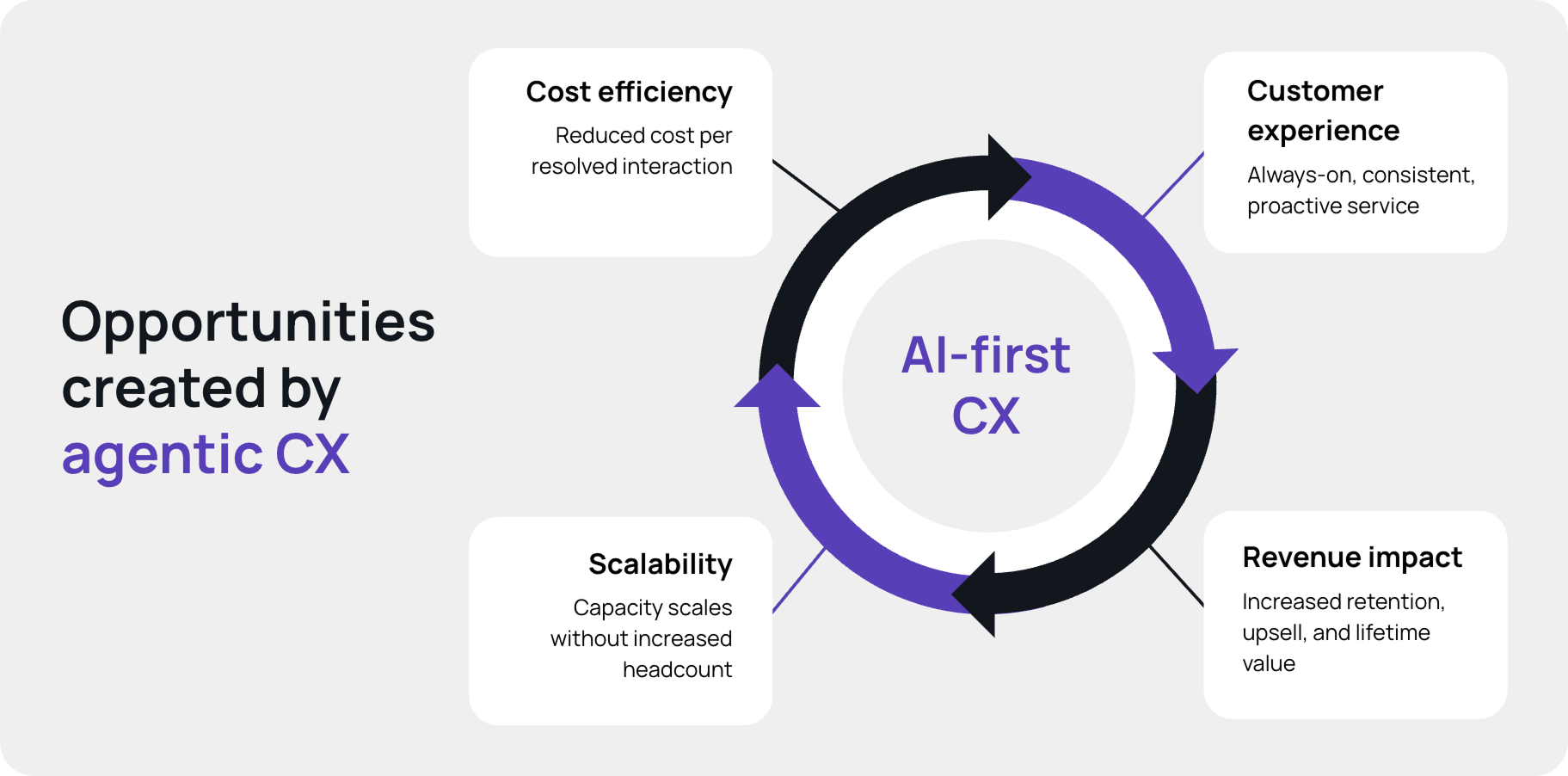
Cost efficiency
AI can reduce cost per resolved interaction by 30–60% by eliminating repetitive labor and increasing resolution rates.
Customer experience
Always-on, consistent, and increasingly proactive service will become the norm, reducing customer effort while improving satisfaction.
Revenue impact
Customer service will evolve from a cost center into a driver of retention, upsell, and lifetime value.
Scalability
Growth will no longer be constrained by staffing. With AI-first service, capacity scales with infrastructure, not headcount.
The core risk: Complexity doesn’t disappear
There’s risk in every change, and the shift to AI-first CX is no exception. We can expect some missteps and uncertainties as enterprises make the transition. But in my view, the big risks all boil down to one thing – complexity.
The truth is, as much as AI streamlines customer service delivery, it doesn’t eliminate the inherent complexity of a CX operation. It just moves that complexity away from managing people and schedules.
Instead, CX leaders will now face increased complexity with:
- Orchestration across systems
- Data quality and accessibility
- Decision logic and policy enforcement
- AI behavior and performance
These are all manageable challenges. But without an intentional strategy, it will be easy to fall into predictable traps:
- Running dual-stack operations (AI layered on top of legacy workflows)
- Proliferating competing AI agents
- Creating inconsistent or opaque decision-making
- Over-trusting incomplete or low-confidence AI outputs
So, what does an intentional strategy for shifting your operation to AI-first service look like? It starts with recognizing that you won’t make this change successfully with the typical incremental adoption of point solutions. The shift to AI-first requires system thinking.
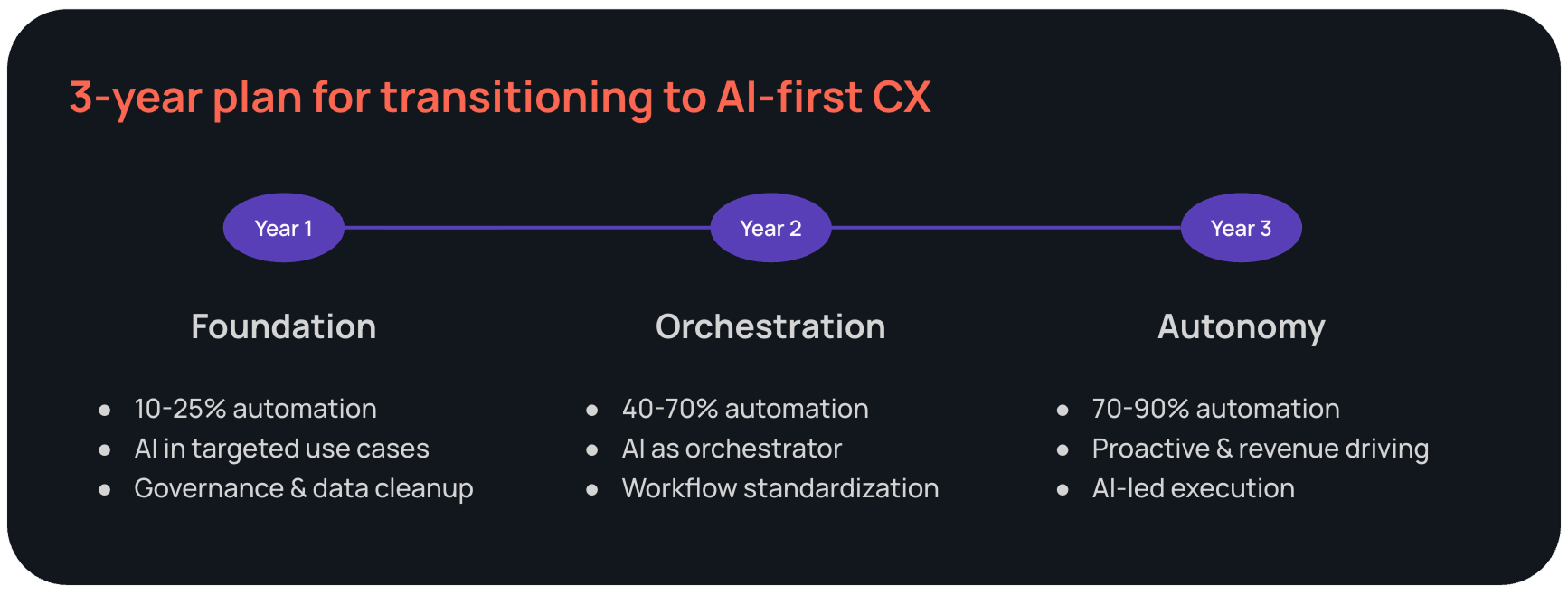
The 3-year strategic playbook for transitioning to AI-first CX
Year 1: Foundation (prove value)
The first year is about controlled experimentation and capability building. But let me be clear – this is not about piloting a proof of concept. It’s about careful planning, real-world deployment, and iterative tuning to prove value.
Key moves
- Deploy AI agents in targeted, high-volume use cases
- Begin transitioning human agents into human-in-the-loop roles
- Establish governance structures, ownership, and guardrails
- Introduce decision observability
- Clean, structure, and centralize knowledge and data
- Upskill teams in AI supervision and QA
Expected outcome
- 10–25% automation with measurable ROI and reduced operational risk
As you roll out your AI agent, remember that this phase is where most organizations stall. Why? Because they treat AI as a pilot instead of a new model for customer service. The goal in this phase is not experimentation for its own sake, but to prove that AI can reliably execute real work and deliver returns long-term.
Year 2: Orchestration (scale workflows)
Once you’ve demonstrated that an agentic AI platform can handle and resolve interactions, the next step is scaling execution. It’s tempting at this point to rapidly define and deploy as many new automation use cases as you can dream up. But there’s some foundational work you’ll need to do in tandem with use case expansion. This is where you begin to focus on the role of AI as a unified orchestrator in your contact center.
Key moves
- Shift to AI-first interaction handling
- Implement an orchestration layer across channels and backend systems
- Build dedicated teams for AI Experience Engineering and AI Operations
- Expand policy engines and decision observability
- Standardize workflows and integrations
- Optimize the human workforce that supports and oversees the AI
Expected outcome
- 40–70% automation with AI executing end-to-end workflows
At this stage, AI stops being just a front-end assistant and becomes the operational backbone of your customer service operation. The focus shifts from conversations to coordination. This is where you lay the groundwork for genuine transformation. Yep, I’m using that word again. It definitely applies here.
Year 3: Autonomy (optimize outcomes)
In year three, AI becomes the primary execution layer—and CX becomes a strategic growth lever. This is where the foundational changes you made in year 2 really pay off. Those changes allow your contact center to fully embrace an AI-first model for customer service.
Key moves
- Enable AI to operate with high autonomy across most interactions
- Expansion of humans as governors, tuners, and exception handlers
- Integrate AI into revenue-driving functions like retention and pricing
- Introduce proactive and predictive service models
- Align KPIs to customer lifetime value and revenue impact
Expected outcome
- 70–90%+ automation with CX operating as a revenue engine
Once you’ve reached this maturity level, your organization is no longer “using AI”—it is running on AI.
The operating model shift
The transformation to AI-first customer service is not subtle. It’s huge. And it’s structural.
I think looking at the shift side-by-side this way drives home a key point: once your organization has matured into an AI-first model, customer experience is no longer a support function—it’s an intelligent system embedded across the business.
Critical capabilities required
As we contemplate just how massive the implications of AI-first service will be, I think it’s important to stay focused on the capabilities that will make it possible. They’re not all about technology. A lot of the enabling capabilities are rooted in people and processes.
1. AI governance and ownership
Every AI system needs a clear owner. Governance frameworks must ensure:
- AI outcome accountability
- Policy enforcement
- Auditability
- Risk management
- Continuous improvement
Without this, AI autonomy becomes a liability.
2. Data and knowledge infrastructure
AI is only as effective as the data it can access. You must invest in:
- Structured, standardized data models
- Unified knowledge layers accessible to AI systems
- Real-time data integration across systems
Fragmented knowledge = fragmented decisions and fragmented CX.
3. Orchestration layer
This is the control plane of AI-first operations. It enables:
- Workflow coordination across systems
- Centralized decision logic
- Integration management
- Consistent execution across channels
Without orchestration, AI becomes a collection of disconnected agents rather than a cohesive system.
4. Workforce transformation
Your workforce won’t disappear. But it will evolve. New roles emerge:
- AI Product Owner
- Flow Builder / Conversation Designer
- AI Operations (AIOps)
- Observability & QA specialists
The emphasis shifts from execution to optimization. Organizations that invest in reskilling will outperform those that rely on reactive downsizing.
5. Performance measurement evolution
Traditional metrics don’t translate to AI-first environments.
Instead of:
- Average handle time
- Tickets per hour
Shift your focus to:
- Resolution quality
- Customer effort
- Containment with accuracy
- Customer lifetime value (CLV)
- Revenue impact
You can’t optimize AI-first CX with traditional call center metrics.
Critical strategic decisions
When you commit to making the transition to AI-first customer service, be prepared for these strategic decisions.
Investment priority
Treat AI as core infrastructure, not a side project. This transition will require sustained, multi-year investment.
Organizational ownership
Define executive accountability early. Whether it sits with a Chief CX Officer, Chief AI Officer, or a hybrid role, ownership must be explicit.
Risk posture
Decide how much autonomy AI systems can have—and under what conditions. Governance frameworks should evolve alongside capability.
Workforce strategy
Where possible, choose reskilling over reduction. There’s more long-term value in building institutional AI expertise than just cutting labor costs.
Timeline commitment
This is not a quarterly initiative. You’ll need to align leadership around a 24–36 month transformation horizon.
The imperative for CX leaders: Design your new operating model
Customer service is becoming an intelligent operating system that executes work, makes decisions, and drives business outcomes. AI will replace the current customer service model with an AI-first approach.
The question for CX leaders today is whether you’ll strategically design the system that replaces your current operating model—or simply inherit whatever model emerges in your organization by default.
The companies that move early—and govern well—won’t just reduce operating costs. They’ll turn customer experience into a scalable, intelligent growth engine.
And in that future, CX won’t be measured by how efficiently it handles problems. It will be measured by how effectively it creates value.