Table of Contents



A few AI CX platforms announced “personal AI agent detection", like Muse and Claude in Chrome. We have been looking at this space for customers, so here's what I've learned about what's actually detectable with confidence and what isn't.
Why it matters now: a personal agent's time is nearly free, so the $10 credit that wasn't worth a 40-minute hold is now worth delegating. And in regulated industries, legal teams are already asking whether an account can be considered verified when an AI is operating it, and what data may be disclosed to one. Both questions start with the same one: can you tell?
It all depends on where the agent runs.
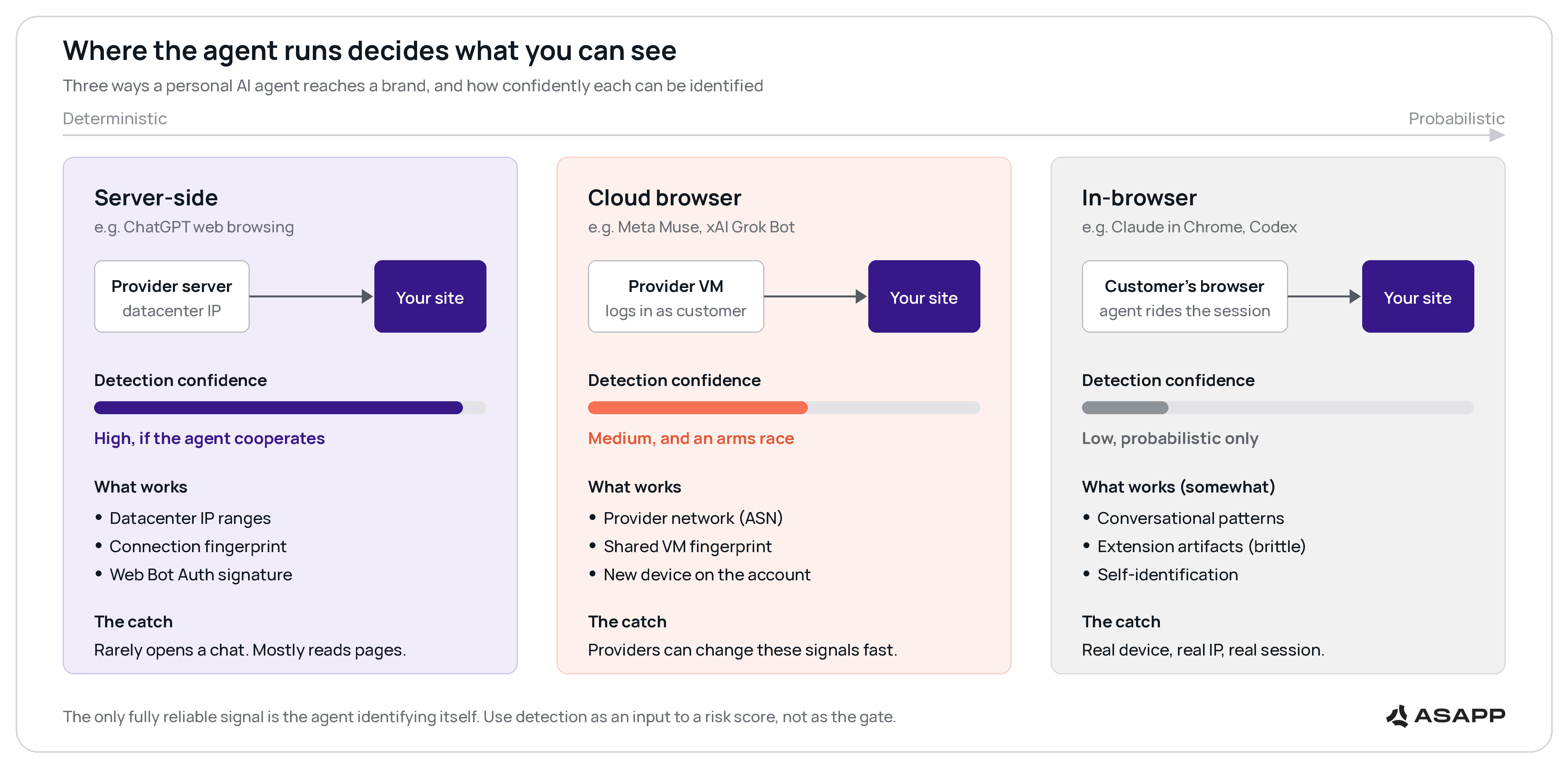
Server-side agents (like ChatGPT's web browsing)
They call your systems from provider infrastructure. These are the easy cases: datacenter IPs, TLS fingerprints, and increasingly Web Bot Auth signatures, which AWS, Cloudflare, Akamai, and Fingerprint now verify. When the agent cooperates, identification is deterministic. But most personal AI agents do not fall in this category.
Cloud browser agents like Meta's Muse
They run in a hosted VM with their own Chromium and log in with the customer's credentials. They're semi-detectable because they leave a repeatable footprint built from two signals. The first is network: in our observation, Muse traffic doesn't originate from Meta's own network but egresses through a small set of third-party networks, which still narrows the footprint to a handful of ASNs. The second is the browser itself: every Muse session we've seen presents as desktop Chromium on Linux, and real human customers on that exact combination are rare. Neither signal is deterministic on its own, but together they mark a session as very likely a cloud agent rather than a person.
That's the surface Amazon had to work with when it walled off Muse. But it's an arms race. When Amazon fingerprinted Perplexity's Comet, Perplexity shipped a workaround within a day. Note that ChatGPT's agent mode also runs a cloud browser, but OpenAI signs those requests with Web Bot Auth, which is why it's identifiable and Muse isn't. The difference is cooperation, not architecture.
In-browser agents (Claude in Chrome, Codex driving the user's own Chrome)
They are the hard case. The agent runs inside the customer's own browser and inherits their device spec, IP, cookies, and authenticated session. At the network layer, it looks like a legitimate human session. The signals CX vendors list for this case are device fingerprint (useless here, it's the real device), account history (only catches abusive volume), conversational patterns and request cadence (probabilistic, with meaningful false positive rates). Worth mentioning that some agentic browsers that ship their own build, like Comet or Atlas, expose browser-level fingerprints, but an extension inside stock Chrome doesn't.
Here's the whole picture in one view.
The only reliable signal
Across all three, the agent telling you it's an agent, or authenticating with Web Bot Auth, is the only fully reliable signal, and it only works when the agent cooperates.
So my view is that detection is worth having, but as an input to a risk score, not a deterministic gate. The durable controls are architectural: step-up verification on sensitive actions, access scoped to risk, and a governed channel so cooperative agents don't have to pass as humans in the first place.
Happy to compare notes if you're working on this too.