Speaker 1
Hello, and welcome to the webinar, human in the loop is not a fallback, why enterprise AI needs native oversight. My name is Megan Billingsley, and we're glad you could join us for this conversation.
Most enterprises have deployed AI in their contact centers and CX operations. Few have defined who is actually accountable and how to trace when something goes wrong. This session is about closing that gap, not with more governance layers from yesterday's operating model, but with a fundamentally different approach.
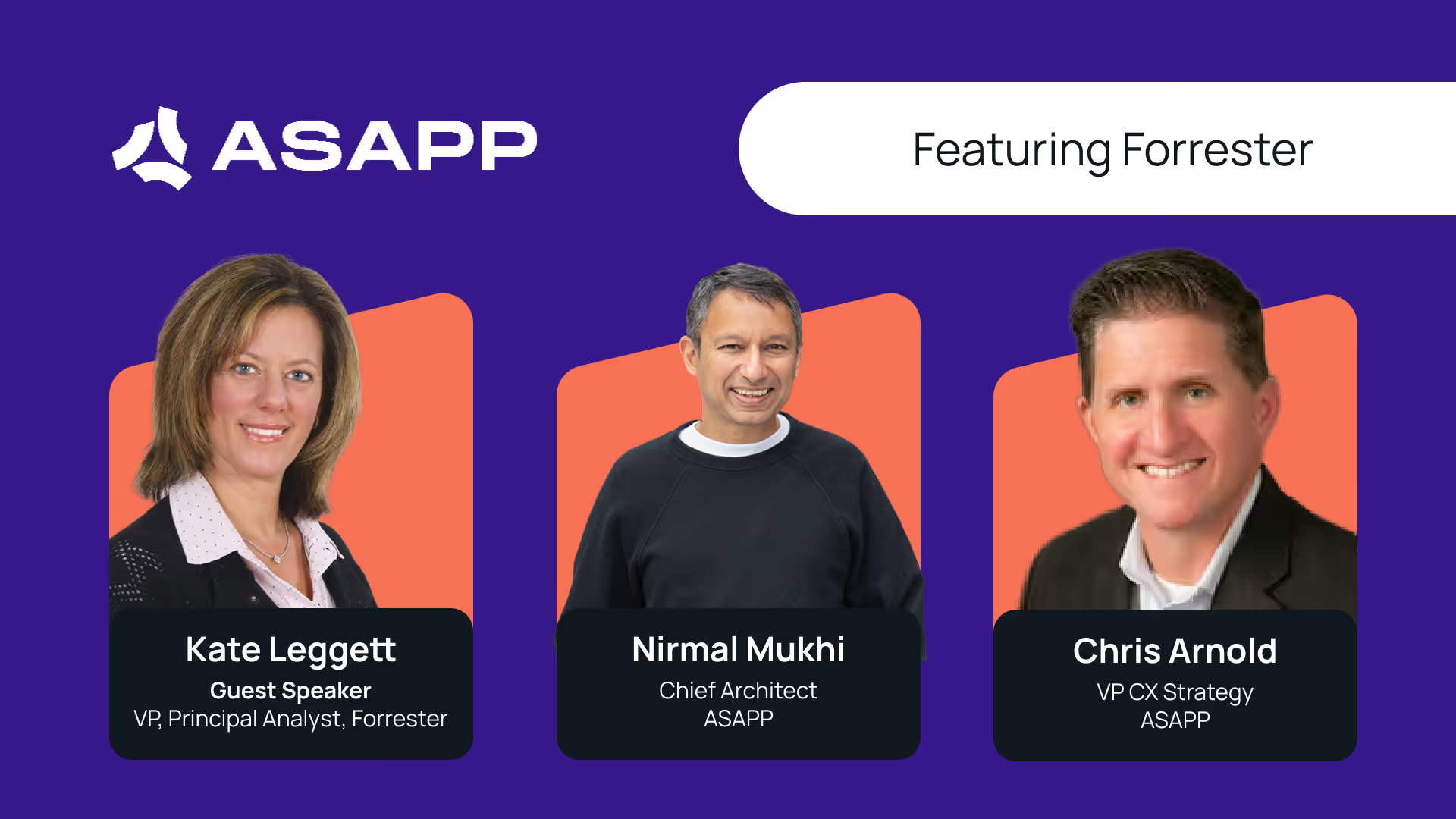
I'm thrilled to be joined today by Peter Kotulas, product manager with ASAPP, and Chris Arnold, VP CX strategy at ASAPP. Before we get started, I'd love to give you both an opportunity to give a brief introduction of yourselves and your work. So, Peter, let's have you go first.
Speaker 2
Thanks, Megan. Excited to be here. I'm Paniotez Kotelas. I go by Peter. I'm a product leader in AI here at ASAPP, and I mainly look after our human in the loop product, a model that embeds human judgment directly into agentic workflows.
Rather than treating them as a human fallback, HeLa is designed as an intentional collaboration, and that's mainly what I focus on here at ASAPP.
Speaker 1
Great. And, Chris?
Speaker 3
Thanks, Megan. Excited to be here as well. So I'm I'm vice president of customer experience strategy at ASAPP. That just means I spend the vast majority of my time working with CX leaders at enterprises really of all shapes and sizes where we build road maps as they're getting started on their agentic AI journey.
We bid out build out those road maps. We detail out all the operational requirements, a lot of the things we talk about today. And I've been doing this for the last six and a half years or so. Worked with many of the largest companies in the world as they've started their AI journey. And I came to ASAPP, after a twenty year career at Verizon where, actually, I started out as an agent on the phone many, many moons ago, and I think I did just about every So I've lived the life of an operator, so I have a deep appreciation for the real world challenges. And at ASAPP, we've really built a product that's, you know, market fit, and it's fit to, meet those operational needs.
Speaker 1
Fantastic.
Thank you both for taking the time to be with us today. And with that, let's dive right in. I'd love to start off by talking about why the industry gets human in the loop wrong. So, Peter, what does human in the loop actually mean, and why do most vendor implementations fall short?
Speaker 2
I love this question. You'll see most platforms define human in the loop as an escalation path. The AI runs until it can't, and then a human takes over. That's a full handoff, not oversight.
At ASAPP, true oversight means humans are present in the workflow, not waiting on the outside. And that's how we think about it differently.
Speaker 1
Great. Thank you. And, Peter, is a fallback the same as oversight, or why does the difference matter for Enterprise CX?
Speaker 2
That's really important. A fallback is a safety net that activates when the AI agent system fails. Oversight is different. It's a continuous design process or workflow that works in real time.
Those are different things with different accountability implications for customers and for your brand. In a regulated industry, for instance, being able to say a human was involved is very different to being able to say a human was accountable for the workflow.
Speaker 1
Got it. Thank you. Chris, I'd love to bring you into the conversation at this point. Why should human and AI execution be native and continuous rather than sequential?
Speaker 3
Yeah. I think if you I mean, if you just look at the history of customer experience, you know, having been an operator and, you know, been in this space for over two decades, you know, we've had sort of a binary mindset is the way I think about it. So you think about the way we've executed in the past is you've had sort of voice or digital. You have automation or an agent. You know? And, ultimately, that the cumulative effect of that binary thinking was it was either cost savings or improvements to customer experience.
And I think the importance of everything that Peter was just mentioning is we no longer need this binary mindset. We now have an opportunity to really achieve these AI first outcomes in both voice and digital. And what we're gonna talk about today is actually having the first opportunity where it's not automation or agent, it's both. And that's really where the magic will happen as we'll unpack this a little bit more. We for the first time, technology is enabling humans to work together with the technology to get the best of both worlds.
Speaker 1
And, Chris, what does it mean for humans, workflows, and customer context to stay connected throughout, not just at handoff points?
Speaker 3
Yeah. So if you think about sort I would say the the biggest issue with customer experience for for the last two decades is the friction and the fragmentation. We've added channels. We've added queues. We've added complexity.
We've made investments in tremendous amounts of technology that really hasn't moved the needle in terms of moving the customer experience, and all of us operators for a very long time have used buzzwords like omnichannel.
Well, I think for the first time, we're actually going to realize omnichannel outcomes. So, again, when you are no longer operating from a binary perspective, it's no longer voice or digital, It's now both. Voice and digital in a single platform can stitch the customer journey together in a way that wherever your customer wants to engage with you, we can do it across voice, we can do it across digital, and you don't lose context. And that's the most frustrating thing is not only do I not achieve first contact resolution, but I get handed off across all these different, transfer points. And I have to repeat myself. Customer effort goes up, customer experience goes down, and then, obviously, cost, is incurred by the enterprise. And for the first time, everything that we're talking about with AgenTex solutions, in this case, human in the loop agent, is actually enabling the context to stay persistent, lowering customer effort, lowering cost, and improving experience all at the same time.
Speaker 1
Excellent. Thank you. I'd love to take some time to dig a little deeper there. You mentioned human in the loop agent. So can you tell us what is HeLa, and how does it put this philosophy into production?
Speaker 3
Absolutely. Yeah. Human in the loop, you'll hear it. It's almost another buzzword. And we really want to avoid that because the way ASAPP thinks about HeLa, which stands for human in the loop agent, which is ASAPP's native framework for coordinated human AI execution.
So in the past, we've had operating models, particularly in the contact center where humans were the primary executor of workflows. Human in the loop agent now creates an opportunity for the human and the AI to collaborate together, where it's the AI that's managing the the vast majority of the workload, the interaction with the customer itself. And all of this is built within the ASAPP customer experience platform. It's what we call the CXP.
So rather than what you might see in the market today, sort of bolted on solutions that is attaching AI to, you know, a sort of a human centric operating framework, this is completely different because in a HeLa environment, humans do not exist primarily to to rescue failed AI interactions. Instead, they guide, supervise, train, and and really the goal is to continuously improve autonomous AI system, the CXP itself, while the AI performs the vast majority of the customer facing work. That's the biggest difference, and it's really completely changing the role of the human, where now the human is providing the guidance.
It's creating it's building trust in what the AI is saying and doing with the with the with the customer during the live interaction, and we shouldn't think of it as a feature. It's, again, not bolted on. It's the it's the new operating model. Done correctly, it is completely transforming how customer experience is managed, and how AI shares context with humans, and humans provide the right guidance, for the AI itself.
Speaker 1
Got it. Thank you so much. So, Peter, Chris talked about CXP. Can I ask you, how does CXP determine when AI should involve a human without breaking workflow continuity?
Speaker 2
It really starts with defining what the ideal customer journey is within the CXP. So our customers identify what the customer journey should flow with the AI agent staying in control.
CXP then uses a continuous assessment of the interaction, how it's happening in real time.
It utilizes confidence thresholds and compliance requirements to really determine when is the ideal point for human involvement.
And when that point is reached, that is when the workflow changes from a single AI automation workflow to a collaborative model. The customer experience really ends up being we don't put you on hold.
The human steps in with full context already loaded and gives judgment where it's needed in this workflow to the AI, and the AI stays in control of this entire conversation. And that's the difference here.
It is not one handing off to the other. It is a collaborative, universal experience for the end customer.
Speaker 1
And, Peter, how does human intervention with HeLa make the system permanently smarter over time?
Speaker 2
That's one of the biggest outcomes that we can drive here at ASAPP. Every time the human corrects or overrides the AI action over time, that input is captured and fed back into the system.
This allows our customers to do two things. One is over time, the AI learns how humans are working alongside it, which means the operation can get more accurate and more efficient.
And over time, they can investigate which parts of this process need to be optimized for human judgment and which parts can be moved over to full AI automation. And that what that leads to is we see that the AI automation over time will grow, and the human judgment will be only utilized at very particular points in this conversation and should shrink over time. And that's how the interaction over time becomes more permanently smarter.
Speaker 1
Excellent. Thank you so much. Chris, what does this look like in production?
Speaker 3
So, you know, I think in our industry, buzzwords are inevitable, and so you'll hear a lot of things. But I think, you know, we don't want good terminology like AI first to become a buzzword. Because when I think about AI first, I think we want, CXP, you know, in the in the instance of ASAPP. We want CXP what we would call at the top. We want CXP answering the phone.
We want CXP in production twenty four by seven, three hundred and sixty five days a year because it will scale to one hundred percent of your interactions.
And so AI first. But, also, we use AI native. And and I like to take native one step further to say it's AI centric. Done correctly, like I said before, this isn't a bolt on solution.
The AI is a single brain that should operate your entire CX operation across all entry points wherever your customer shows up, whether it's in the IVR, the website, the mobile app, the phone, chat, asynchronous messaging, you know, all the the touch points. And so with AI at the center, you now have the human playing the role of let's train the AI so that, you know, we can also simulate how will this AI behave before we put it into production. We can see exactly what it's gonna say and what it's gonna do.
We can simulate it, and then we can release it into production. And we can have humans now instead of being the executors of the interaction, they are supervising and guiding exactly what Peter just talked about. There's these very small moments that really matter to the customer experience, to business outcomes, think compliance and policy. We can clearly put guardrails in place to say, the AI cannot facilitate this autonomously, so let's check-in and make sure it makes a good choice.
Critical thinking is important, and so we're going to, have that human guide and provide the accountability that enables us to accelerate trust in how the AI will perform. And then we can observe all of this in real time, and it's so critical to understand that we can learn from every one of these human in the loop agent, guidances, if you will, interactions. We can learn from them because that's how if you're at fifty percent automation today, seventy percent will be possible tomorrow because we will be able to learn from what the humans are guiding, and then we can trust the AI over time to do more and more autonomously.
And so it's not just automation for automation's sake. In production, we have the ability to use humans and AI in a collaborative way so that, ultimately, it drives experience, customer experience, higher than we've ever seen before. You will employ you'll improve employee experience because we are modernizing jobs. We're putting AI into the hands of employees across the entire CX ecosystem by upskilling them.
And then, obviously, shareholder value is a very important point. We're creating business value by becoming more and more efficient over time. That's what AI centric organizations will look like in production.
Speaker 1
Got it. Thank you. And I'm glad that you underlined the point about native versus bolted on. Peter, I'd like to ask you what changes operationally when human oversight is native rather than bolted on?
Speaker 2
So the key difference here is that agents spend less time really rebuilding the context. Chris touched on this earlier. And the specific value add is they spend more time on where judgment is needed, where the AI just needs guidance. The only work that reaches a human is the only work where judgment is needed. So imagine a AI workflow that's going through time and you get to a point of the human agent needs to provide a approval to the refund. All of the initial work of the back and forth, what the refund's about, the reasoning, all of that can be automated. And we only wanna give that human judgment and work to the approval process.
All you need is to escalate for a fifteen to thirty second moment in time, give that human agent full context, and allow them to add that judgment where the end customer experience doesn't break and the AI stays in control, and that's the key difference here. Supervisors get the visibility that they've never had before. It's not just about outcomes, but it's more about the decisions and interventions that produce them. And that's really what changes operationally is you're just adding value to the AI at a specific moment in time.
Speaker 1
Perfect. Thank you. And, Chris, as we're wrapping up today, if you're evaluating AI vendors right now, what are the two or three questions you should be asking about human oversight that you probably aren't?
Speaker 3
That's a, it's honestly a monumental challenge these days because there are so many vendors in the market. And, honestly, I I think first, don't just look for a vendor. You're looking for a partner, because this is a maybe a once in a career opportunity. There's every boardroom in the world's talking about AI strategy.
And so if I were to put it into three critical questions, maybe I'll go back to sort of the framework I used before where I talked about customer, employee, and shareholder value. I think this is helpful here because we want an AI partner when in production, which we we just talked about, for it to create maximum value. From a customer perspective, we really wanna make sure that as we deploy more technology, as we automate more, we never wanna harm the customer experience. So how do we do that?
It's really how I started. We lower customer effort. We achieve greater levels of first contact resolution. We meet customers where they are in their channel of choice.
We give them sort of the choice convenience and control of being available twenty four by seven without the wait times, you know, that Peter just talked about. So there's a lot of opportunity for us to invest in these technologies and improve customer experience.
But I think the enterprises I work with most frequently sort of miss the importance of the employee experience.
With AI enabled workforce, it fundamentally changes not just the operating system. It changes everything about the entire CX ecosystem.
And so what does the world of work, you know, from a CX perspective look like when every employee has AI in their hands? Well, there's an opportunity for us to really upskill, every employee. It's not just the agents on the phones. It's the back office operations teams that are supporting the ones that are building these flows, training the AI, observing you know, doing the simulations, observing after the fact, insights analyst to really make sure we have a closed feedback loop that the AI is constantly getting better.
Every employee will need to be upskilled. And so I think you need to have an AI platform that gives all of these employees a tool that can help sort of help them usher in the world of AI. And then lastly, the cumulative effect of all of this is that we should be so incredibly efficient while also improving customer experience that it creates a competitive advantage, and that's where shareholder value comes in. And so that's sort of what I would think of as the trifecta of value.
Let's maximize customer, employee, and shareholder value as we execute on this huge opportunity that's enabled by Agintiq AI.
Speaker 1
Great. Thank you so much. That brings us to the end of our discussion, but we have some time left, so I'd love to address just some frequently asked questions for you both. What about for someone who has thousands of agents? How would they prepare their workforce for a shift this big? Chris, would you like to take that?
Speaker 3
Yeah. That's a that's a very important question. And a lot of the enterprises I work with have thousands, if not tens of thousands of agents. And, you know, I think it's in the contact center world, you know, small changes lead to pretty disproportionate outcomes, some good, some bad.
So don't feel like you need to boil the ocean. But to answer the question, I think getting started from a workforce perspective, understanding, you know, with the or the platform like ASAPP CXP, you know, it's not just about the frontline agents. It's about all of the sort of supporting cast around them. And so we have designed a platform where we wanna put AI into the tools of all employees.
And to do this well, I think we have to acknowledge sort of the elephant in the room, and that is AI is coming for our jobs.
That's been the headlines for far too long, and I don't really subscribe to the sort of sky is falling, apocalyptic view of AI. I think as leaders, we should do a very good job of putting first together a a communication plan to say, here is our company's AI strategy, and here's where you fit into it. And here's the tools that we will provide you to upscale you, to enable you to become an AI first employee.
You know, employees are already out there using tools like ChatGPT and other LLMs, and this is a a really a purpose built tool to improve customer experience.
And so with the right tool in place, with the right communication plan, I think you can begin to change the rhetoric from AI is replacing humans to now AI is actually enabling the workforce to drive not only productivity, but to also ultimately do what we are all paid to do, which is improve the customer experience.
Speaker 1
Yeah. I love that. Thank you so much. Peter, next one for you. What happens when a human agent gives the AI bad guidance? Who catches it, and how does the system respond?
Speaker 2
I love this question.
Usually, what happens in today's world is if an agent sends a message to an end customer, that message goes directly. There is no safety net. There is no way to catch that. And we heavily reply on our agent training and agents being as accurate and helpful as possible.
Now that paradigm shifts completely with the human in the loop solution. You now have a safety net to control your branding, your messaging, and even your bad guidance from agents. So in the human in the loop context, the human is providing guidance to the AI. So if the human agent happens to provide guidance that is completely off scope or out of the context of the question that was asked to them, for instance, if the agent is asked to provide approval on a refund and they happen to start discussing something about changing someone's flight.
What happens is the AI will take that input, analyze it, and before producing a message to the end customer, they will understand that this guidance or instruction is completely off base and will correct for that through multiple methods depending on how the customer configures this interaction. And that provides a great safety net for controlling the customer experience at all points through the journey, which is very different to what happens today.
Speaker 1
Got it. Thank you so much. I think we've got time for one more common question. Chris, I'll send it to you. What does getting started actually look like, and what should organizations expect to change about operations and customer interactions? How do I get started?
Speaker 3
Yeah. I think, I mean, first and foremost, I think it's critical that you find the right AI partner.
I I still see many enterprises that are sort of experimenting with AI. You know? They're they're experimenting with tools like ChatGPT, and they're using them for FAQs, and all of those things are fine.
But we don't want a modernized version of build versus buy. To execute on this agentic AI opportunity, I think it's really important to have a great partner who understands the CX ecosystem, the complexity that comes with customer support, and not just support and service, but also sales. We didn't talk a lot about that today, but I think the revenue generating opportunities in front of us will be much, much bigger than we've ever seen before. And so I think to get started, after you've identified the right partner for your business, I think it's don't underestimate the power of small changes.
As I mentioned before, small changes, you know, when you're dealing with these this number of interactions, small changes can lead to really large outcomes. And so I think that really begins with understanding why are your customers interacting with you. What are they calling about? What are they chatting about?
And you need to understand, you know, what data do I have available to help support the automation on those interactions. You know, do I have the right FAQs, the right knowledge base, the right APIs that facilitate transactions? Because, ultimately, the goal is resolution on the first attempt. And so you understand your interactions.
Get started with two or three really small use cases. Sorta dip your toe in the water, learn, and then iterate. And it'll sort of be a flywheel where you'll start small, but that flywheel will pick up momentum. And then a year, two years from now, you'll be in a completely different place.
And as you scale your interactions, the AI interactions, you will have some measure of HeLa interactions. And over time, you will learn from those HeLa interactions, and that will fuel the next level of automation. And so it's a very iterative process, but don't sit on the sidelines. Don't experiment. Get in the game. Get started now. Start small, and then learn and then iterate over time.
Speaker 1
Excellent. I think that that is the perfect note to end on. Thank you so much, Peter and Chris, for this insightful discussion. That does it for us today.
But before we sign off, I just wanted to thank you, our audience, for watching. To learn more about how ASAPP builds AI that enterprises and their customers can actually trust, scan the QR code or visit asapp dot com slash c x trust. Today's webinar will continue to be available on demand if you want to review anything that was discussed. Have a great day.