Table of Contents



This article is part of the Agentic CX Playbook, a collection of frameworks, roadmaps, and operating models for CX and CX Operations leaders building AI-first service operations.
For many organizations, AI governance begins as a discussion about risk, compliance, and control. While those elements are essential, they represent only a fraction of its true value. As customer experience organizations move from AI-assisted service to autonomous service operations, governance becomes the mechanism that determines whether AI delivers incremental efficiencies or transformational business outcomes. The highest performing organizations are discovering that effective AI governance is not a barrier to innovation, but the foundation that enables scale, trust, and continuous optimization. It ensures that AI agents align with enterprise objectives, customer expectations, and operational policies while providing the transparency and accountability required to deploy autonomy with confidence.
In our previous post, we introduced the 10 Tenets of AI Governance as the guiding principles for responsible AI deployment. In this article, we build on that foundation by exploring the governance capabilities, organizational structures, and maturity stages required to transform AI governance from a control function into a strategic advantage. An advantage that maximizes customer experience outcomes while accelerating the journey toward an AI-native service operation.
Level 1: Reactive Response
Theme: “We deployed AI, now we’re managing issues as they arise.”
Characteristics
- No formal ownership of AI agents
- Governance handled informally by IT or vendors
- Limited visibility into decisions or data sources
- Manual QA on small samples
Risks
- Inconsistent CX outcomes
- Compliance exposure
- Over-reliance on vendor defaults
Gate to Level 2
- Assign named owners for each AI system
- Establish baseline policies and logging
Level 2: Foundational Governance
Theme: “We have clearly defined rules, owners, and basic controls.”
Characteristics
- Clear ownership (business + technical) per agent
- Defined guardrails (escalation thresholds, approval limits)
- Basic audit logs and reporting
- Early AI Trainer, Supervisor, and Observer roles introduced
Risks
- Siloed governance across teams
- Policies applied inconsistently
- Limited cross-agent coordination
Gate to Level 3
- Standardize governance across CX
- Introduce supervision, observability and policy enforcement at scale
Level 3: Operational Governance
Theme: “Governance is embedded into managed operations.”
Characteristics
- Centralized CX AI Governance Hub established
- Full observability:
- Decision logs
- Data lineage
- Outcome tracking
- Policy engine enforces constraints automatically
- Cross-agent conflict resolution defined
KPIs Governed
- Resolution quality
- Customer effort
- Escalation quality
- Automation with guardrails
Risks
- Growing orchestration complexity
- Need for tighter alignment with enterprise KPIs
Gate to Level 4
- Align all agents to shared enterprise objectives
- Expand governance beyond CX into cross-functional systems
Level 4: Enterprise Governance Aligned
Theme: “All AI systems optimize for enterprise outcomes.”
Characteristics
- CX governance aligned with:
- Revenue
- Risk
- Operations
- Shared KPIs (e.g., CLV, CSAT, cost to serve, margin)
- Real-time supervision and human guidance
- Governance integrated into AI product lifecycle
Capabilities
- Scenario simulation before deployment
- Continuous tuning loops
- Proactive risk detection
Risks
- Scaling governance across departments with competing priorities
- Vendor and model dependency
Gate to Level 5
- Enable autonomous optimization with human oversight at system level
Level 5: Autonomous Governance
Theme: “Historical optimization has tuned the system such that it governs itself within defined boundaries.”
Characteristics
- AI agents operate with dynamic policy enforcement
- Automated anomaly detection and correction
- Human governance focuses on:
- Strategy
- Ethics
- System design
Capabilities
- Self-optimizing workflows
- Predictive CX interventions
- Enterprise-wide orchestration
KPIs
- Customer lifetime value
- Proactive resolution rate
- Trust and reliability scores
Risk
- Over-reliance on automation without periodic human challenge
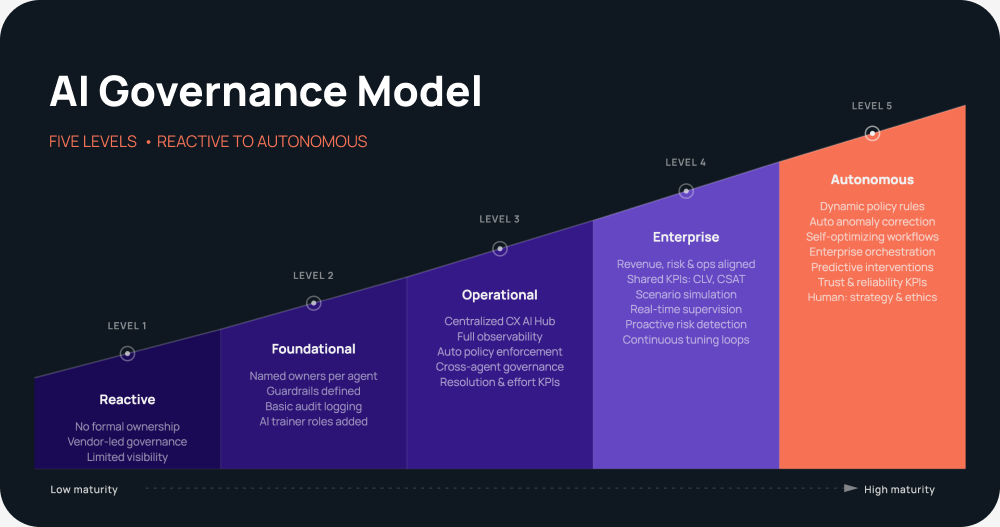
Governance maturity is not about control as much as it is about enabling safe, scalable autonomy aligned to business outcomes. To accomplish this level of maturity, it’s critical that the organization is built with AI at the center rather than treated like a feature bolted onto the technology stack. An example of this type of organizational structure is as follows:
CX-Specific AI Governance Org Chart
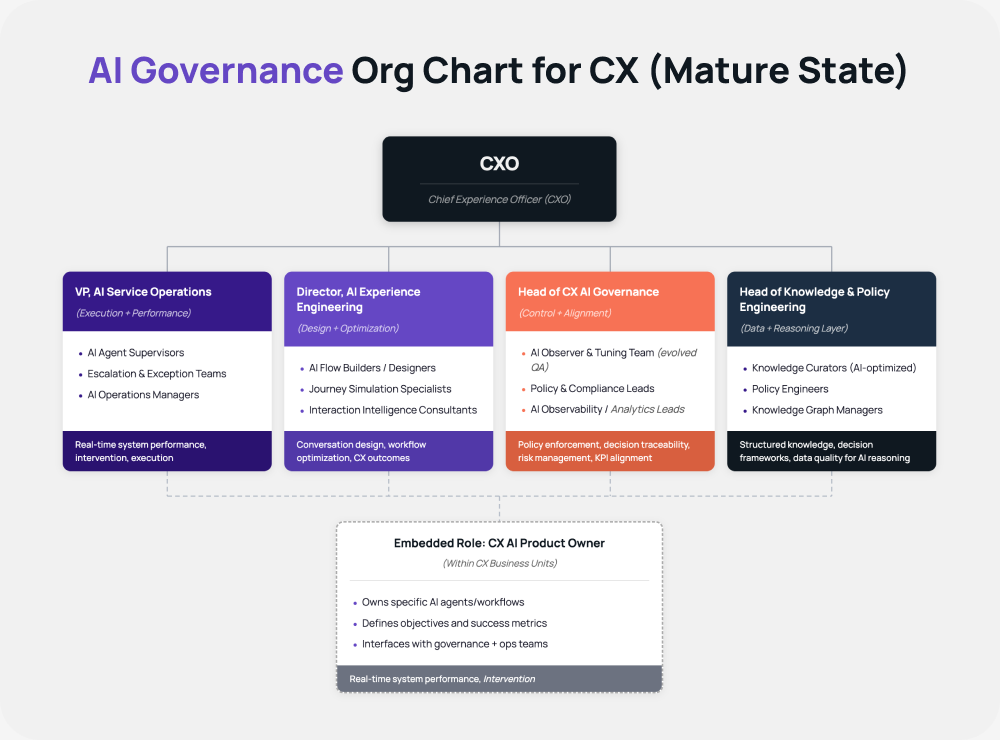
Chief Experience Officer (CXO)
Owns end-to-end CX outcomes and AI-driven service strategy
VP, AI Service Operations (Execution + Performance)
- AI Agent Supervisors
- Escalation & Exception Teams
- AI Operations Managers
Focus: Real-time system performance, intervention, execution
Director, AI Experience Engineering (Design + Optimization)
- AI Flow Builders / Designers
- Journey Simulation Specialists
- Interaction Intelligence Consultants
Focus: Conversation design, workflow optimization, CX outcomes
Head of CX AI Governance (Control + Alignment)
- AI Observer & Tuning Team (evolved QA)
- Policy & Compliance Leads
- AI Observability / Analytics Leads
Focus:
- Policy enforcement
- Decision traceability
- Risk management
- KPI alignment
Head of Knowledge & Policy Engineering (Data + Reasoning Layer)
- Knowledge Curators (AI-optimized)
- Policy Engineers
- Knowledge Graph Managers
Focus:
- Structured knowledge
- Decision frameworks
- Data quality for AI reasoning
Embedded Role: CX AI Product Owner (Within CX business units)
- Owns specific AI agents/workflows
- Defines objectives and success metrics
- Interfaces with governance + ops teams
How This Org Works Together
Execution Loop
AI Ops → runs agents → flags issues
Optimization Loop
Experience Engineering → improves flows
Governance Loop
Governance Team → enforces policy + monitors risk
Knowledge Loop
Knowledge Team → improves data and reasoning
What Makes This Model Effective
- Clear ownership at every layer
- Separation of concerns (run vs design vs govern)
- Continuous feedback loops
- Alignment to enterprise outcomes rather than siloed KPIs
Final Takeaway
The organizations that unlock the most value from AI in CX will not be those with the best models. They will be those with the most mature governance systems.
Autonomy without governance creates risk. Governance without autonomy creates stagnation. The advantage lies in balancing both.