Table of Contents



Most AI customer service tools do not serve customers. They deflect them. They greet, classify, and then push the work to a human or a queue. The customer ends up where they started, only later.
A modern AI-powered customer service agent is built to do the opposite. It interprets what the customer is asking for, reasons through the steps required to resolve it, takes action across your back-end systems, and verifies the outcome inside the same interaction. The customer experience improves because the work actually gets done. Cost-to-serve drops because no human agents are involved: nothing is queued, handed off, or repeated.
This represents more than a technology upgrade. It changes how customer service operates. Instead of humans executing every interaction while AI provides assistance, AI increasingly becomes the primary executor while humans become the intelligence layer that supervises, guides, and continuously improves the system. The operating model changes—not just the software.
For CX leaders managing cost-per-contact, CSAT, and compliance, the distinction between deflection and resolution is the only one that matters. In this article, we will walk through what enterprise AI agents actually do, what separates them from chatbots and conversational AI, how to keep humans in the loop, and what to measure once they are live.
Key takeaways
- An AI customer service agent is designed to resolve customer issues end to end, not just answer customer queries or route people to another queue.
- What makes one different is its ability to understand intent, reason through multiple steps, and act inside back-end systems through real-time APIs.
- The strongest deployments keep AI managing, owning, or in control of the conversation while humans approve edge cases behind the scenes.
- For regulated enterprises, governance, observability, and selective human expertise have to be designed into the operating model from the start
- To judge whether the AI is working, look beyond containment to first-contact resolution, cost-per-resolution, CSAT, and escalation quality.
How does an AI agent work? The short answer: it resolves.
A true customer service AI agent resolves work. It completes the task that triggered the contact.
Resolution looks concrete in production.
- A traveler asks to change a flight; the AI agent confirms identity, pulls the itinerary, applies fare rules, processes the rebooking, and issues new boarding passes inside one conversation.
- A cardholder disputes a charge; the AI agent verifies the customer, checks the transaction, opens the case in the bank's ledger, and issues a provisional credit.
Deflection looks like the opposite. The bot greets the customer, asks for an account number, fails to find a relevant article, and transfers the conversation to a customer support agent who has no context. The customer repeats themselves. The interaction starts over.
Enterprise buyers have grown skeptical of "AI customer service" claims because earlier generations of bots and IVR flows promised help and delivered handoffs. Modern AI agents are evaluated on whether they finish what they started.
From IVR to agentic AI: a quick definitional map
The category labels in this space have blurred. Vendors call the same product a chatbot, a virtual agent, a conversational AI, or an AI agent depending on the buyer in the room. The practical difference is what each generation can do once the customer starts speaking.
Rules-based chatbots and IVR systems
Rules-based chatbots and IVR systems follow predefined decision trees. They recognize a fixed set of intents and usually optimize for deflection rather than resolution. Every CX leader knows the failure modes: menu loops, brittle flows, repeat authentication, and conversations that restart from scratch after every transfer.
Conversational AI platforms
Conversational AI improved how customers interact with automated systems by using natural language processing (NLP) and, more recently, generative AI to understand free-form requests and respond naturally.
But many of these tools remain a front-end layer. They handle the conversation, then defer to a human agent or a ticketing workflow to actually do anything. Vendors blur the line between conversational copilots, which help customer service teams, and true AI customer service agents, which act on behalf of the customer.
Agentic AI that completes work end-to-end
Agentic AI closes the gap. Customer service AI agents understand a customer goal, reason through the steps required to achieve it, use tools and APIs to access enterprise systems, and coordinate the actions needed to deliver the outcome—with minimal human intervention. Each step is observable. Each action is logged.
What actually happens inside AI agents for customer service
Consider a customer whose flight has been canceled. To resolve the request, the AI agent verifies identity, retrieves the itinerary, applies fare rules, completes the rebooking, and confirms the outcome—all within a single interaction. Those activities can be grouped into four capabilities: understanding, reasoning, acting, and verifying.
What happens inside an AI customer service agent
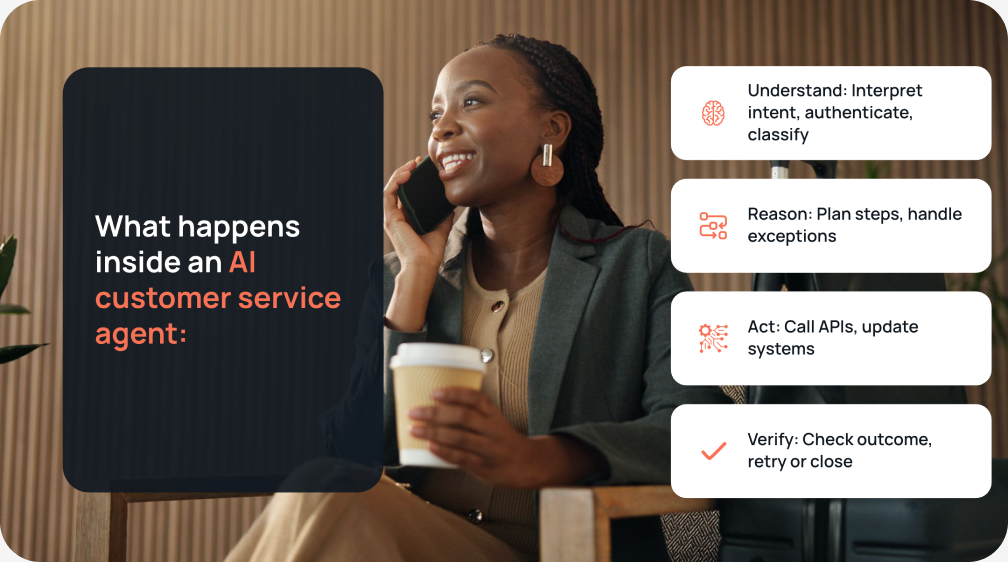
1. Understanding customer intent and context
The agent processes the customer's free-form language alongside conversation history, account context, and channel signals, then infers intent, authenticates identity, and classifies the request.
Performance at this step depends on much more than the foundation model. It depends on how well the agent has been tuned to your domain, how reliable retrieval is from your knowledge bases, and how strictly policy constraints are enforced when the AI is uncertain.
2. Reasoning across multiple steps to reach a resolution
Once intent is understood, the agent plans. It confirms prerequisites, decides what order to do things in, handles exceptions, and holds the context together so the customer does not repeat anything.
Consider a billing dispute. Resolving it requires checking identity, pulling the transaction, applying the dispute policy, opening a case in the system of record, issuing a provisional credit, and explaining the timeline. A bot can answer "what is your dispute policy." An AI customer service agent runs the workflow.
3. Taking action through back-end system integrations
Real value appears when the AI can act. Resolving customer issues often requires updating records, processing payments, changing reservations, modifying subscriptions, or checking order status across multiple systems. Through secure API integrations with CRM, billing, and operational platforms, AI agents can execute those actions in real time rather than handing the work to another queue.
More advanced deployments may orchestrate specialized AI agents, human agents, and enterprise systems to complete a request. The goal is not complexity for its own sake. It is coordinating the right capabilities to resolve customer inquiries efficiently and consistently. The orchestration layer is what makes the system trustworthy at scale. It enforces required steps, logs every action, and routes work between AI and humans when judgment is needed.
4. Iterating based on feedback within the same interaction
A capable customer service AI agent verifies its own work. After taking an action, it checks whether the action succeeded. If the customer is still confused, it asks a clarifying question. If the API returns an error, it retries or escalates. If the resolution is partial, it does not declare victory.
This closed loop is what improves first-contact resolution. Customers hate restarting after a partial fix more than they hate the original problem.
Why some AI customer service agents fail
Many AI-powered customer service deployments can hold a conversation but struggle to resolve customer issues. The most common failure modes are:
- The AI understands the request but cannot take action in business systems.
- The AI can complete simple tasks but fails when exceptions occur.
- The AI lacks access to customer data needed to make decisions.
- The AI escalates too often, creating additional work for human agents and support teams.
- The AI operates without observability, making errors difficult to identify and correct.
The difference between a chatbot and an AI customer service agent is not merely the quality of the conversation. It is the ability to complete workflows reliably under real-world conditions.
How AI customer service agents operate across channels
Customer service AI agents are not a web chat feature. Enterprise deployments require omnichannel: voice, messaging, native apps, and authenticated digital journeys, often within a single interaction. Choosing the right starting use cases is the most important decision in the first year. We go deeper on the criteria in our guide on selecting the best AI customer service agent use cases.
Chat, voice, and digital channels
The channel changes the engineering requirements. Chat allows rich context. Voice demands real-time turn-taking, low-latency speech recognition, and natural prosody. Digital journeys require continuity across app, web, and SMS.
Voice deserves first-class treatment. A large share of contact center demand still arrives by phone, especially for high-stakes intents like outages, fraud, and travel disruption. An AI customer service agent that can hold a natural voice conversation and act in core systems unlocks far more customer support automation and value than a web chatbot can.
High-volume regulated industries: telecom, financial services, airlines, insurance, and healthcare
Industry context shapes both the use cases and the controls. In telecom, the highest-volume intents are plan changes, device troubleshooting, and outage updates. In financial services, card disputes, balance inquiries, and authentication-heavy support. In airlines and hospitality, flight status and rebooking. In insurance, claim status and prior authorization. In healthcare, scheduling and benefits questions.
What these verticals share is regulation. Audit trails, approvals, privacy controls, and consistent policy execution matter as much as the automation rate. As agents gain autonomy and access to business data, organizations must ensure agent behavior is observable, controlled, and auditable.
The human-in-the-loop model most enterprises can benefit from
You should not have to choose between fully autonomous AI and fully manual escalation. Treating those as binary options creates an artificial constraint. The better model is AI-led resolution with selective human judgment, applied at the points where it changes the outcome. Human-in-the-loop should be a design decision, not a fallback.
Why all-or-nothing escalation falls short
All-or-nothing escalation forces customers to repeat themselves at the most sensitive moment. Transfers can mean re-authentication, lost context, and a hit to CSAT.
This approach also caps automation. No matter how capable the AI gets, an escalation-based operating model is limited by how often the AI fails and dumps work back to human agents. The ceiling is set by the design, not the AI model.
How AI and humans collaborate to resolve
A collaborative model behaves differently. AI stays in the customer interaction. When human expertise is needed, the AI brings in a human expert behind the scenes for guidance, context, or judgment the AI cannot provide on its own. The customer keeps moving. The expert provides expertise, not a handoff.
Triggers for human involvement should be well-defined and reserved for decisions where human judgment improves the outcome. This could include policy exceptions, regulatory decisions, complex troubleshooting, or high-impact actions that require additional review.
Human involvement can also reveal opportunities for future automation. Enterprise teams can review where human expertise was needed, identify recurring failure patterns and policy deviations, onboard new customer intents, and improve how the AI handles similar requests in the future. Over time, this continuous feedback expands the range of customer requests the AI can resolve autonomously without sacrificing governance or service quality.
What this looks like in a live contact center environment
In practice, a single specialist can support several AI-led interactions simultaneously, providing human judgment without taking over the customer conversation. This model reduces workload on frontline teams while allowing human expertise to be applied across multiple interactions at once. In voice deployments, concurrency is the capacity multiplier that makes this model possible.
How to measure whether your AI agent is actually working
Containment is the metric most often used to declare success, and the metric most often hiding failure. A customer who hangs up frustrated is contained. A customer who tries a different channel an hour later is contained. A customer who gave up is contained.
First-contact resolution and containment rate
Containment is the share of contacts handled by the AI without human involvement. FCR is the share of contacts where the issue was actually solved on the first attempt. A bot that ends every conversation can hit 100% containment and 0% FCR. FCR is the better north star because it correlates with CSAT, cost-to-serve, and retention.
Cost-per-resolution and CSAT
Cost-per-resolution is the cleanest economic unit for AI customer service. Calculate the total cost of serving an intent, including labor, platform cost, and downstream repeat contacts, then divide by resolved contacts. The trend tells you whether automation is creating real leverage, improving operational efficiency, or simply shifting costs from one part of the organization to another.
Pair it with changes in CSAT. Lower cost matters only if satisfaction holds or improves. Many organizations also track resolution times to understand whether AI is helping customers reach outcomes faster without sacrificing quality.
Escalation quality and AI accuracy over time
Measure escalations by readiness, not just frequency. When the AI hands off, did it preserve context? Did it produce a correct summary? Did it set up the right next step? A well-designed escalation feels like a continuation, while a poorly designed one feels like starting over.
Track AI accuracy over time. Enterprise AI should improve through monitoring, testing, and human feedback. An AI agent that performs no better than it did at launch is plateauing rather than expanding the range of customer requests it can resolve safely.
AI customer service agents are moving from experimentation to execution
Customer service AI agents are no longer a research project. As more organizations deploy AI in customer-facing roles, the question is whether these systems can reliably resolve customer requests under real-world enterprise conditions, and continue improving once they are in production.
Most conversational AI platforms can answer questions. The strongest AI customer service agents go further by combining reasoning, workflow execution, enterprise integrations, governance, and human expertise to reliably complete the work required to resolve customer needs.
When those capabilities work together, organizations can improve customer experience, streamline support operations, reduce operational costs, and increase resolution rates without sacrificing trust.
Talk to an ASAPP CX specialist about deploying an AI customer service agent in your contact center →
FAQs
What is an AI customer service agent? An AI customer service agent is software that understands intent, reasons through steps, and completes service work across your systems. The important distinction is resolution: it should solve the issue, not just answer a question or route the customer elsewhere.
How is a customer service AI agent different from a chatbot or IVR? Rules-based bots and IVR flows follow predefined paths, so they usually handle FAQs, collect inputs, or send customers to an agent. A modern AI customer service agent can interpret free-form customer requests, use tools, and take multiple actions to reach an outcome. That matters because deflection may lower volume, but resolution is what improves first contact resolution, cost to serve, and customer satisfaction.
How does an AI customer service agent actually work? First, it interprets the customer's goal from natural language, conversation history, and business context. Then it reasons across the required steps, calls back-end systems, and checks results before responding or asking for confirmation. In stronger designs, feedback from the interaction and any human review helps the agent improve safely over time.
Can I use AI for customer service in a regulated enterprise? Yes, but you should treat governance as a design requirement, not a cleanup step after launch. Look for audit trails, observability, policy controls, governance workflows, and human oversight for high-impact decisions. These controls help organizations automate more customer interactions without losing traceability, compliance discipline, or access to human expertise when needed.
How do you measure whether an AI customer service agent is working? Start with first-contact resolution, autonomous resolution rate, and cost per resolution. Not containment alone. These metrics reveal whether the AI is actually completing customer requests rather than simply ending interactions or moving work elsewhere. Then track customer satisfaction, escalation quality, and AI accuracy over time. If these metrics improve together, your AI customer service agent is likely resolving work, not just shifting it around.
For more on evaluating platforms and AI agents in this category, see the best AI agent platforms for customer service: a 2026 buyer's guide and AI for customer service: the complete guide for enterprise teams.