Table of Contents



This article is part of the Agentic CX Playbook, a collection of frameworks, roadmaps, and operating models for CX and CX Operations leaders building AI-first service operations.
For years, customer service leaders have been told that the path to AI transformation is simple: automate what you can and escalate everything else to humans. Unfortunately, that approach doesn't create transformation. It simply inserts AI into an operating model that was designed for human execution.
The organizations achieving the greatest success with agentic AI are taking a fundamentally different approach. They recognize that AI is not another tool to be deployed inside the contact center. It is becoming the primary operating system for customer experience.
This shift requires a new model: Human-in-the-Loop AgentTM (HILA). In a HILA environment, humans do not exist primarily to rescue failed AI interactions. Instead, they guide, supervise, train, and continuously improve autonomous AI systems while the AI performs the majority of customer-facing work.
As enterprises move toward AI-centered service operations, three principles consistently separate organizations that achieve breakthrough outcomes from those that simply create a more expensive version of the contact center they already have.
Tenet 1: Design AI as the primary executor, humans as the intelligence layer
The most common mistake organizations make is treating AI as a support tool for human agents. AI-centric organizations reverse that relationship.
In traditional service models, humans own the interaction and technology supports the human. In an AI-centric operating model, autonomous agents become the primary executors of customer interactions while humans provide guidance, judgment, and oversight when needed.
This requires leaders to redesign workflows around three distinct operating modes:
- Autonomous Resolution
- Guided Resolution (HILA)
- Human Escalation
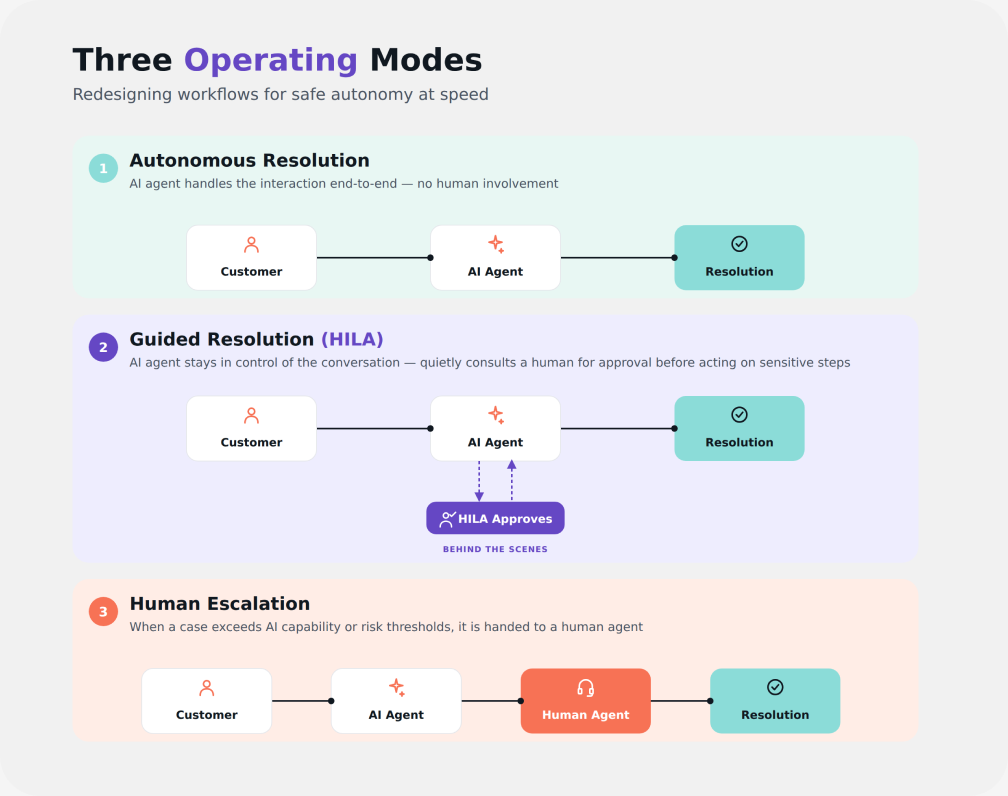
The critical distinction is that HILA is not an escalation. Escalation transfers ownership and accountability from AI to a human. HILA allows AI to retain ownership while requesting targeted guidance that enables human accountability with autonomous resolution.
To achieve this, organizations must segment customer demand based on complexity and risk, allowing AI to autonomously handle high-volume transactional work while introducing human guidance only where judgment, ambiguity, or policy interpretation are required.
The objective is not maximum automation. The objective is maximum autonomous resolution with appropriate human supervision and accountability.
Leadership Question: Are humans still the default owners of your customer interactions, or have they become the intelligence layer that helps AI perform at scale?
Tenet 2: Build human guidance as a system, not an exception
Most enterprises treat human involvement as a contingency plan. AI-centric organizations treat human guidance as a core operational capability.
Human expertise should not be routed through the same workforce that handles customer interactions. Instead, organizations must establish dedicated AI supervision functions responsible for guiding, correcting, and improving autonomous agents in real time.
This includes:
- AI-Agent Supervisors
- AI Trainers
- Policy and Knowledge Curators
- Interaction Intelligence Analysts
The role of these teams is not customer resolution. Their role is AI performance management.
This shift fundamentally changes workforce strategy. Early in the transformation journey, organizations should not focus on reducing headcount. They should focus on reallocating expertise toward supervision, optimization, and learning.
The highest-performing organizations understand that the 20% of interactions requiring human guidance are not evidence of AI failure. They represent the learning pipeline that will unlock the next wave of automation.
Every guidance interaction should improve the system.
Every correction should strengthen future performance.
Every exception should become training data.
Leadership Question: Are your people spending their time resolving customer issues, or teaching AI how to resolve them autonomously in the future?
Tenet 3: Optimize for learning velocity, not automation rate
Most AI programs measure success using outdated operational metrics.
Automation percentage alone does not determine whether a transformation is succeeding. Organizations can automate aggressively and simultaneously damage customer experience, increase risk, and create operational complexity.
AI-centric organizations focus on a different objective: learning velocity.
Every AI interaction should generate intelligence that improves future outcomes. Every HILA event should become structured feedback. Every customer interaction should make the system smarter.
This requires:
- Confidence-based routing
- Dynamic risk thresholds
- Closed-loop learning systems
- Continuous prompt and policy optimization
- Knowledge refinement
- Real-time performance measurement
Success is measured not only by automation rates, but by how quickly the system improves over time.
Leading organizations replace traditional metrics such as Average Handle Time and First Contact Resolution with measures that reflect AI-native operations:
- Autonomous Resolution Rate: The percentage of total customer interactions fully resolved by AI without any human involvement. This becomes the primary replacement for traditional containment metrics because it focuses on successful outcomes, not simply keeping customers away from agents.
- AI Containment Rate: The percentage of interactions that never require a full human escalation. This measure includes HILA-guided interactions. This tells leaders how much customer demand remains inside the AI operating system.
- HILA Rate: The percentage of AI-managed interactions that require human guidance but not full escalation. A declining HILA rate accompanied by stable CSAT is evidence that the AI is optimizing.
- Guidance Latency: The average time between an AI guidance request and a human supervisor response. This becomes the equivalent of Average Speed of Answer for the AI-supervision workforce. If latency increases, customer experience degrades rapidly.
- AI Learning Velocity: This is the most important metric and the one most organizations fail to measure. This is the AI-centric measure of repeats. Calculated by comparing repeated HILA requests over desired period of time. Reduction of guidance requests over time is a measurable indicator of the system learning. This ultimately drives increases in Autonomous Resolution Rate.
- Customer Lifetime Value Impact: The incremental change in customer lifetime value attributable to AI-powered customer experience. This is the metric that finally elevates CX from a cost center to a value creation engine. If AI only reduces labor costs, leadership will eventually hit diminishing returns. If AI increases retention, loyalty, and revenue, it becomes one of the highest ROI investments in the enterprise.
The goal is to create a customer experience operation that becomes more intelligent with every interaction.
When learning velocity is high, today's 50% automation becomes tomorrow's 70%. Today's 20% HILA becomes tomorrow's 10%.
Leadership Question: Is your AI program optimizing for short-term labor reduction, or long-term system intelligence?
The future belongs to AI-centric service organizations
The organizations that win in the next decade will not be those that remove humans from customer service. They will be the ones that reposition humans to create the highest possible leverage.
In the AI-centric enterprise, humans become supervisors, trainers, governors, and optimizers of autonomous systems. AI becomes the primary executor of customer interactions. Together, they create a service operation that continuously learns, scales efficiently, and delivers increasingly better customer outcomes.
The ultimate goal is to create a smarter, more efficient operating system that produces customer experiences that build a sustainable competitive advantage.
Organizations that embrace these three principles:
- AI as the primary executor
- Human guidance as a core capability
- Learning velocity as the primary optimization target
will build customer experience organizations capable of delivering both lower costs and superior customer outcomes at scale.